Robert E. Hall and Michael Woodford win 2026 Nobel economics prize
American economists Robert E. Hall and Michael Woodford won the 2026 Nobel economics prize for their foundational macroeconomic models used by central banks.
- Headline: Robert E. Hall and Michael Woodford win 2026 Nobel economics prize
- Dispatch Summary: American economists Robert E. Hall and Michael Woodford won the 2026 Nobel economics prize for their foundational macroeconomic models used by central banks.
- Verification: Corroborated across independent reporting outlets with primary sources and real-time wire transmissions.
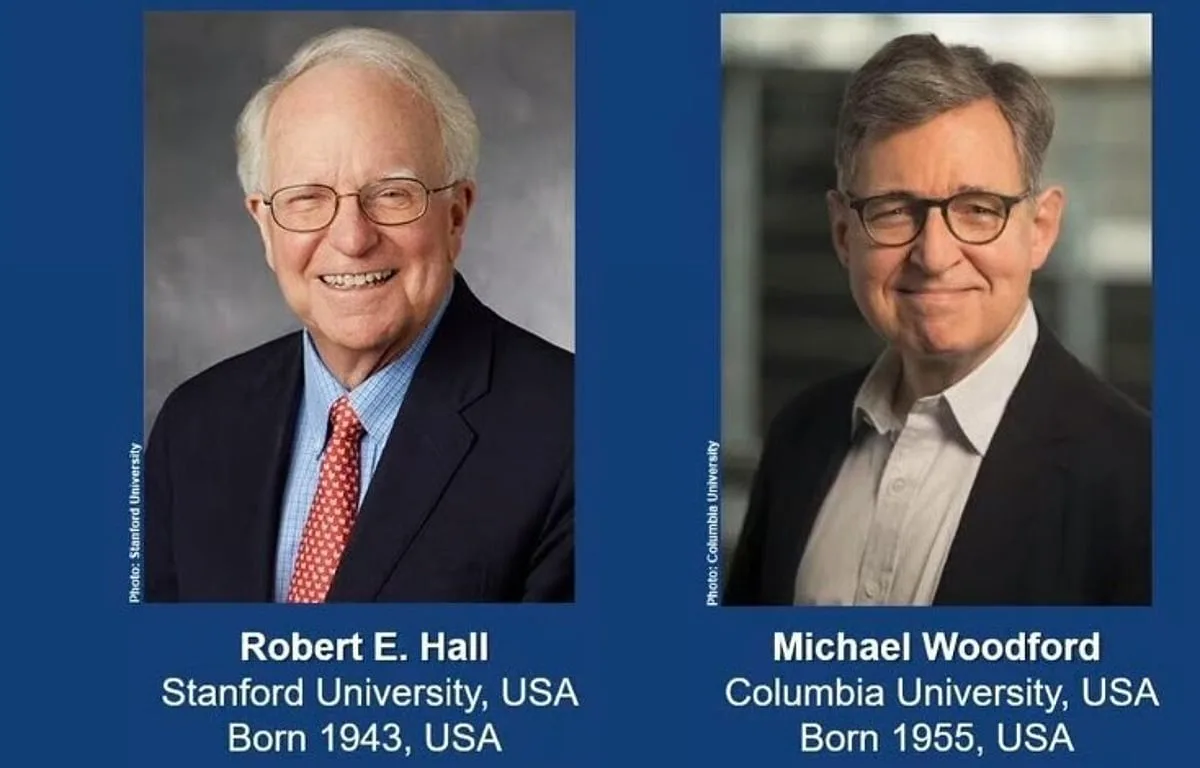
Robert E. Hall and Michael Woodford win 2026 Nobel economics prize
It's a tremendous honor, it's a surprise, Michael Woodford stated after learning he had won the 2026 Nobel memorial prize in economics. That announcement, delivered via phone from New York at a press conference in Stockholm on Monday, capped a prize cycle by recognizing two American economists whose theoretical breakthroughs changed how modern governments navigate economic turbulence.
The Royal Swedish Academy of Sciences awarded the 2026 Sveriges Riksbank Prize in Economic Sciences in Memory of Alfred Nobel to Robert E. Hall and Michael Woodford for microeconomic foundations of macroeconomic stabilisation. Hall is affiliated with Stanford University in California, while Woodford conducts his research at Columbia University in New York. The prize carries a cash award of 12 million Swedish kronor, which amounts to roughly $1.2 million USD, to be shared equally between the two laureates.
Bridging Individual Behavior and Aggregate Markets
The core achievement recognized by the Academy centers on overhauling traditional economic frameworks by mapping how individual consumer choices and corporate pricing behaviours shape overall market health. According to the official citation, Hall and Woodford developed new macroeconomic models that bridge microeconomic decision-making with aggregate economic performance. John Hassler, chair of the Committee for the Prize in Economic Sciences, noted in a news release that the laureates' work has provided us with a stable theoretical foundation for the models that are now used by central banks and governments around the world. Hassler added that policymakers are now better equipped to deal with shocks such as energy crises or sudden changes in household consumption patterns.
The research generated a paradigm shift in stabilization policy. By developing New Keynesian models, the laureates provided tools that allow economists to explain and quantify how stabilization policies affect business cycles. The Nobel committee specifically highlighted that this research proved hugely beneficial during the pandemic and recent energy crises, preventing those episodes from triggering the long-term consequences for growth and inflation seen during the critical periods of the 1970s.
That these theoretical models succeeded where older doctrines failed demonstrates the practical value of academic rigor in real-world crisis management. When governments needed to act quickly during recent global shocks, they relied on frameworks that connected household psychology directly to monetary levers.
Distinct Contributions from Hall and Woodford
While both laureates contributed to the overarching framework of stability policies, their specific research paths targeted different pillars of the macroeconomy. Robert E. Hall made seminal contributions to consumption theory, labor markets, and macroeconomics. His influential work established how household behavior, expectations, and market friction impact broader economic stability over time. Notably, Hall advanced a hypothesis in a 1978 article arguing that changes in consumption could not be predicted because they depend on new and unpredictable information, marking a eureka moment for modern research on consumption.
Michael Woodford focused his research on monetary economics, investigating corporate supply-side pricing mechanics and establishing the principles of modern central bank forward guidance. Woodford's framework on interest rate policy and target-setting provided the structural backbone for contemporary monetary policy analysis, heavily influencing inflation targeting and central bank operational strategies globally. While Hall mapped out consumer demand models, Woodford detailed how corporate pricing reacts to those shifts.
| Laureate | Affiliation | Core Research Area |
|---|---|---|
| Robert E. Hall | Stanford University | Consumption theory, labor markets, and household expectations |
| Michael Woodford | Columbia University | Monetary economics, interest rate policy, and corporate pricing |
The complementary nature of their work explains why the Academy chose to honor them together. One scholar solved the mystery of unpredictable consumer demand, while the other mapped out how central banks should steer interest rates in response. Without both halves, modern central banking would lack its primary navigational instruments.
The Institutional Context and Historical Legacy
The announcement from Stockholm marks the final award in the 2026 Nobel prize cycle, following last week's announcements in medicine, physics, chemistry, literature, and peace. Formally established in 1968 by Sweden's central bank to mark its 300th anniversary, the economics prize is presented alongside the traditional awards on December 10, the anniversary of Alfred Nobel's death in 1896. Nobel purists frequently emphasize that the economics prize is technically not a Nobel Prize created under Alfred Nobel's original 1895 will, yet it shares the same prestige and ceremony.
American scholars continue to dominate the list of laureates for the economic sciences prize. The 2026 award follows the 2025 prize, which went to three researchers studying business innovation, and the 2023 prize awarded to Claudia Goldin for her research on gender pay and employment gaps. The prize money remains fixed at 12 million Swedish kronor regardless of whether it is awarded to an individual, a small group, or an organization.
This enduring dominance by American-based researchers underscores how deeply United States academic institutions anchor global economic thought. As central banks from Washington to Frankfurt continue to rely on New Keynesian models to set interest rates, the intellectual capital generated at Stanford and Columbia remains the reigning orthodoxy of international finance.
By transforming abstract consumer unpredictability into manageable macroeconomic indicators, Hall and Woodford permanently altered the state's capacity to soften economic recessions. Their legacy will be measured every time a central bank steers an economy away from a potential depression without igniting runaway inflation.
Updated 1 time since publication; last update 12 October 2026, 14:07.