US envoys Witkoff and Kushner visit Kyiv for talks with Zelenskyy
US envoys Jared Kushner and Steve Witkoff arrived in Kyiv for talks with President Volodymyr Zelenskyy as part of a US-led effort to end the war in Ukraine.
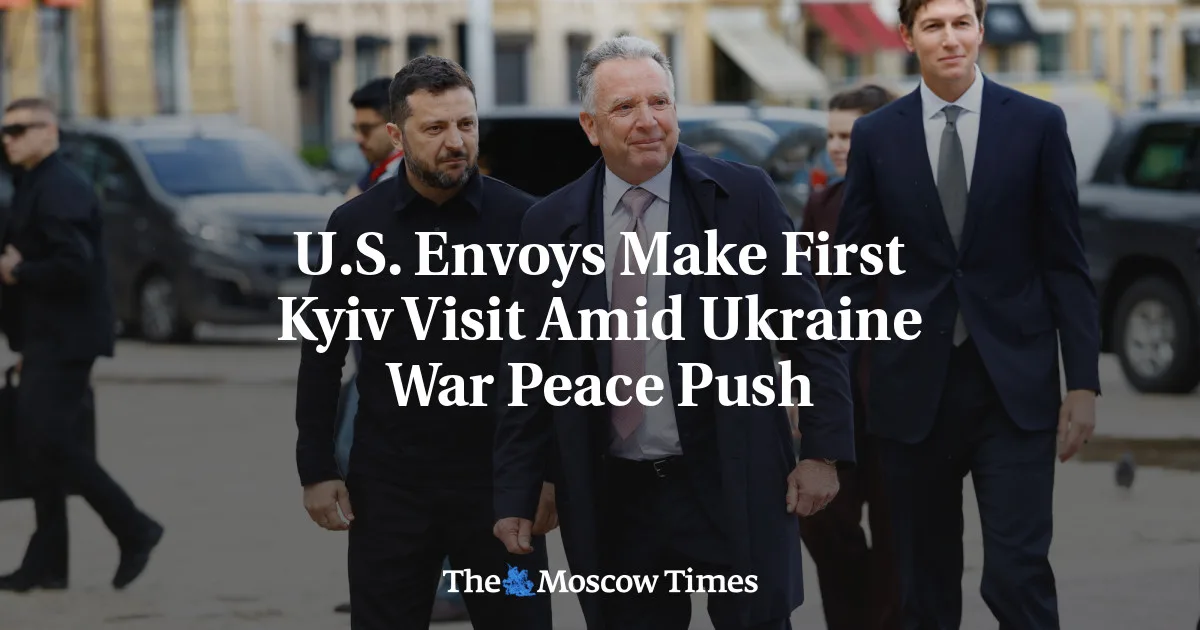
US envoys Jared Kushner and Steve Witkoff arrived in Kyiv on Sunday for their first official visit to the city as part of a renewed U.S.-led effort to end the war in Ukraine, but Ukrainian President Volodymyr Zelenskyy warned that the conflict is likely to continue into winter. The delegation, representing President Donald Trump, had met Russian President Vladimir Putin the previous day in Moscow, where discussions focused on proposals to de-escalate the conflict. Zelenskyy’s remarks, made after the Kyiv talks, underscored the challenges facing diplomatic efforts as both sides prepare for prolonged hostilities.
Zelenskyy said the war “at the moment” appeared likely to extend into the winter, citing Russia’s intensified strikes on Ukrainian cities ahead of its State Duma elections. He emphasized the need for continued support from the U.S. and European allies, particularly as Ukraine seeks to bolster its defenses against Russian drone and missile attacks. “We very much hope that we will be able to reach agreements with our American partners, and we are counting on the support of our European partners if the war continues in winter,” he said. The Ukrainian leader also highlighted ongoing efforts to develop systems to counter Russia’s jet-powered drones, citing collaboration with 67 domestic companies.
The envoys’ visit followed a three-hour meeting with Putin in Moscow, where Russian officials described the talks as “constructive” and “frank.” Kremlin aide Yuri Ushakov noted that discussions centered on “economic issues and potential joint projects” rather than the war itself. However, Witkoff and Kushner emphasized their focus on peace, with Witkoff stating that both sides would need to make compromises to end the conflict. “It’s going to take both sides to make some compromises and narrow the issues between them,” he said. Kushner reiterated Trump’s commitment to a “durable peace,” noting that the administration aimed to “create the right conditions” for long-term stability.
Zelenskyy reiterated that territorial issues “remain relevant” but stressed that such matters could only be resolved at the “level of leaders.” The talks also addressed long-term security guarantees and economic support for Ukraine’s postwar reconstruction. A follow-up meeting involving Ukraine, the U.S., and Europe was agreed upon, though no location was set. Witkoff highlighted the importance of collaboration, pointing to the presence of national security advisers from France, Germany, and the UK as evidence of “critical” partnerships.
The envoys’ arrival in Kyiv coincided with a fragile ceasefire agreement barring aerial attacks on Moscow and Kyiv for three days. However, fighting persisted elsewhere, with Russia launching drone and missile strikes across multiple Ukrainian regions. Ukraine’s State Emergency Service reported at least one death and 10 injuries from Saturday night attacks, while Russia claimed to have shot down 258 Ukrainian drones over 14 regions, including Crimea. Kyiv’s air force intercepted 82 drones and six missiles on Sunday, and Ukrainian forces struck a Russian oil refinery in Ryazan.
Zelenskyy welcomed the delegation at Kyiv’s St. Sophia Cathedral, a site recently targeted by a Russian drone strike. The visit also followed a session with European national security advisers, including the UK’s Jonathan Powell and France’s Emmanuel Bonne, who had met Zelenskyy earlier in the day. Witkoff described the talks with Zelenskyy as “substantive” and pledged to continue negotiations “as long as it takes.” However, public sentiment in Kyiv remained divided, with some residents expressing hope for progress and others dismissing the envoys’ efforts as another futile attempt at diplomacy.
The envoys’ mission faced longstanding challenges, including deep-seated disagreements over territory, security guarantees, and the future of eastern Ukraine. Russia has demanded Ukrainian concessions in the Donbas region, while Kyiv has refused to accept any settlement without its approval. Zelenskyy’s government has prioritized credible security assurances from Western allies to deter further Russian aggression. “We need an agreement that will never be broken,” said Svitlana Kurylenko, a 19-year-old cafe worker.
The talks came as Ukraine grapples with a critical shortage of U.S.-made Patriot interceptor missiles, which has left the country vulnerable to Russian drone attacks. Russian forces have increasingly used fast-flying, jet-powered drones capable of reaching speeds of 250mph, complicating Kyiv’s air defense efforts. Meanwhile, Russia has intensified its use of long-range missiles to target Ukrainian infrastructure, raising concerns about the impact of an approaching winter. Zelenskyy’s defense technology adviser, Serhii Beskrestnov, warned that evacuating elderly residents from Kyiv might be necessary if Russian strikes on energy facilities escalate.
Zelenskyy also announced plans for additional talks involving European national security advisers, signaling a broader diplomatic effort. The U.S. has pledged to increase production of Patriot missiles next year, with Germany expanding its own production under existing licensing agreements. Witkoff noted that the U.S. was pursuing “a diplomatic resolution to this conflict, not a kinetic resolution,” and pointed to the presence of E3 nations’ advisers as evidence of collaboration. However, no specific proposals were disclosed, and the White House described the talks as a step forward rather than a breakthrough.
The envoys’ visit underscored the Trump administration’s renewed focus on Ukraine after months of prioritizing its conflict with Iran. Kushner and Witkoff, who have visited Moscow multiple times, faced criticism for their lack of prior engagement with Kyiv, a gap the current trip aimed to address. Despite the challenges, the delegation’s efforts highlighted the complexities of mediating a conflict that has claimed hundreds of thousands of lives and displaced millions. As the war enters its fifth year, the outcome of these talks may depend on whether both sides can bridge their irreconcilable demands.
Dateline Wire is dedicated to independent, evidence-backed reporting. This briefing was synthesized from primary source reporting, corroborated across independent newsrooms, and verified against our Editorial Standards.