Voyager 1 Reaches Historic One Light-Day Milestone From Earth
NASA's Voyager 1 spacecraft approaches a distance of one light-day from Earth, turning every communication into a 48-hour endeavor.
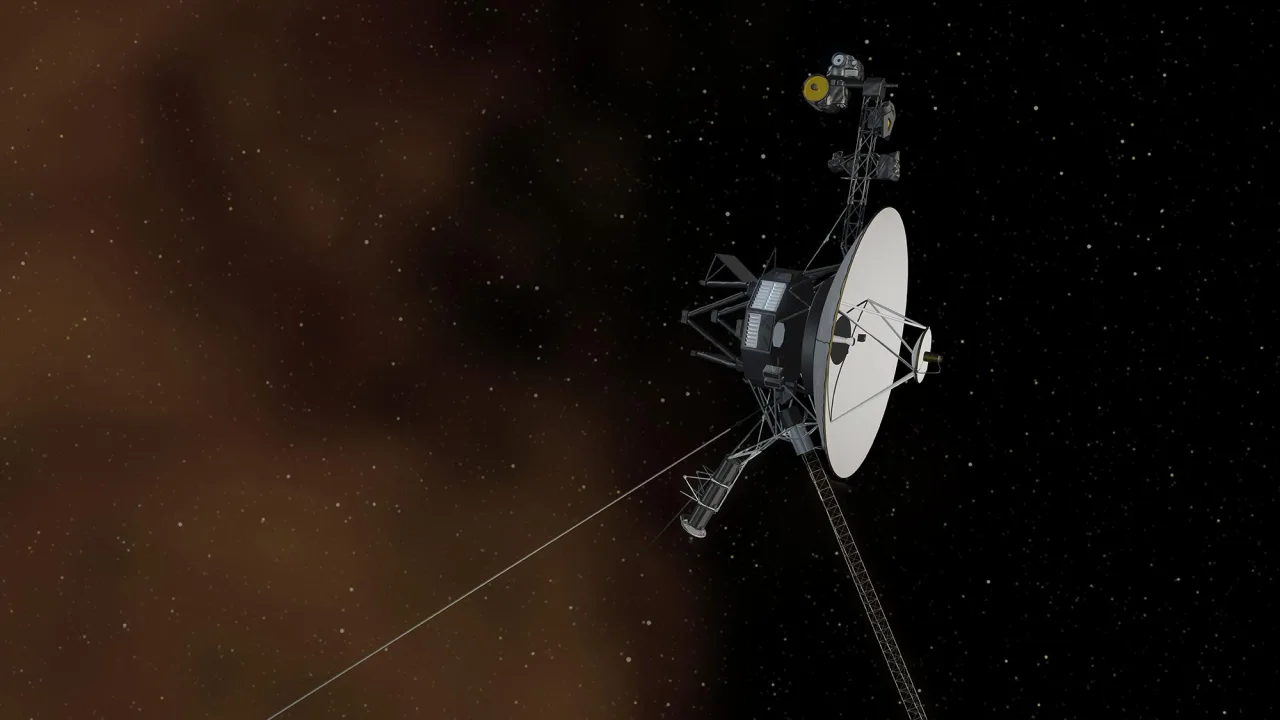
For skywatchers and space enthusiasts across the globe, reaching the latest milestone from NASA's most distant explorer requires nothing more complicated than a smartphone screen or a standard flashlight. On Tuesday night, people around the world marked the eve of a historic space event by flashing three quick pulses and one long pulse into the night sky, spelling out the letters VGR in Morse code. That global display of light celebrated an unprecedented journey that brings the Voyager 1 spacecraft to a distance where radio signals take an entire day to complete a one-way trip.
Launched on September 5, 1977, the unmanned probe is crossing a threshold that no human-made object has ever reached before. By Wednesday, November 18, 2026, at 5:16:07 a.m. Eastern Standard Time, Voyager 1 will officially surpass a distance of one light-day from Earth. That milestone translates to approximately 16.09 billion miles, or 25.902 billion kilometers, transforming humanity's relationship with its oldest interstellar ambassador into an exercise in deep cosmic patience.
Why Is Talking to Voyager 1 Now a 48-Hour Operation?
The numbers behind this journey boggle the human imagination. At a distance of approximately 173 astronomical units, any command sent from NASA's Deep Space Network takes 24 hours to reach the spacecraft traveling at the speed of light. Another full day must pass for the probe's reply to traverse the void back to Earth. That makes a basic exchange a 48-hour endeavor, complicated further by the spacecraft's computing architecture. What the probe sends back uses a channel delivering a message confirming that it is still alive and reporting on the interstellar environment it traverses.
That slow dialogue governs how engineers manage a machine built nearly half a century ago. Susie Dodd, project manager for the Voyager mission at NASA's Jet Propulsion Laboratory, notes the stark operational reality: if she sends a command to Voyager 1 at 8 a.m. on Monday, she will not receive its reply until around 8 a.m. on Wednesday. Every troubleshooting session and power adjustment requires immense forethought because nobody can issue a quick command and immediately check the result.
How Are Engineers Keeping an Aging Probe Alive in Interstellar Space?
To keep the mission functioning, NASA engineers have been managing limited power, such as by switching off scientific instruments one by one. Only two instruments remain operational today: the magnetometer and the plasma wave subsystem, which continues to detect the faint electromagnetic pulse of interstellar space. William Kurth, research scientist at the University of Iowa and principal investigator on the plasma wave instrument, emphasizes the legacy of these surviving systems. The instrument was originally designed and built at Iowa under the guidance of the late physicist Donald Gurnett, contributing to landmark discoveries such as detecting lightning on Jupiter and confirming in August 2012 that Voyager 1 had crossed the heliopause into interstellar space.
Voyager 2, launched on August 20, 1977, is the twin probe of Voyager 1. Both spacecraft traveled on different trajectories, and Voyager 2 performed close-up observations and exploration of Uranus and Neptune. NASA predicts that Voyager 2 will reach the distance of one light-day from Earth in November 2035. While the mission's active phase will eventually end as power supplies fall, the spacecraft will continue orbiting the galaxy for billions of years. Tucked aboard is the Golden Record, a gold-plated copper disc carrying greetings in 55 languages, sounds of Earth, music, and an introductory message from then-President Jimmy Carter.
What Does This Milestone Mean for Humanity Right Now?
The celebration of this cosmic milestone extends far beyond NASA control rooms, touching classrooms, museums, and amateur astronomy clubs worldwide. That sense of perspective anchors the enduring cultural footprint of the mission. When Voyager 1 turned its camera toward home in 1990 at the urging of astronomer Carl Sagan, it captured the Pale Blue Dot, an image that transformed humanity's view of its place in the universe. Allison Jaynes, associate professor and director of graduate studies in the Department of Physics and Astronomy at the University of Iowa, views the current milestone through that same lens. A light day is our first step toward visiting distant stars, representing both a fantastical idea and an amazing human accomplishment. As scientific teams prepare for a moderated discussion at NASA's Jet Propulsion Laboratory on Thursday, November 19, at 12 p.m. EST, observers on Earth can look back at a half-century of exploration that started with a simple bottle thrown into the cosmic ocean.
Readers wishing to engage with the milestone can review NASA's online archives for the automated VGR flasher tool, examine updates on the upcoming 2027 Voyager documentary, or tune into the agency's live panel discussion scheduled for Thursday afternoon.