Trump, Xi and Putin issue joint declaration on peace after China talks
Donald Trump, Xi Jinping, and Vladimir Putin issued a four-point joint declaration following a 90-minute closed-door meeting in Shenzhen.
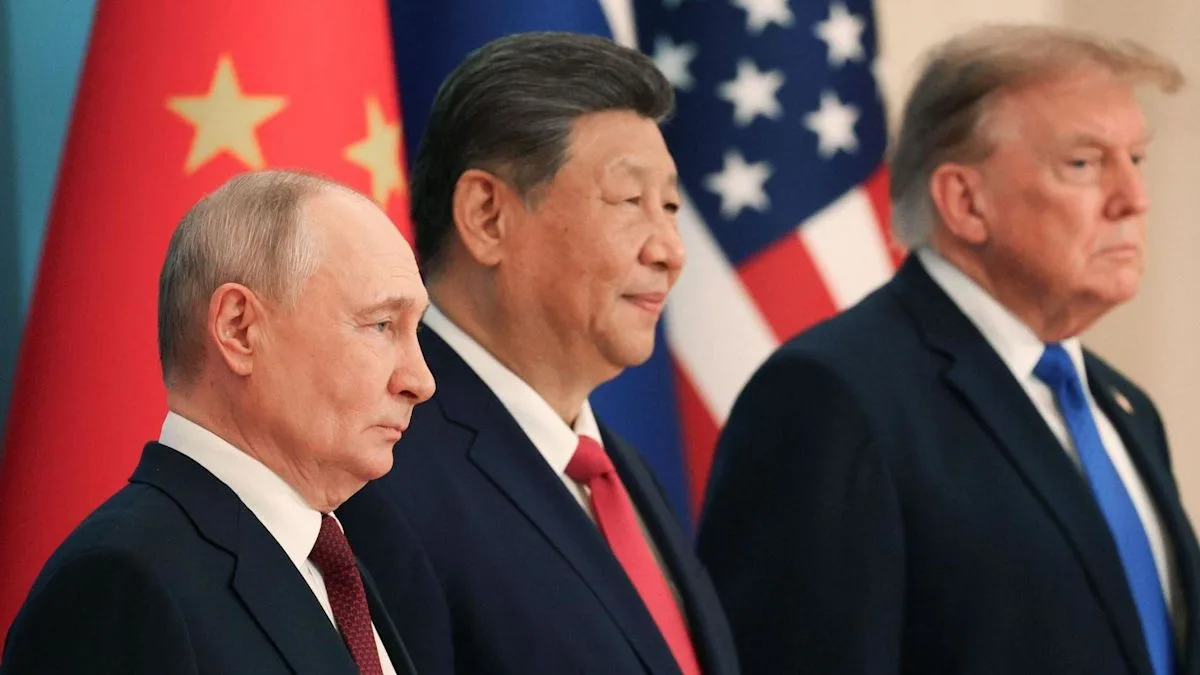
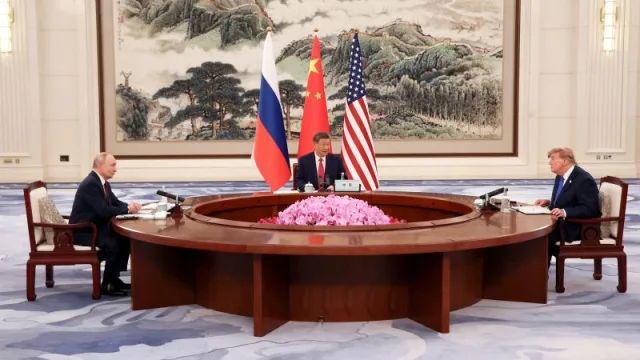
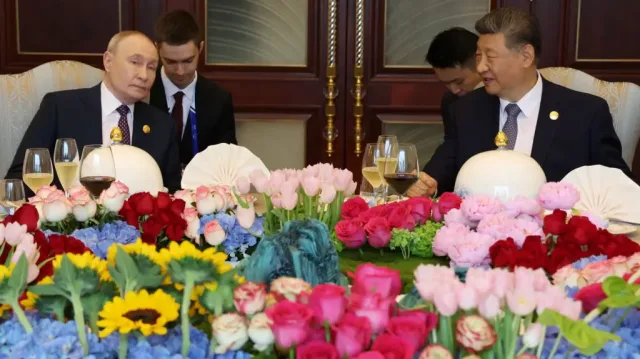
A staggering 90-minute closed-door meeting at a lakeside villa in Shenzhen has produced a four-point joint declaration that leaders of the United States, China, and Russia call historic. The document, distributed by Chinese state news agency Xinhua and the Kremlin, was forged around a large, dark, round table featuring a pink flower arrangement at Kylin Villa on Thursday. Donald Trump, Xi Jinping, and Vladimir Putin signed a pact that fits on a single index card, promising United Nations reform, increased supplies of refined petroleum products, immunity for state officials against international courts, and a renewed pledge that nuclear war cannot be won and must never be fought.
That compact leaves the world's most critical conflicts entirely unaddressed. Neither Ukraine, where Russia's full-scale invasion nears its fifth anniversary, nor Iran, where Washington and rival blockades have choked the Strait of Hormuz, made it onto the page. Smaller nations and Western allies watching from afar have been left unnerved, fearing that three powerful men met on the sidelines of the Asia-Pacific Economic Cooperation summit to carve up spheres of influence over the heads of smaller states. Jonathan Eyal, international director at the RUSI think tank in London, observed that the pushback against international norms and courts is the most interesting aspect. The big powers dictate, the small powers suffer.
What led the three global powers to this moment now?
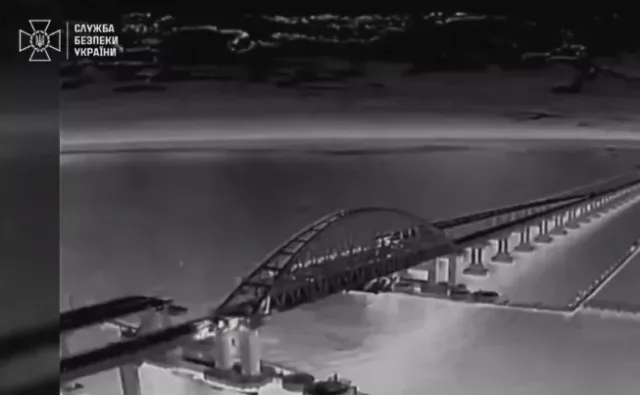
The convergence of interests in Shenzhen stems from distinct pressures facing each leader on the world stage. Trump arrived in China reeling from a midterm election loss, bogged down by a war with Iran that has choked oil supplies and pushed up consumer prices, and facing questions over a scandal involving Nvidia chips diverted to China through Southeast Asia. Putin arrived fresh from a setback in his war against Ukraine after the crippling of a bridge linking Crimea to Russia, operating with an economy barely a tenth the size of China's and most of its businesses barred from trading with the West by sanctions. Xi entered the talks seeking to project stability and trade openness while quietly propping up Moscow's war effort and expanding China's nuclear arsenal to more than 600 warheads.
The timing also follows the expiration on February 5 of New START, the last treaty limiting U.S. and Russian strategic nuclear forces, leaving the world's two largest arsenals uncapped for the first time in more than half a century. Trump had insisted that nuclear arms control be a central topic of the summit, despite China's historical objections to joining talks alongside Washington and Moscow, which hold more than 5,000 warheads each. The resulting agreement offers no numerical caps, timelines, or mechanisms, committing the three nations only to conduct a dialogue on reducing nuclear risks.
How does this compare to past superpower summits?
The diplomatic choreography in Shenzhen invites immediate comparison to Cold War superpowers sitting down to ease global tensions, yet the substance falls remarkably short of past precedents. When Ronald Reagan and Mikhail Gorbachev inked a joint statement declaring that a nuclear war cannot be won 41 years ago this week in Geneva, that summit statement explicitly named raging geopolitical flashpoints including Afghanistan, the Iran-Iraq War, and Cambodia. By contrast, the Shenzhen declaration omits Ukraine, Gaza, Sudan, and Taiwan entirely, serving instead as a minimalist text that flatters the egos of three leaders who answer to no international courts or treaty limits.
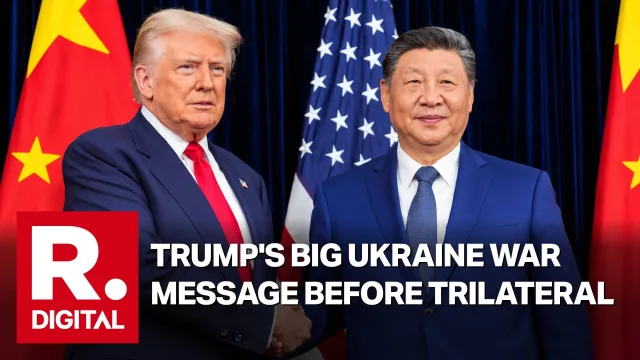
The visual pageantry surrounding the event also broke decades of diplomatic protocol. Breaking with tradition, Xi greeted Trump at the airport—the first time he has done so with any visiting leader since becoming president—reciprocating Trump's gesture at Joint Base Andrews in September. The red-carpet welcome complete with cheering children, an air force flyover, and a brief hug contrasted sharply with the more muted arrivals of other world leaders, such as Japanese Prime Minister Sanae Takaichi, who landed without any welcoming ceremony. Trump hailed the pomp as a major win, telling Fox News, This is a great president, one of the great presidents of the United States, and he's never gone to the airport to meet somebody.
Who is affected by the Shenzhen declaration and what are the risks?
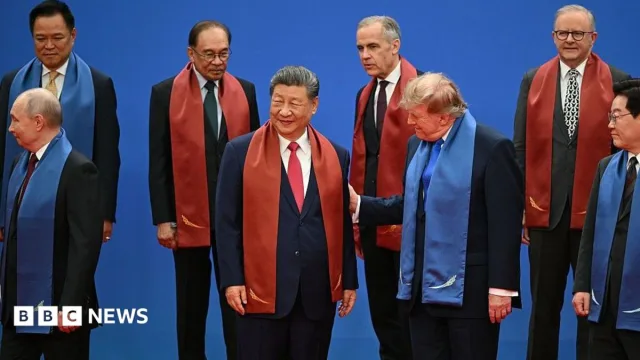
Smaller nations and traditional Western allies bear the immediate fallout of this trilateral alignment, finding their security interests sidelined as great powers dictate terms. Ukrainian President Volodymyr Zelensky had feared that Shenzhen might produce a deal struck behind Kyiv's back, and while the declaration left Ukraine off the page, the meeting ended just hours before Ukraine and its main European allies met in Berlin with Trump's envoys Steve Witkoff and Jared Kushner. Meanwhile, Australian Prime Minister Anthony Albanese faced sharp criticism from domestic opposition and Greens politicians after posing for a family photo at the APEC gala dinner alongside Vladimir Putin, who attended his first APEC gathering in nearly a decade.
The declaration's concrete pledges carry profound implications for international justice and global energy markets:
- The International Criminal Court, which issued an arrest warrant for Vladimir Putin in March 2023 over the unlawful deportation of Ukrainian children, is explicitly targeted by a clause demanding that the ICC and similar bodies must not abuse their jurisdiction.
- Venezuela's Nicolás Maduro, currently asking a federal judge in New York to dismiss charges against him on grounds of head-of-state immunity following his capture by U.S. forces on January 3, is indirectly impacted by the summit's embrace of state official immunities.
- Global energy markets face uncertainty over a pledge to increase production and supply of refined petroleum products, even as the U.S. and Iran maintain rival blockades around the Strait of Hormuz and Western sanctions target Russian oil funding.
- Taiwan faces mounting pressure as Xi issued a veiled threat during his bilateral meeting with Trump, telling Washington to handle the Taiwan issue appropriately to avoid major setbacks in their relationship.
What practical steps can affected observers and travelers take?
For international investors, energy consumers, and policy analysts navigating the fallout of the Shenzhen summit, the sources outline specific developments and timelines to monitor:
- Track the separate diplomatic track in Berlin, where European allies and Ukrainian leaders are meeting with U.S. envoys Steve Witkoff and Jared Kushner to coordinate security guarantees independently of the Shenzhen talks.
- Watch for any formal mechanisms or dates arising from the promised nuclear risk reduction dialogue, noting whether Beijing agrees to substantive stockpile limits alongside Washington and Moscow.
- Examine legal filings in New York federal court regarding head-of-state immunity arguments brought by detained leaders such as Nicolás Maduro in light of the new trilateral declaration.
What do the different capitals say about what comes next?
The participating governments have offered markedly different accounts of what the summit achieved and where diplomatic efforts will lead next. Russian Foreign Minister Sergei Lavrov similarly described the atmosphere during the trilateral exchange as very good,
emphasizing that Moscow views the Trump administration's approach as a cause for optimism. Putin himself maintained that Russia, China, and the U.S. share numerous interests in settling regional conflicts, though he insisted that Kyiv and Europe remain unready to compromise.