Crimean Bridge attacked again, Russia says
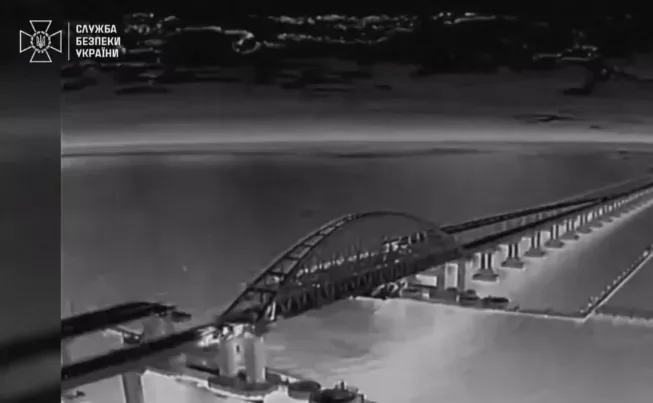
The Kerch Bridge has been struck for the third time in a week, halting vital rail lines and prompting vows of severe retaliation from Russian President Vladimir Putin.
We will respond to these attacks, and I want everyone to be clear about that,
Russian President Vladimir Putin told reporters in Shenzhen, China, promising a retaliation that he vowed would be far more painful than Kyiv's latest blows. That threat arrives as the strategic Kerch Bridge linking Russia to illegally annexed Crimea was struck for the third time in a single week, halting vital rail lines and plunging Moscow's logistical network into fresh turmoil. The renewed aerial assault marks a dramatic escalation in the war, testing the resolve of the Kremlin as its leaders simultaneously navigate high-stakes diplomatic summits in Asia and face coordinated Western-backed peace talks in Europe.
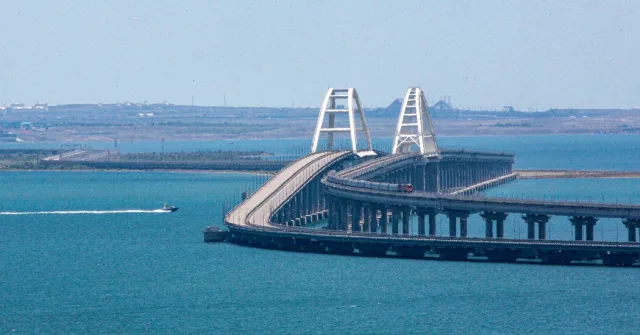
The sequence of destruction unfolded in rapid succession over the span of a few days. The 12-mile, double-arched crossing—built and unveiled to great fanfare in 2018, four years after Russia's 2014 annexation of the peninsula—has long remained a prime target for Ukraine due to its heavy reliance by Moscow for troop resupply and military transport. Ukrainian President Volodymyr Zelensky hailed the initial phase of the offensive as an unprecedented operation weeks in the making, executed through a methodical seven-stage plan that began with the dismantling of enemy air defense systems, radars, and electronic warfare assets protecting the structure before delivering the final blow.
Escalating Strikes and Diplomatic Fallout
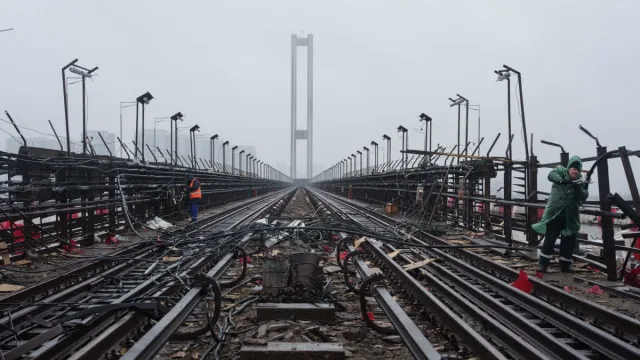
On Tuesday, Ukrainian missiles and drones deployed an arsenal of long-range weaponry against the landmark, destroying its central road section and collapsing a stretch into the water. According to the country's Defence Ministry, Thursday's follow-up strike utilized domestically produced Neptune cruise missiles to target and damage the railway tracks. The Moscow-installed head of Crimea, Sergei Aksyonov, confirmed via Telegram that the nighttime drone and missile barrage forced the temporary suspension of train services across the span while emergency specialists assessed the damage. The Russian transport ministry reported that no one was injured in the latest incident, and train traffic was slated for restoration starting from around 4 p.m. on Thursday. Car traffic, however, remains prohibited for the foreseeable future as a section about 200m (660ft) long of the tarmac was dragged below into the sea when missiles hit the arch on Tuesday.
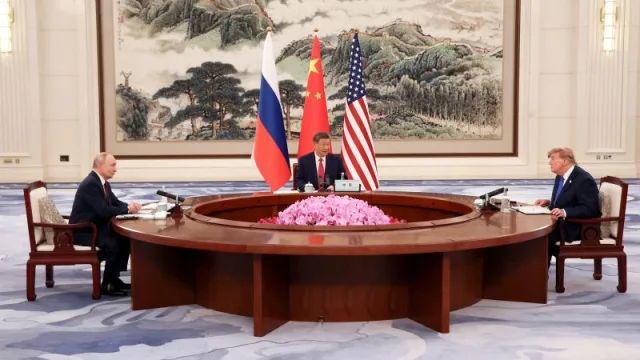
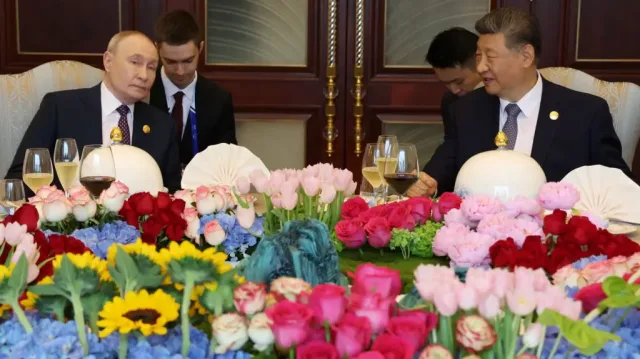
The timing of the attacks appears deliberately calibrated to coincide with a flurry of international diplomacy. Putin met in China with U.S. President Donald Trump and Chinese President Xi Jinping for landmark talks, where Trump referred to Putin as my friend.
Hours later, U.S. special envoys Jared Kushner and Steve Witkoff arrived in Berlin alongside German Chancellor Friedrich Merz, French President Emmanuel Macron, and British Prime Minister Andy Burnham to meet with Zelensky and European leaders. Amid these multilateral discussions, MarketScreener reported that Putin firmly ruled out signing up to ceasefires covering the energy sector or the Black Sea. Meanwhile, Russia's broader military campaign continued unabated, with the Russian Defence Ministry claiming air defences intercepted 53 Ukrainian drones over 10 Russian regions overnight, while Ukrainian officials recorded strikes across 18 locations, leaving at least 10 people wounded and destroying civilian targets in Odesa and Kyiv.
- November 17: Ukraine launches a seven-stage drone and missile operation that destroys the central road section of the Crimean Bridge, collapsing a major arch into the seabed.
- Wednesday: Russian retaliatory drone strikes kill at least four people in Odesa and hit bridge crossings over the Dnipro River in Kyiv, causing power and water outages.
- Thursday early hours: A fresh nighttime drone and missile attack hits the Crimean Bridge for the third time in a week, halting rail traffic and prompting damage assessments.
- Thursday afternoon: Train services across the Kerch Bridge begin to be restored, according to Crimean authorities, while Putin vows severe retaliation from Shenzhen, China.
The strategic implications of these operations extend far beyond structural engineering repairs. While Kremlin spokesman Dmitry Peskov insisted that the bridge will be rebuilt, and it will be even better than before,
military analysts note that repairing the crossing will take considerable time and must proceed under the constant threat of further Ukrainian fire. Putin claimed the bridge was used exclusively for civilian purposes and ordered that it be closed to the transport of military hardware or ammunition. Conversely, Kyiv's defense ministry argued that the strikes successfully achieved their core objective of gaining time and saving lives by choking off the flow of supplies to occupying forces heading toward the front line. Ukrainian officials warned that Russia will now be forced to reroute fuel and ammunition overland, where domestic drones lie waiting for the cargo.
Broader Repercussions and Regional Strains
For ordinary citizens, travelers, and residents caught in the crossfire, the compounding destruction translates into severe daily disruptions and heightened danger. In Kyiv, recent Russian strikes on the Pivnichnyi (Northern) and Pivdennyi (Southern) bridges triggered traffic closures, partial damage to the metro system, and cascading power and water outages just as winter approaches. Across the border regions, the unrelenting drone campaigns have displaced communities and strained emergency response networks. At the same time, political tensions are mounting among Ukraine's Western allies. Ukrainian officials harbor deep-seated fears that their national sovereignty could be compromised by backroom agreements between Washington and Moscow, particularly given that U.S. support has been severely curtailed under President Trump. European leaders are scrambling to avoid being sidelined in upcoming security arrangements, while U.S. Democrats in Congress prepare to challenge the administration's stance following midterm election victories.
The path forward remains fraught with diplomatic friction and military escalation. U.S. envoy Jared Kushner stated on X that Washington's primary focus in Berlin is to strengthen coordination with Ukraine and Europe, forge a unified position on a lasting peace, and shape the format for upcoming multilateral negotiations addressing postwar security. Yet, with Putin dismissing sectoral ceasefires and threatening painful reprisals, prospects for an immediate de-escalation appear remote. European governments remain determined to isolate Moscow diplomatically and maintain heavy economic sanctions, even as Britain's Prince Harry highlighted a perceived separation between the Trump administration's foreign policy and the broader sentiment of the American public.
As repair crews grapple with the twisted steel and sunken tarmac of the Kerch Strait crossing, the kinetic war of attrition grinds on without pause. Ukraine's Ministry of Defence maintains that every interruption to the bridge buys precious time for its front-line defenders, while Moscow signals that its response will test the limits of Ukrainian resilience. With high-level talks in Berlin and China yielding no immediate breakthroughs, the conflict's physical and diplomatic fault lines grow sharper by the day.
In response to the mounting destruction and threats of severe retaliation from Moscow, Kremlin spokesman Dmitry Peskov reiterated that despite the extensive damage and the complexity of undertaking repairs under persistent fire, Russian authorities remain committed to restoring the crossing to full operational capacity.