Two firefighting helicopters collide midair fighting blazes in Greece
A midair collision between two firefighting helicopters battling wildfires near Athens has left two crew members dead and two others injured as extreme heat fuels blazes across Greece.
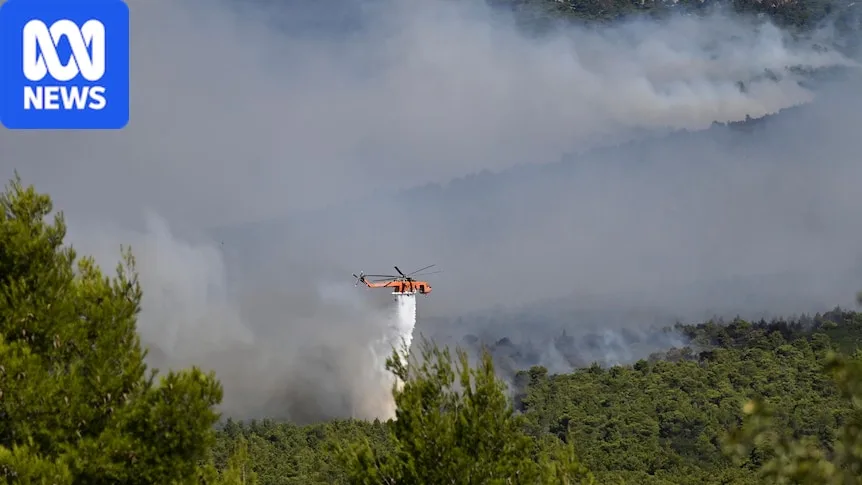
Two firefighting helicopters collided midair while battling a wildfire west of Athens on Sunday, killing two crew members and leaving two others injured, as Europe grapples with an escalating wildfire crisis. The crash occurred near the coastal area of Psatha, a region under intense fire pressure, with footage showing one aircraft crashing into a ravine and bursting into flames. The incident underscores the heightened risks faced by emergency workers amid record-breaking heat and wind-driven blazes across the continent.
The collision involved two Bell helicopters, each carrying two personnel, operating in the Psatha area as part of efforts to contain a wildfire spreading through western Attica. Greek authorities confirmed that a Danish pilot and a Greek fire service liaison officer died in the crash, while a British pilot and a Greek coordinator survived, though the latter was injured. The surviving crew members were hospitalized for observation, and the Greek Prime Minister, Kyriakos Mitsotakis, expressed "deepest sorrow" for the loss, calling the incident a tragic reminder of the dangers faced by frontline workers.
The crash unfolded amid worsening conditions as strong winds fanned flames across Greece, forcing fresh evacuations and complicating firefighting operations. Firefighters struggled to collect water from the sea due to turbulent weather, while gale-force gusts drove flames into industrial zones and residential areas. The Psatha blaze, which began near Agios Vasileios on Friday, threatened communities including Porto Germeno, a coastal town on the Gulf of Corinth, and an industrial district outside Megara. Over 500 firefighters and 23 aircraft were deployed to the region, but adverse weather hindered efforts.
The collision added to the toll of Europe’s wildfire season, which has already displaced hundreds of thousands of people. In France, the Gironde megafire—spanning 420 square kilometers—remained contained but still burned within its perimeter, with thousands unable to return to homes destroyed in the blaze. The fire, which forced 224,000 evacuations, was linked to record-breaking temperatures and dry conditions exacerbated by climate change. In Spain, major fires that had threatened cities like Madrid were no longer advancing, but the season has already claimed at least 13 lives and prompted a national emergency.
The Greek wildfires, part of a broader European crisis, have been fueled by a combination of prolonged heatwaves and vegetation growth following a mild winter. Meteorologists noted that the country is experiencing "very bad fire weather," with conditions so extreme that even aerial resources face operational limits. The Psatha fire, which has burned an estimated 40 to 50 square kilometers, has been described as a "titanic battle" by Greek media, with residents like farmer Minas Tzortzanis lamenting the destruction of "a pristine forest, a paradise" reduced to ash.
The crash also highlights the reliance on foreign firefighting crews, as the two helicopters involved were leased to support Greece’s efforts. The incident has prompted a temporary grounding of all Bell helicopters in the country, according to a Ministry of Civil Protection source, while investigations into the collision’s cause continue. The Greek fire service emphasized that the exact circumstances of the crash remain under review, though preliminary reports suggest the helicopters collided midair during operations.
Climate change has been a recurring theme in coverage of the wildfires, with scientists linking this year’s extreme conditions to human-driven warming. The European Environment Agency reported that wildfires have caused nearly 800 deaths across the continent over the past four decades, while the Copernicus Climate Change Service noted that Europe has warmed more than twice the global average since the 1980s. In France, a rapid analysis by the World Weather Attribution group found that climate change made the conditions behind this year’s blazes at least twice as likely.
As Greece and its neighbors brace for more intense fire seasons, the helicopter crash serves as a stark reminder of the mounting challenges. With wildfires threatening tourism hubs like Kefalonia and Nea Tenedos, and emergency services stretched thin, the region faces a prolonged struggle against an increasingly unpredictable climate. For now, crews continue to fight blazes under extreme conditions, even as the human and environmental costs mount.