Astronomers detect first atmosphere on a rocky, habitable-zone exoplanet
Astronomers have confirmed the presence of an atmosphere on the rocky super-Earth LHS 1140 b, marking a significant step in studying potentially habitable worlds.
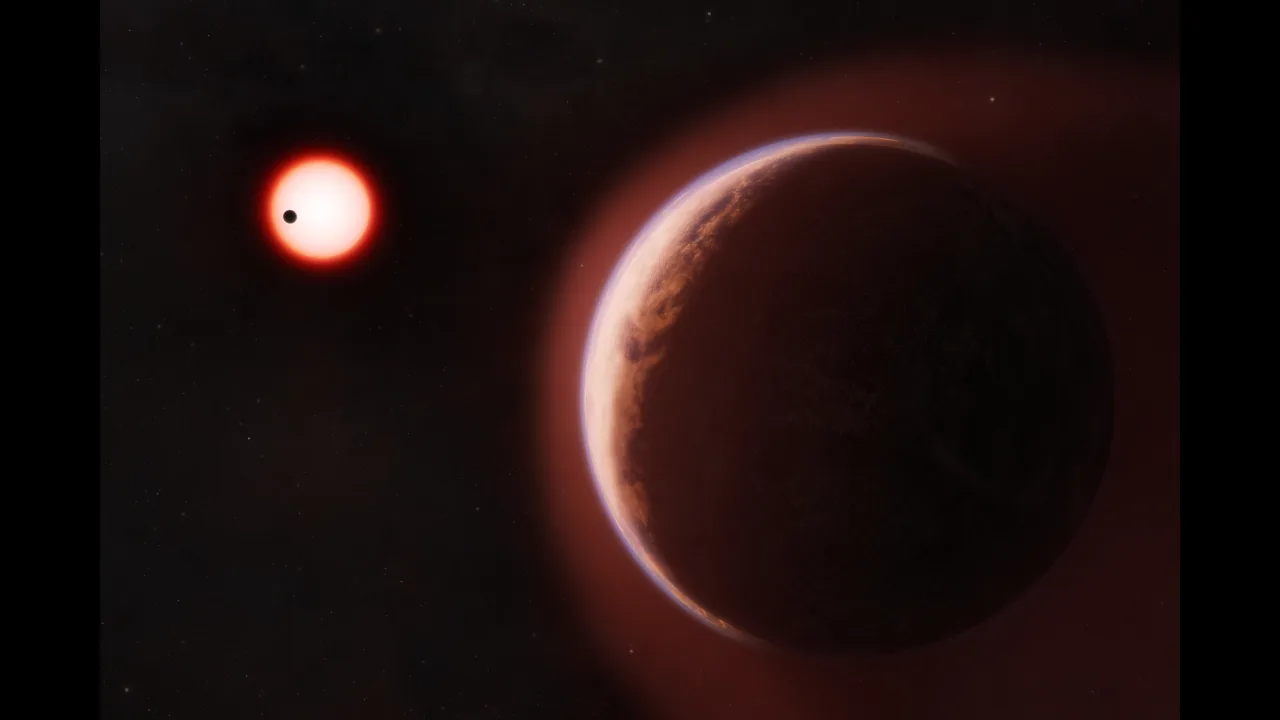
Astronomers have made a novel discovery: the first confirmed atmosphere on a rocky exoplanet located within the habitable zone of its star. The planet, named LHS 1140 b, lies 48 light-years from Earth and orbits a red dwarf star in the constellation Cetus. This finding, published in the journal *Science*, marks a pivotal step in the search for potentially habitable worlds beyond our solar system.
LHS 1140 b, a super-Earth with a mass 5.6 times that of Earth and a radius 1.7 times larger, was first identified in 2017. However, its atmosphere remained undetected until recently. Using the Warm Infrared Echelle (WINERED) Spectrograph on the Magellan Telescope in Chile, a team led by Collin Cherubim, a planetary scientist at Harvard University, detected helium escaping from the planet’s upper atmosphere. This is the first direct evidence of an atmosphere on a rocky exoplanet in a habitable zone, where conditions could allow liquid water to exist on the surface.
“An atmosphere is essential for a planet to support life as we know it,” Cherubim said. “This is the first time anyone has found an atmosphere on a rocky planet in the habitable zone of another star.” The discovery challenges long-held assumptions about the habitability of planets orbiting red dwarfs, the most common type of star in the galaxy. These stars are known for their intense radiation, which typically strips atmospheres from nearby planets. Yet LHS 1140 b has retained its atmosphere for over 3 billion years, suggesting that such worlds may be more resilient than previously thought.
The team’s findings were driven by a theoretical model developed by Cherubim during his doctoral studies. The model predicted that LHS 1140 b would have a helium-rich upper atmosphere, a phenomenon he termed “helium worlds.” To test this, the researchers observed a rare celestial alignment in 2024, when LHS 1140 b and its neighboring planet, LHS 1140 c, transited their star on the same night. While LHS 1140 c showed no signs of an atmosphere, LHS 1140 b’s spectrum revealed a clear helium signature. This detection was statistically robust, confirming the model’s predictions.
Despite the presence of helium, the planet’s atmosphere is likely complex. Models suggest it may contain water vapor, carbon dioxide, and other gases, though these remain unconfirmed. “We’re not saying this planet has life,” Cherubim emphasized. “But it has the right ingredients—rocky composition, habitable temperature, and an atmosphere—that make it a prime candidate for further study.”
The discovery also highlights the potential of ground-based telescopes in exoplanet research. While space missions like the James Webb Space Telescope (JWST) have dominated atmospheric studies, the team’s use of the Magellan Telescope demonstrates that terrestrial observatories can play a critical role. “This has been a model validation, and hopefully it’s just the first of many more observations to come,” Cherubim said.
Red dwarfs, though abundant, are often dismissed as hostile to life due to their volatile nature. However, LHS 1140 b’s longevity and stability offer new hope. “This planet is in the canonical liquid water habitable zone,” Cherubim noted. “It’s at the right temperature to sustain liquid water, which is necessary for Earth-like life.” The planet’s red dwarf star, LHS 1140, is older and less active than many of its counterparts, reducing the risk of atmospheric erosion over time.
While the detection of helium is a milestone, the team acknowledges that much remains unknown. Future observations will aim to characterize the planet’s full atmospheric composition and determine whether it hosts oceans or other signs of habitability. “This is a small sample; it’s one planet so far,” Cherubim said. “I’d like to keep testing the predictions and see just how common this phenomenon might be.”
The discovery has already sparked excitement within the scientific community. Robin Wordsworth, a co-author and professor at Harvard, called it a “major milestone” in the quest to understand planetary evolution. “Twenty years ago, we wondered if other terrestrial-type planets even existed. Now we know at least one has retained an atmosphere,” he said. As researchers continue to refine their techniques, LHS 1140 b stands as a beacon in the search for life beyond Earth.
Dateline Wire is dedicated to independent, evidence-backed reporting. This briefing was synthesized from primary source reporting, corroborated across independent newsrooms, and verified against our Editorial Standards.