US Launches Strikes on IRGC Missile Site on Iran Qeshm Island
The United States military launched precision airstrikes against an IRGC missile site on Iran's Qeshm Island in response to recent drone attacks.
US and Kuwait Air Defences Respond to Incoming Drones as Conflict Flares Around Strait of Hormuz
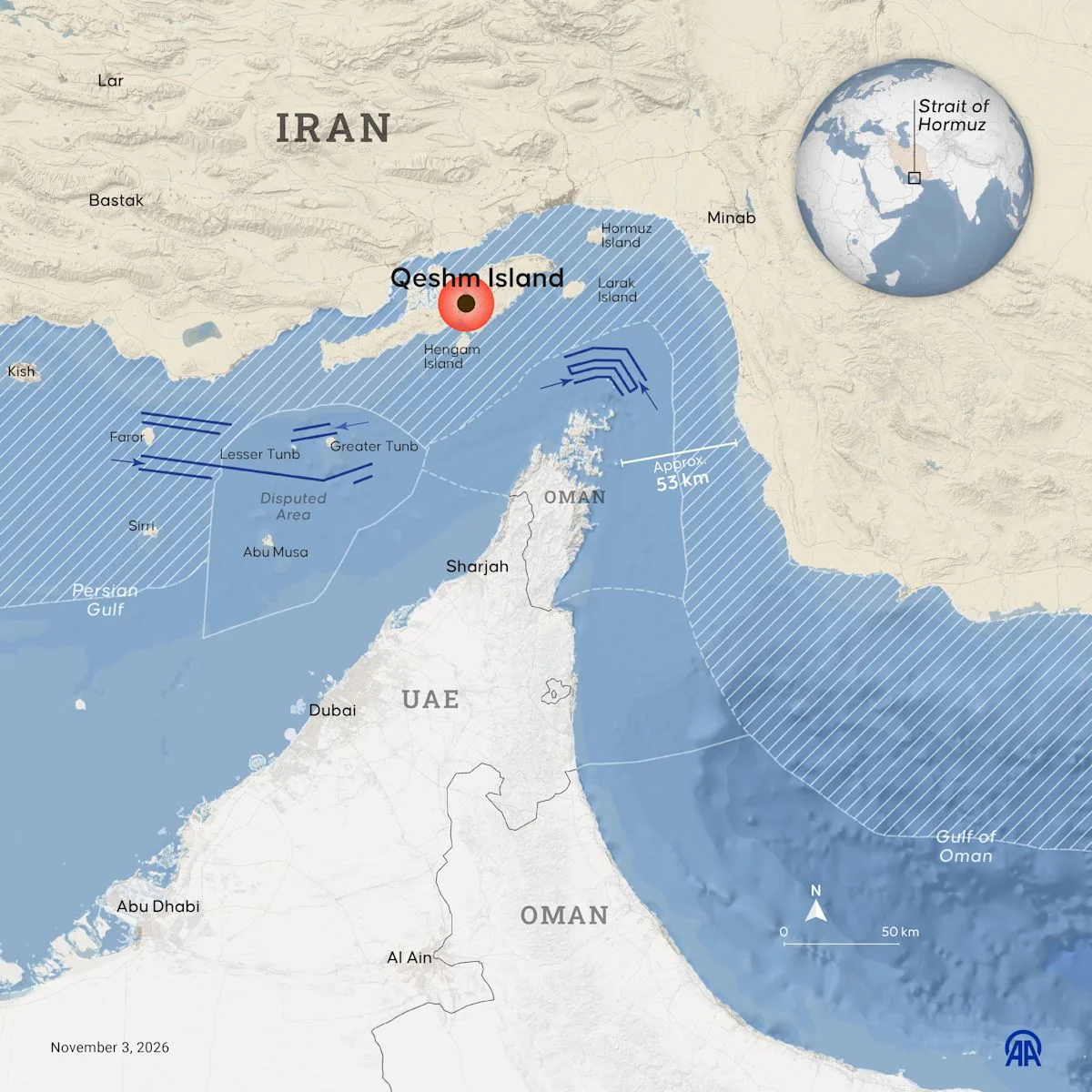
The United States military carried out precision strikes on an Islamic Revolutionary Guard Corps (IRGC) missile launch site on Qeshm Island in the Strait of Hormuz on Tuesday. Kuwait's military said its air defence systems were responding to hostile drone attacks, while Bahrain issued an urgent security alert urging residents to move to safe locations following renewed regional tensions.
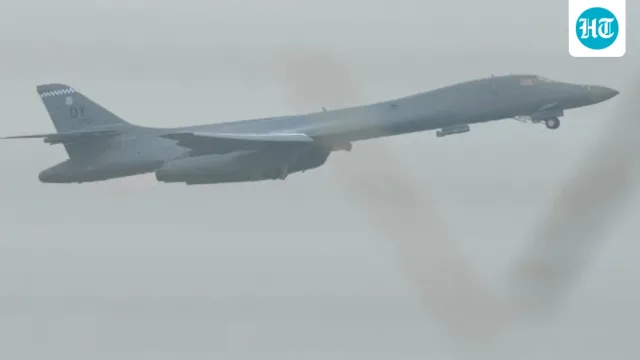
The latest military escalation included a U.S. fighter jet strike on an Iranian military target on Qeshm Island near the Strait of Hormuz. According to a U.S. military official, American forces used precision munitions to strike the missile launch site in self-defense, describing the operation as a response to what Washington characterized as Iranian aggression targeting U.S. personnel and military assets. The strike was aimed at preventing Iran from using the site to threaten American forces in the region. U.S. forces have previously carried out similar operations against military targets on Qeshm Island.
Confirming the operation, a U.S. military official told Reuters the strike was carried out in retaliation for Tehran's attacks on U.S. personnel and assets, though the official declined to provide further details. Meanwhile, Iran's semi-official Fars news agency reported that an explosion was heard on Qeshm Island earlier in the day, and Iran's semi-official Mehr news agency, citing a Hormozgan provincial official, reported that the U.S. strike caused no damage to residential or commercial areas or infrastructure. Ahmad Nafisi, the deputy provincial governor of Hormozgan province, claimed in comments carried by the state-run IRNA news agency that the American strikes caused no damage to residential, commercial, or infrastructural areas, while residents in the northwestern part of Qeshm city reportedly heard several explosions.
The conflict that began on February 28 with U.S. and Israeli strikes on Iran, including an attack that killed Iran's Supreme Leader Ayatollah Ali Khamenei, has now entered a prolonged phase. That operational reality leaves the region locked in a cycle of intermittent exchanges rather than continuous large-scale fighting, even as the deployment of the USS Theodore Roosevelt to the U.S. Central Command area of responsibility on November 15 joined two other aircraft carriers in the Middle East to show the scale of American military presence.
Air Defence Interceptions in Kuwait and Bahrain
Kuwait's army stated that its air defence systems were responding to hostile drone attacks, with its General Staff clarifying that explosions heard in the area were linked to air defence systems intercepting incoming threats while urging residents to follow security instructions. In Bahrain, the Ministry of Interior asked citizens and residents to remain calm, move to the nearest safe location, and rely on official channels for updates amid reports of Iranian drone attacks targeting U.S. military assets.
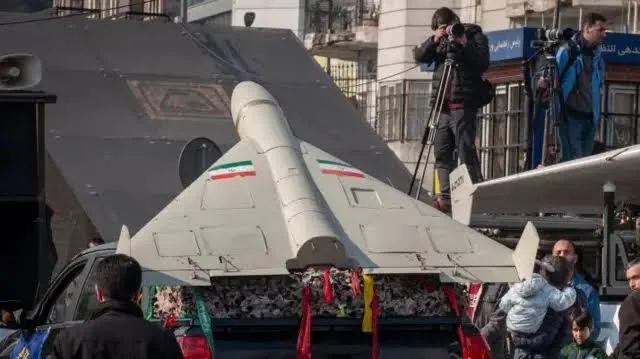
The U.S. strike was precipitated by Tuesday's drone attack on the Sheikh Isa Air Base in Bahrain. The IRGC claimed its combat drones successfully struck a U.S. radar system at the base in retaliation for repeated violations of Iranian airspace by American drones. U.S. Central Command officially refuted this account:
Iran's Islamic Revolutionary Guard Corps (IRGC) claimed its drones hit a U.S. military radar system at a base in Bahrain early this morning. This is FALSE.
U.S. Central Command
CENTCOM confirmed that while multiple Iranian one-way attack drones were indeed launched toward Bahrain, they were successfully intercepted without any damage to U.S. equipment or injury to personnel. This marks the third time in less than a week that Iran has issued claims of hitting the facility, each denied by American and Bahraini authorities.
The regional instability is compounded by Houthi militant activity in Saudi Arabia. On Tuesday, the Iran-backed group claimed to have targeted the Saudi East-West pipeline with five one-way attack drones across two separate pumping stations. The following entities and regions remain caught in the crossfire:
- Commercial shipping vessels transiting the Strait of Hormuz and Bab el-Mandeb Strait.
- U.S. military personnel and radar installations stationed in Bahrain.
- Saudi energy infrastructure, specifically the 750-mile East-West pipeline.
- The population of Iran, which Amnesty International reports is facing intensified state repression under the cover of wartime conditions.
Tensions between Iran and Bahrain have risen further following Bahrain's sentencing of 64 people, most of them Shi'ite clerics, to life imprisonment on charges of colluding with Tehran to undermine the state. Iran condemned the verdict, and Iran's Revolutionary Guards spokesperson Hossein Mohebbi criticized Bahrain's cooperation with Washington and its position on Shi'ite religious authorities, warning that its actions could affect its regional standing. Tehran has repeatedly denied interfering in Bahrain's internal affairs.
Strait of Hormuz Shipping Disruptions and Energy Markets
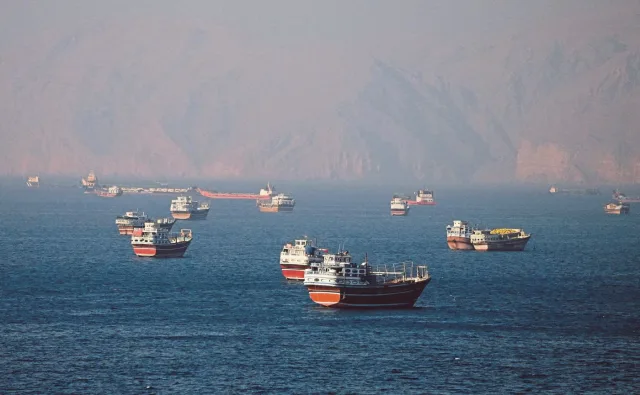
The security situation around the Strait of Hormuz has deteriorated amid reports of attacks on commercial vessels. The United Kingdom Maritime Trade Operations agency stated that the crew of a tanker travelling through the waterway was unaccounted for following an attack north of Oman's port city of Khasab. Iran's Revolutionary Guards and navy also claimed that a liquefied natural gas vessel and two oil tankers had caught fire in the strait, though these reports could not be independently verified by Reuters. Separately, the Iranian Navy claimed to have downed two U.S. drones over the Strait of Hormuz and reported that a third oil tanker was damaged after striking a sea mine near the waterway on Tuesday. The U.S. military maintains that shipping lanes in the southern Strait of Hormuz are mine-free and safe to navigate, standing in direct opposition to Tehran's warnings to mariners to avoid these routes.
President Donald Trump stated that Washington will continue its naval blockade of Iran due to Tehran's disruption of shipping through the Strait of Hormuz, maintaining one of the key obstacles to reaching an agreement. Brent crude futures rose 0.4 per cent to $92.76 a barrel on Tuesday, remaining below the wartime peak of $126.41 recorded in April but sitting significantly higher than pre-conflict levels.
Intelligence Allegations and Ongoing Mediation Efforts
Amid the military escalations, Iranian Foreign Minister Seyed Abbas Araghchi and Parliament Speaker Mohammad Bagher Ghalibaf rejected reports alleging that Tehran is formulating plans to target senior Trump administration officials in Washington, DC, using chemical weapons or a dirty bomb, accusing pro-Israel media of spreading propaganda. Araghchi dismissed the reports in a social media post on Tuesday, alleging an attempt to create support for a potential conflict with Iran. Iranian Deputy Foreign Minister Kazem Gharibabadi similarly rejected allegations from a CNN report that Tehran could use chemical weapons in an attack on Washington, DC, stating:
Iran is one of the biggest victims of chemical weapons; victims who were targeted with these inhumane weapons with the support of today's accusers, especially the United States.
Kazem Gharibabadi
The CNN report cited sources indicating that fresh American intelligence showed Iranian actors mapping out plans to secure alternative options against high-ranking Trump administration figures, though the intelligence showed no signs of an imminent attack and officials debated whether personnel were in place to execute such plans.
Diplomatic discussions involving Oman and Qatar continue as regional governments attempt to prevent further escalation. Qatar’s Foreign Ministry spokesperson Majed Al Ansari confirmed that mediation efforts between Washington and Tehran are ongoing, noting that officials met with the Iranian side on Tuesday to exchange views on pending proposals and bridge disagreements. Iranian Foreign Minister Abbas Araghchi also visited Oman, discussing maritime security, international shipping, trade, and efforts to prevent further military escalation with Omani officials, alongside meeting Sultan Haitham bin Tariq to brief him on Iran's diplomatic initiative to end the conflict.
Updated 1 time since publication; last update 18 November 2026, 02:57.