Iran Launches Drone Attacks on US Military Base in Bahrain
Iran launched a six-drone attack on the U.S. airbase in Bahrain, sparking conflicting damage reports and heightening regional tensions in the Gulf.
Iran launched a six-drone strike on a U.S. airbase in Bahrain on Sunday morning, prompting air raid sirens, security alerts, and conflicting accounts of the damage from military commanders and state media.
Most unexpectedly, the escalation arrives after months of relative quiet in the island kingdom and directly follows a domestic security crisis in Washington, where Treasury Secretary Scott Bessent revealed he and his family relocated to a military base after receiving Iranian death threats and facing what he termed reckless journalism by The Wall Street Journal.
Who Triumphed in the Skies Over Al-Riffa Air Base?
Sunday's confrontation centered on Al-Riffa Air Base in Bahrain, which hosts U.S. forces and serves as the headquarters of the U.S. Navy's Fifth Fleet. Iran's Islamic Revolutionary Guard Corps announced through Fars News Agency that it had attacked the facility with six drones in retaliation for hostile U.S. actions. State media footage released by the IRGC claimed the strike targeted an early-warning radar system.
Yet American and local authorities offered a sharply different assessment of the aerial assault. U.S. Central Command stated that U.S. forces shot down two incoming drones, confirming that nobody was hurt and nothing was damaged. Bahrain's military announced that its air defense systems intercepted several aerial attacks before they hit their targets, echoing earlier reports from U.S. Central Command regarding a previous attempt. Hours before the IRGC statement, Bahrain's Interior Ministry issued urgent security alerts asking residents to stay calm and move to safe places as explosions echoed across parts of the country.
| Reporting Entity | Claimed Target | Interception Status |
|---|---|---|
| IRGC (Iran) | US early-warning radar system at Al-Riffa Air Base | Stated six drones successfully struck the facility |
| CENTCOM (US) | US military site in Bahrain | Reported two drones shot down with zero damage or injuries |
| Bahraini Ministry | Airbase and surrounding airspace | Confirmed air defense systems intercepted several aerial attacks |
Why Has the Conflict Flared Again in the Gulf?
The Sunday morning strikes shatter a period of relative calm in Bahrain that had lasted since September. During that September blitz, U.S. Navy Secretary Hung Cao stated that the Iranian military had blew the hell
out of the installation, according to The Hill. Following months of concentrating their pressure campaign on commercial shipping rather than American military bases, Iranian forces appear to be signaling renewed dissatisfaction as the wider conflict pushes past the eight-month mark.
Esmail Baghaei, a spokesperson for the Iranian Foreign Ministry, stated at a press conference on Sunday that the country would continue to respond to military aggression by the U.S. and other nations. The IRGC asserted that its actions served as a serious warning to halt attacks, linking the timing to an enemy aerial strike against a communications tower in Sirik, located in southern Iran. While state media reported the Sirik hit, RFE/RL noted that the statement stopped short of directly naming the United States as the perpetrator.
Are Energy Routes Through the Strait of Hormuz Collapsing?
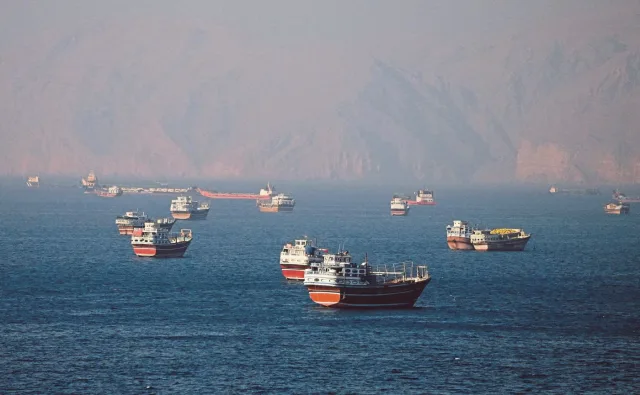
While the skies over Bahrain lit up with defensive interceptions, the maritime bottleneck at the Strait of Hormuz remains a primary theater of economic warfare. The strait, carrying roughly a quarter of global oil flows, has been effectively closed since March 2 following U.S. and Israeli strikes on Iran, according to a CSIS analysis. October saw 37 vessel attacks in the strait, marking the highest monthly total of the conflict, followed by at least 14 more confirmed in November, per CNN.
Maritime security reports show the daily hazard facing civilian crews in the region. UK Maritime Trade Operations reported that a Liberia-flagged oil tanker was hit by an unidentified projectile roughly 14 nautical miles northwest of Ras Al-Khaimah in the United Arab Emirates, triggering an engine-room fire. All 22 crew members aboard, including 19 Indian nationals, were safely evacuated. Meanwhile, the IRGC claimed that four oil tankers on November 11 and 12, along with a liquefied petroleum gas tanker, struck mines and exploded after ignoring warnings in the eastern Strait of Hormuz, though independent verification remains absent.
Can Diplomatic Channels Outpace Rising Regional Tensions?
Despite the military exchanges, leaders on both sides continue to project divergent stances on the possibility of a negotiated settlement. President Donald Trump described the war as and won
by the U.S. and indicated he might hold off from attacking Iran if the U.S. faces no new provocations, though he maintained a naval blockade and directed Vice President Vance to focus on domestic corruption. Treasury Secretary Scott Bessent added that the administration's economic pressure is working, noting to Larry Kudlow on Fox News that We are squeezing them, and their death threats tell me that everything I'm doing is working.
We are squeezing them, and their death threats tell me that everything I'm doing is working.
Scott Bessent, Treasury Secretary, via Fox News
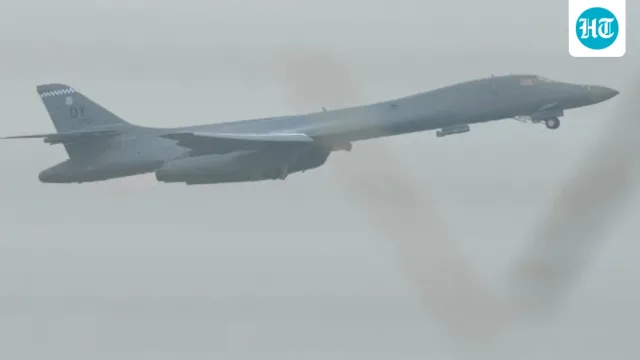
On the opposing side, Iranian President Masoud Pezeshkian accused Washington on Wednesday of threatening his country with America's largest non-nuclear weapon, the so-called mother of all bombs, even while pursuing peace talks. With diplomatic channels stalled and Saudi Arabia, Qatar, Jordan, and Egypt issuing statements of solidarity with Bahrain, the standoff shows few signs of immediate resolution. The U.S. continues limited defensive operations, including warplane strikes earlier this month against an anti-aircraft site on Qeshm Island, while the naval blockade in the Strait of Hormuz persists.
Bahrain's air defenses remain on high alert following Sunday's interceptions, as military forces across the region brace for potential retaliatory cycles tied to the unchanging status of the Bab el-Mandeb Strait and the Persian Gulf.