Russian bombing of Ukrainian aid centre and shelter kills 24
Ten guided bombs struck an aid distribution center and shelter in Komyshuvakha, killing 24 people just as a localized humanitarian ceasefire expired.
- Headline: Russian bombing of Ukrainian aid centre and shelter kills 24
- Dispatch Summary: Ten guided bombs struck an aid distribution center and shelter in Komyshuvakha, killing 24 people just as a localized humanitarian ceasefire expired.
- Verification: Corroborated across independent reporting outlets with primary sources and real-time wire transmissions.
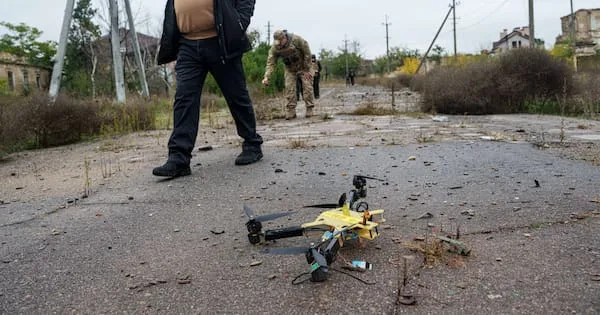
A Russian bombing campaign struck an aid distribution center and a neighboring shelter in the village of Komyshuvakha in southern Ukraine on Monday, killing 24 people. The attack unfolded as a limited humanitarian ceasefire expired in the nearby Kherson region, shuttering a brief window for evacuations that Ukrainian leaders had hoped might serve as a foundation for broader peace talks.
Ukrainian President Volodymyr Zelensky said in a post on X that 10 guided bombs targeted the area, which included a local school building used to distribute humanitarian aid and a nearby shelter. Zelensky initially put the death toll at 18, but Ukraine's state emergencies service DSNS later confirmed that 24 people had died, including two rescuers and four police officers. Regional head Mykhailo Semikin reported that five people were injured and about 20 people were initially considered missing beneath the rubble, leaving emergency responders to search through collapsed buildings using flashlights as night fell.
Why did this strike happen as the Kherson ceasefire ended?
The timing of the bombardment coincided with the expiration of a limited ceasefire agreement in the Kherson region on Monday. That brief pause in fighting, which began on Oct. 27, facilitated humanitarian aid and evacuation missions in the Russian-occupied city of Oleshky, and marked the most significant truce between Kyiv and Moscow since Russia's full-scale invasion began nearly five years ago.
Speaking to reporters in Kyiv earlier on Monday before the Zaporizhzhia bombings, Ukraine's ombudsman and lead civilian negotiator for the mission, Dmytro Lubinets, expressed hope that the localized ceasefire and evacuation would act as a model for other such efforts. President Zelensky echoed that sentiment, stating, There was a moment when the next steps could have shown that progress toward peace was possible.
Instead, Zelensky argued that the strikes in Komyshuvakha signaled a deliberate reversal. With these killings, Russia is sending an entirely opposite signal: Russia is counting on more killings,
he wrote, adding that Russian forces could not have been unaware that the local residents who remained in Komyshuvakha received humanitarian aid there every week.
How did rescue operations unfold under fire?
Efforts to locate survivors in Komyshuvakha faced severe impediments. Regional head Mykhailo Semikin described the attack as a terrible tragedy and confirmed that rescue teams were forced to halt their operations a number of times because of ongoing Russian drone attacks in the area. Semikin and Ukrainian emergency services posted footage showing the school building reduced to smouldering rubble alongside a massive crater left by the munitions.
The violence was not confined to Zaporizhzhia. Across Ukraine, authorities reported a wave of coordinated attacks. Emergency services registered 17 people injured in separate drone strikes, including 12 injuries in the eastern Kharkiv region—where a refrigeration facility, greenhouses, and residential buildings were damaged—and five injuries in the Black Sea port city of Odesa, where a warehouse was targeted and homes were damaged.
What happened during the simultaneous cyberattacks on mobile alerts?
Hours before the deadly bombings, government-run mobile alert apps in both Ukraine and Russia were compromised by cyberattacks late Sunday and early Monday, sowing confusion through false emergency notifications. Ukrainian users received phony warnings written in English, Russian, and Ukrainian regarding high radiation levels, chemical threats, public disturbances in Kyiv, and an imminent nuclear strike referencing a Russian ballistic missile called the Oreshnik.
Despite the alarming text, the fake alerts generated little panic among Ukrainians. Social media flooded with humorous posts, AI-generated apocalypse images, pets relaxing, and memes featuring Kyiv Mayor Vitali Klitschko, a former international kickboxing champion, alongside the message, It's a good thing we have a boxer for a mayor.
Ukraine's air raid alert channel warned users not to click links in suspicious notifications, while the state-run Center for Countering Disinformation directed the public to alternative social media emergency channels. Yurii Ihnat, a spokesperson for Ukraine's air force command, stated in a television interview that the cyberattack had no impact on the country's security and defense operations. A Russian Telegram channel linked to security services reported that a hacking group named Hitcore claimed responsibility for breaching the Ukrainian system, though the Associated Press could not independently verify the claim.
In Russia, the Emergency Situations Ministry stated that hackers dispatched a false alert at approximately 2:45 a.m. Moscow time on Monday across 33 of the country's 89 regions. Kremlin spokesperson Dmitry Peskov acknowledged the vulnerability, noting that state agencies face constant cyberthreats utilizing artificial intelligence. All government bodies must take steps to improve the cybersecurity of our digital resources,
Peskov said.
- October 27: A localized ceasefire begins in the Russian-occupied city of Oleshky as part of a humanitarian aid and evacuation mission.
- Late Sunday: Government-run mobile emergency alert apps in Ukraine and Russia are breached by hackers, sending false warnings of nuclear and chemical threats.
- Monday: The limited ceasefire in the Kherson region expires; Ukraine's general staff reports that Russian forces utilized the pause to bolster drone defenses and replenish ammunition.
- Monday: Guided aerial bombs strike a humanitarian distribution center and shelter in Komyshuvakha, Zaporizhzhia, killing 24 people.
- Tuesday: A day of mourning is declared across the entire Zaporizhzhia region.
While search and rescue operations continued in Komyshuvakha amid ongoing security threats, military engagements escalated on multiple fronts. Ukraine's general staff reported that Russian forces used the Kherson ceasefire window to replenish ammunition and strengthen drone defenses. Meanwhile, Russia's Ministry of Defense claimed it shot down 212 Ukrainian drones overnight, and independent Russian media outlets reported that Ukrainian drones targeted one of Europe's largest oil transport hubs in Samara.
| Region | Reported Impact | Casualties and Damage |
|---|---|---|
| Zaporizhzhia (Komyshuvakha) | Aerial bombing of aid center and shelter | 24 killed, 5 injured, ~20 missing |
| Kharkiv | Drone strikes | 12 injured; damage to refrigeration, greenhouses, homes |
| Odesa | Drone strikes on port infrastructure | 5 injured; warehouse and homes damaged |
| Kherson | Expiration of humanitarian ceasefire | Fighting resumed after evacuation pause |
Local authorities declared a day of mourning for Tuesday across the entire Zaporizhzhia region as communities honor the victims, including the two State Emergency Service rescuers and four police officers among the dead.