France Arrests 1,200 as Nationwide Protests Turn Violent
Nationwide demonstrations over living costs and school conditions in France turned violent on Saturday, leading to over 1,200 arrests and widespread property damage.
- Headline: France Arrests 1,200 as Nationwide Protests Turn Violent
- Dispatch Summary: Nationwide demonstrations over living costs and school conditions in France turned violent on Saturday, leading to over 1,200 arrests and widespread property damage.
- Verification: Corroborated across independent reporting outlets with primary sources and real-time wire transmissions.
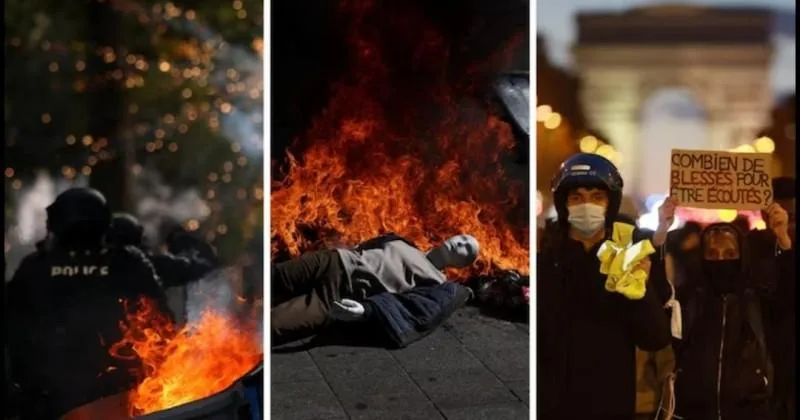
More than 1,200 people were arrested across France on Saturday after nationwide demonstrations over the cost of living and secondary school conditions deteriorated into violent clashes, arson, and widespread looting. Amid the chaos, an elderly couple in their eighties were robbed by rioters in Paris and left on the street wearing only their underwear.
The unrest represents a major escalation following weeks of student-led rallies that began at high schools in Paris' poor northern suburbs over teacher absences, staff shortages, and ageing facilities in schools serving teenagers aged 15 to 18. Those initial grievances rapidly morphed into a broader national movement involving trade unions, workers, and revived factions of the yellow vest movement. The Interior Ministry reported a nationwide turnout of 550,000 people, while the CGT trade union put the figure at approximately 800,000, including about 110,000 demonstrators in Paris.
The Institutional Clash: Government Response Versus Public Grievances
The state apparatus and the political opposition are now locked in a fierce dispute over who bears responsibility for the destruction. French President Emmanuel Macron condemned the violence, warning that those who carried out vandalism, attacked administrative offices or businesses, or engaged in looting would be prosecuted and punished. Prime Minister Sébastien Lecornu confirmed that 1,200 people had been arrested and stated that 150 police officers were injured during the clashes, though the government later cited a cumulative figure of more than 900 police hurt in recent weeks. Interior Minister Laurent Nuñez blamed the violence on opportunistic delinquents and the ultra-left, stating that hooded individuals carried out targeted acts of violence.
Local leaders described devastation in urban centres. Paris mayor Emmanuel Gregoire stated that whole streets in the capital had been devastated, while Paris police affirmed they would not back down in the face of rioters. In Limoges, a fire broke out in the historic 140-year-old town hall, built in 1883 and inspired by Paris City Hall. Local representative Maurice Barate noted that the roof collapsed onto the lower floors (except in the west wing), leaving roughly two-thirds of the facade destroyed. In Marseille, masked protesters briefly stormed the town hall after ramming the doors with security barriers. Rioters also torched the tourist office in Lyon, vandalised government buildings in Marseille and Lille, attacked a police compound in Bordeaux, and smashed windows at a BNP Paribas bank in Grenoble.
Protest organisers and participants insisted that the vast majority of demonstrators marched peacefully. A 19-year-old protester in Paris identified as Lola defended the movement, saying We are fighting because the cost of living is too harsh, because the price of fuel is too high, because high school pupils are being violently attacked and hurt all over the country just for trying to protest and ask for more teachers and decent learning conditions.
High school student Kamil Alahyan, 18, pointed to upcoming elections in 2027, politicians who lie, and the ultra-rich accumulating wealth over the past decade. Trade union participants, including teacher Regine Monfroid in Strasbourg, voiced exhaustion with poverty wages and rising rents.
Political figures scrambled to leverage the unrest ahead of the presidential elections scheduled in six months' time to replace Macron. Far-right candidate Marine Le Pen condemned the rioters and claimed that the party of her far-left rival, Jean-Luc Mélenchon, had legitimised the violence. Mélenchon, who supported the student protests, urged demonstrators to stay away from looting, describing it as contrary to their methods. Internationally, U.S. Vice President JD Vance blamed immigration for the unrest, stating on X that Western liberals had ignored fundamental questions of assimilation and compatibility.
Timeline of Unrest and the Toll on Communities
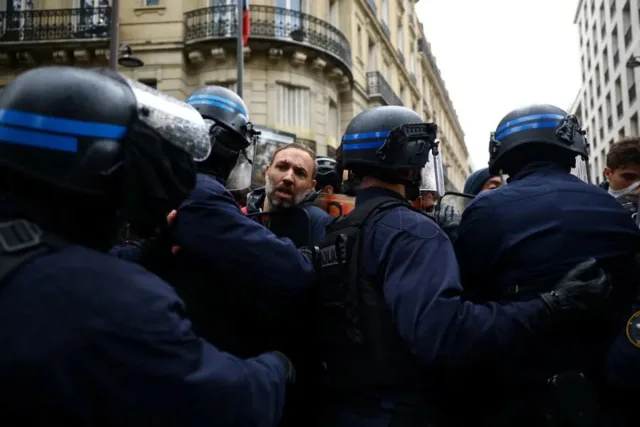
The crisis has intensified scrutiny of law enforcement tactics and public safety. Police deployed tear gas, water cannons, and intermediate crowd-control weapons. The internal police watchdog is investigating at least two dozen allegations of police violence. Demonstrators suffered severe injuries, including a 17-year-old boy in Saint-Étienne who had his right hand blown off by a crowd-control grenade.
- September 2026: Secondary school students in the northern suburbs of Paris begin protesting against teacher absences, staff shortages, and poor school conditions.
- Friday before the marches: Interior Minister Laurent Nuñez confirms that intermediate crowd-control weapons can be used if clashes occur.
- Saturday, October 17: Nationwide marches draw hundreds of thousands of participants, culminating in widespread looting of luxury boutiques, department stores, and supermarkets in Paris, Marseille, Nice, Nantes, Bordeaux, Limoges, Lille, Toulouse, and Strasbourg, alongside the partial destruction of Limoges town hall.
Commercial districts suffered extensive losses as organised groups of masked individuals disconnected security cameras before breaking into shops. In Paris, rioters looted clothing and food stores, luxury outlets including Hermès and Louis Vuitton. In Bordeaux, a Louis Vuitton store was looted; in Lille, an Apple store was ransacked; and in Marseille, a Hermès boutique was targeted alongside dozens of other shops. Ordinary residents caught in the path of the violence faced locked doors, tear gas clouds rising to roof level, and property destruction.