Israeli settlers attack Palestinians and journalist in West Bank harvest
Dozens of masked Israeli settlers attacked Palestinian farmers and burned groves in the West Bank, injuring 20 people and hospitalizing Washington Post photojournalist Heidi Levine.
- Headline: Israeli settlers attack Palestinians and journalist in West Bank harvest
- Dispatch Summary: Dozens of masked Israeli settlers attacked Palestinian farmers and burned groves in the West Bank, injuring 20 people and hospitalizing Washington Post photojournalist Heidi Levine.
- Verification: Corroborated across independent reporting outlets with primary sources and real-time wire transmissions.
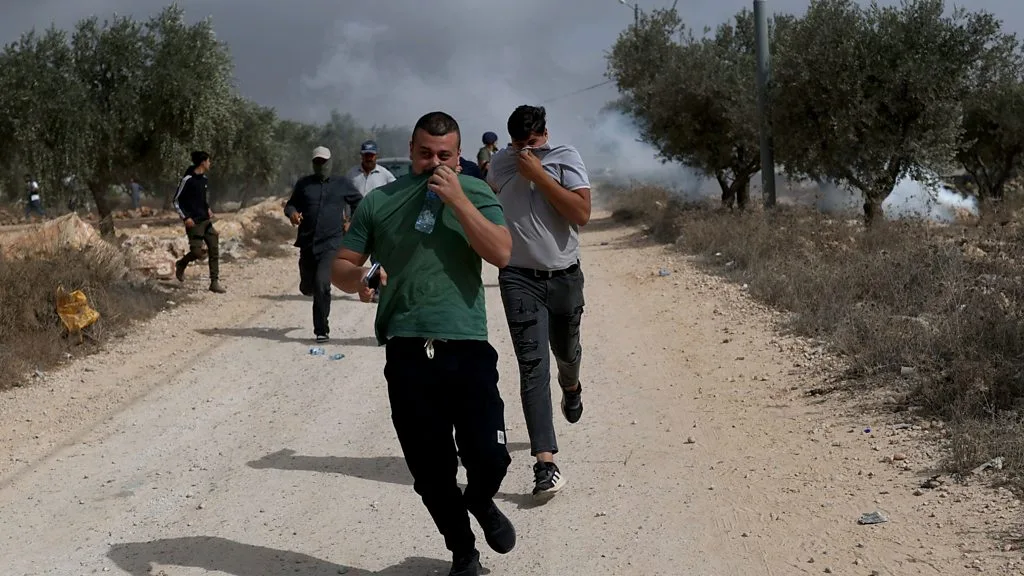
Dozens of masked Israeli settlers attacked Palestinian farmers and burned groves across the occupied West Bank on Friday, leaving 20 people injured in a single day of coordinated assaults during the annual olive harvest, according to the Palestine Red Crescent Society. The violence also targeted international media, culminating in the hospitalisation of Washington Post photojournalist Heidi Levine after she was beaten by a mob.
The escalation marks an alarming milestone in a season that the United Nations says has already seen more attacks by violent Israeli settlers than during the entire harvest period last year. Levels of settler violence have reached an all-time high, driven by the expansion of illegal hilltop outposts that now tightly encircle traditional Palestinian farming villages.
How did the ambush unfold near Abu Falah?
The confrontation erupted on Friday morning in farmland near the Palestinian village of Abu Falah, north of Ramallah. Anticipating trouble, multiple villages had pooled their labour to harvest together as a protective measure, deploying power tools to strip fruit from the branches before dawn broke. Despite these precautions, about a dozen settlers dressed in black charged down a hill from a nearby illegal outpost, torching roughly a dozen olive trees and three cars with slingshots and incendiary materials.
As journalists and peace activists rushed to document the chaos, the initial skirmish drew reinforcements. I would say at least 50 masked men,
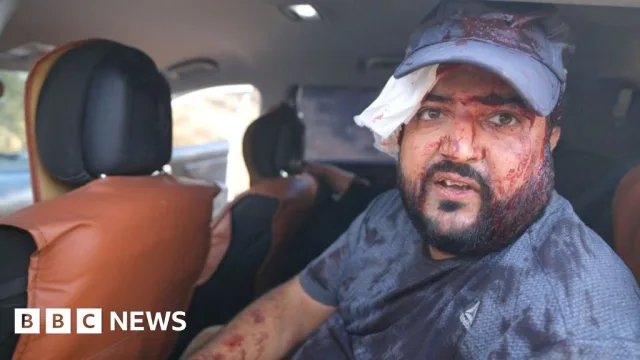
Levine said from her hospital bed, describing how the attackers swarmed the reporting team. She recounted being pushed to the ground, where she was kicked repeatedly for at least 10 minutes despite wearing a helmet and a flak jacket clearly marked with press insignia. Witnesses including activist Andrey X and colleague Jasper Nathaniel pulled Levine away as assailants stripped away her cameras and phone.
Local officials reported that Palestinian-American citizens were among those beaten. Majdi Fheed, an American citizen from neighboring Turmus Ayya, suffered deep head wounds inflicted by nail-studded sticks. Yaser AlKam, a local council member, said Fheed's elderly mother was also injured as families fled along narrow stony tracks amid a stream of smoke-choked cars.
What is different about the violence this season?
While clashes between settlers and Palestinian farmers are a recurring feature of the autumn harvest, aid agencies note that the sheer frequency and impunity of this year's assaults have shattered previous benchmarks. Palestinian officials report that at least four Palestinians have been killed and more than 100 injured since the season began earlier this month, while the UN puts the injury toll at over 120 across the West Bank. Thousands of trees have been damaged, costing farmers hundreds of thousands of dollars.
The convergence of newly established, unauthorized hilltop outposts has turned olive picking into a desperate race against time. Farmers must strip trees at dawn while watching ridges where settlers gather to monitor them. Rights groups and residents state that Israeli authorities have done little to stop the raids, creating an environment where attackers operate with near-total immunity. Sara Qudah of the Committee to Protect Journalists noted that Levine's beating follows the assault earlier this month on Agence France-Presse photojournalist Jaafar Ashtiyeh, calling it part of a disturbing pattern of harassment against the press.
Who is held responsible and what do authorities say?
Prime Minister Benjamin Netanyahu issued a statement on Friday condemning violence against anyone — Jews, Arabs, Christians or journalists — while questioning the sequence of events. The facts surrounding the confrontation near Abu Falah, during which Washington Post photojournalist Heidi Levine was allegedly assaulted, remain unclear and are under investigation,
Netanyahu said, adding that those responsible would be held accountable.
The Israel Police announced that officers from the Judea and Samaria District and forensic investigators had been dispatched alongside military forces to collect evidence. The Israel Defense Forces stated that personnel arrived to manage a violent confrontation, during which tear gas was fired into the fields to disperse the crowds as live ammunition cracked across the valley.
International condemnation was swift. Washington Post Executive Editor Matt Murray called the episode an unwarranted attack on a journalist doing her job and urged a thorough investigation. The U.S. Embassy in Jerusalem and a State Department spokesperson issued statements condemning criminal violence by any party in the West Bank and calling for arrests and convictions. Meanwhile, the Palestinian Journalists Syndicate denounced the incident as a direct assault on press freedom.
What are the broader political pressures driving the crisis?
The spike in violence coincides with the final weeks leading up to Israel's Oct. 27 election. Observers point out that the far-right government currently empowering the settler movement could either be voted out of power or secure another term, leaving extremist factions eager to establish facts on the ground before any potential political shift.
All Israeli settlements are illegal under international law, and even outposts established without government permits frequently receive tacit state support or security cover. As security forces arrived on Friday, their standard intervention pattern, firing tear gas into fields after the damage was done, did little to reassure residents. Seventy-three-year-old local resident Imm Khaldoun watched the vehicles stream past and vowed to return regardless of the danger. This is my land. It's my right [to be here],
she said.
As investigations open, the immediate outlook for the remainder of the harvest remains bleak, with farmers facing mounting economic ruin and journalists weighing the acute physical risks of covering the West Bank.