Tesla launches a ‘flying’ car as it unveils Roadster 2 with SpaceX thrus…
Tesla showcased the second-generation Roadster at a SpaceX test facility in Texas, using thrusters to briefly fly and flip during a live-streamed event.
- Headline: Tesla launches a ‘flying’ car as it unveils Roadster 2 with SpaceX thrus…
- Dispatch Summary: Tesla showcased the second-generation Roadster at a SpaceX test facility in Texas, using thrusters to briefly fly and flip during a live-streamed event.
- Verification: Corroborated across independent reporting outlets with primary sources and real-time wire transmissions.
Tesla Unveils Flying Roadster 2 in Texas
Drivers yearning for science-fiction dreams of airborne commutes can now glimpse a concrete machine, even if they cannot legally drive one on public streets just yet. Tesla has officially showcased its long-awaited second-generation Roadster at a SpaceX test facility in McGregor/Waco, Texas, featuring SpaceX thrusters that allowed the electric sports car to briefly fly, flip, and land during a live-streamed event on Thursday night. Chief Executive Elon Musk greeted the audience with the words, Well, it worked
, as reported by Euronews and 36Kr.
The vehicle has been nearly 10 years in the making since its initial reveal in November 2017, and Tesla has now targeted 2028 for manufacturing to begin, according to Cardealermagazine.co.uk. The Roadster costs around $200,000. For prospective buyers, the spectacle offers staggering performance metrics paired with heavy regulatory hurdles.
From 2008 Origins to 2028 Production Goals
The journey to this week's Texas demonstration stretches back two decades. Tesla launched its first-generation Roadster in 2006, starting deliveries in 2008 before discontinuing the model in 2012 after selling around 2450 units, as noted by 36Kr. Built on a Lotus Elise chassis, that initial sports car proved electric vehicles could achieve high speeds and long ranges, funding Tesla's subsequent master plan for more affordable models like the Model S, Model 3, Model Y, and the Tesla Semi. In February 2018, Musk famously launched his own cherry-red first-generation Roadster into space aboard a SpaceX Falcon Heavy rocket, complete with a spacesuit-clad dummy named Starman still orbiting the Sun.
When Musk first revealed the second-generation Roadster in November 2017 from the cargo bed of a Semi, he promised a 1.9-second 0-60 mph acceleration, a 620-mile range, and a 250 mph top speed. Years of production delays followed as Tesla focused on its wider EV portfolio. Today's vehicle goes far beyond those original 2017 targets by incorporating aerospace technology developed in direct collaboration with SpaceX engineers.
How Do the Suction Fans and Cold Gas Thrusters Work?
The new Roadster achieves its gravity-defying stunts through two primary engineering systems: an underbody fan suction setup and a compressed air propulsion array. Lars Moravy, Vice President of Engineering, explained on stage that the car utilizes carbon fiber-wound high-pressure gas cylinders, identical to the COPVs used on SpaceX's Falcon 9 rocket, holding around 250 kilograms of air across 600 liters of total volume, per 36Kr. Ten nozzles distribute attitude control and main propulsion, running on compressed air rather than burning fuel. Musk noted during the launch, This will be an actual car that’s on the roads. I’m not sure it’s necessarily legal in all jurisdictions, but there will be such a car that someone can own,
as reported by Cardealermagazine.co.uk.
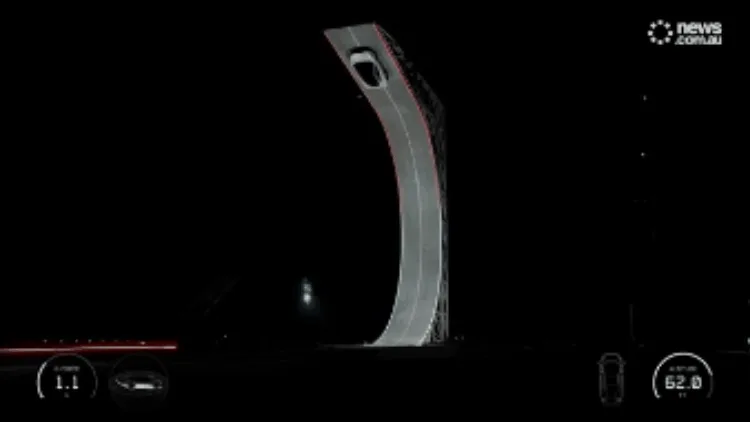
The underbody fan suction system creates negative pressure that generates up to 2G of adsorption force, pressing the car to the ground at twice its own weight. This allows the vehicle to remain stuck upside down on a curved ramp without falling. Franz von Holzhausen, Head of Design, stated that the team drew inspiration from the SR-71 Blackbird reconnaissance plane and transforming vehicles. During Thursday's demonstration, a white Roadster drove up a towering vertical curve, went upside down, launched into the air, performed a kickflip over a row of Tesla vehicles including a Cybertruck, Cybercab, Semi, and Model Y, and landed steadily.
What Are the Safety, Cost, and Regulatory Hurdles?
Elon Musk, CEO, via 36Kr
We are certain it will work, but if things go wrong by any chance, the safety distance here is not nearly enough.
Despite the excitement, the car faces severe operational questions. Stratnewsglobal.com notes that the Roadster is not an aircraft capable of sustained urban air mobility, and Tesla has not established how long the production vehicle could remain airborne or operate outside a controlled test environment. Regulatory oversight remains divided: the National Highway Traffic Safety Administration oversees motor vehicle safety in the United States, while the Federal Aviation Administration regulates aircraft and relevant aspects of aviation safety. Integrating road travel, flight, and rocket propulsion into a single consumer vehicle creates complex emergency and liability challenges if propulsion systems fail.
Furthermore, the specialized thruster equipment will not be fitted to cars in all countries or markets. The road-legal Performance variant lacks thrusters entirely, limiting the flying and flipping capabilities to the limited-edition Thrust and Rocket variants. With a top speed exceeding 230 mph and a range of over 300 to 480 kilometers depending on the variant, the vehicle targets wealthy enthusiasts rather than ordinary commuters looking for a solution to traffic congestion.
Manufacturing is scheduled to begin in 2028, and the Roadster will be available in left-hand drive only on the UK Tesla website, according to Cardealermagazine.co.uk.