Israeli settlers attack olive farmers and Washington Post journalist in …
Dozens of masked Israeli settlers attacked Palestinian olive farmers and a Washington Post photographer in the West Bank village of Abu Falah.
- Headline: Israeli settlers attack olive farmers and Washington Post journalist in …
- Dispatch Summary: Dozens of masked Israeli settlers attacked Palestinian olive farmers and a Washington Post photographer in the West Bank village of Abu Falah.
- Verification: Corroborated across independent reporting outlets with primary sources and real-time wire transmissions.
The annual olive harvest in the occupied West Bank is meant to be an economic lifeline for Palestinian families, yet it has devolved into a violent battleground where official restrictions meet coordinated extremist attacks. On Friday, dozens of masked settlers descended on farmland near the Palestinian village of Abu Falah, setting fire to cars and olive trees while wielding clubs, firearms, and nail-studded sticks against civilians. The assault left at least 12 Palestinians injured in Abu Falah according to a local official, including four dual Palestinian American citizens, and hospitalized Washington Post photographer Heidi Levine after a prolonged beating. This violence is not an isolated outburst but part of a systematic campaign that rights groups say is expanding alongside a surge in illegal hilltop outposts and government policies that restrict Palestinian agricultural access while favoring Israeli citizens.
That stark contrast between promised protection and ground-level impunity forms the core of the crisis. While Israeli Prime Minister Benjamin Netanyahu has occasionally condemned the violence, attributing it to just about 100 settlers, critics and human rights organizations point out that his rightwing government has taken few steps to stop settler violence. Instead, official restrictions have tightened. Israel imposed new rules on the olive harvest this year barring Palestinians from entering about 8,800 hectares (21,800 acres) of agricultural land in Area C without approval of the Israeli military, representing a 30% increase from the year prior. By contrast, the rights group Peace Now says the military decreased the amount of land Israeli citizens were prohibited from entering from about 1,070 hectares in 2025 to 680 hectares in 2026, for the purpose of preventing settler violence. This regulatory squeeze, paired with active settler aggression, leaves Palestinian farmers to race against the sun, stripping trees with power tools in protective groups just to salvage their crops before masked groups arrive.
How did the attack unfold in Abu Falah and Turmus Ayya?
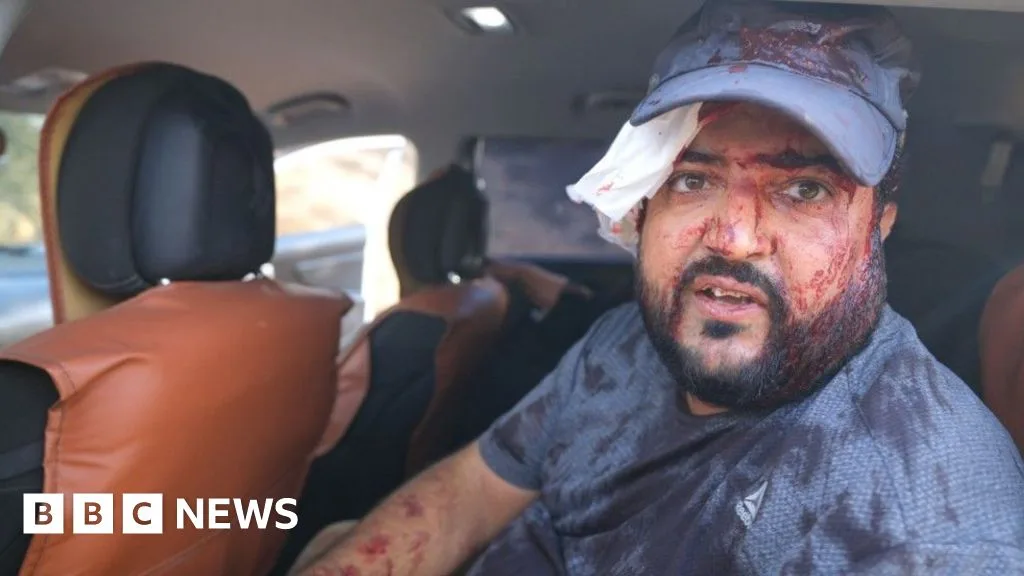
The violence erupted early Friday morning as families from three villages gathered to harvest their olives together near Abu Falah as a form of protection against attack. According to eyewitnesses and reporting from a BBC team on the scene, at least 80 settlers—some carrying firearms or clubs—gathered on a ridge near a new illegal outpost before charging down the hill dressed in black. Armed with slingshots, they hurled rocks at the farmers in view of Israeli military vehicles. Majdi Fheed, an American citizen, told reporters from the backseat of a fleeing car that almost 15 Jewish guys started attacking them with guns, with rocks, with special weapons, leaving him with deep wounds on his head and neck that required hospital treatment. His elderly mother was also injured in the melee.
The chaos quickly escalated across neighboring areas. Hours earlier near the West Bank village of Turmus Ayya, settlers burned three cars after attacking Palestinians harvesting olives. In Abu Falah, the arrival of Israeli forces did not halt the aggression; rather, the standoff exploded into action as settlers began running down towards us as the farmers swiftly retreat and Palestinians set off fireworks to try and push the settlers back. Amid the retreat, live ammunition cracked across the fields, though it remained unclear whether settlers or Israeli forces were firing. Minutes later, Israeli forces began firing tear gas into the Palestinian fields to end the confrontation. According to the Palestinian Red Crescent Society, at least six people were injured in the town of Abu Falah, while the UN notes that settler attacks on the olive harvest this year have killed one Palestinian and injured more than 120 others across the West Bank.
| Indicator | Previous Period / 2025 | Current Period / 2026 |
|---|---|---|
| Restricted Palestinian Land in Area C | Baseline level before 30% increase | About 8,800 hectares (21,800 acres) requiring military approval |
| Restricted Land for Israeli Citizens | About 1,070 hectares | About 680 hectares |
| Settler Attacks Since Harvest Start | Lower annual baseline | At least 170 attacks since September 27 |
Why is this year's olive harvest seeing such a dramatic spike in violence?
The escalation stems from a convergence of political pressure, military policy shifts, and the proliferation of unauthorized outposts. Yesh Din, an Israeli rights group, documented at least 170 settler attacks since September 27, around the start of the annual olive harvest. The United Nations reports that the past two weeks have already seen more attacks by violent Israeli settlers than during the entire harvest season last year. This surge coincides with Israel's elections approach at the end of October, intensifying a climate where extremist factions seek to assert territorial dominance.
Furthermore, the economic stakes for Palestinians have never been higher. With Israel revoked work permits for many Palestinians in the West Bank after the Hamas-led attack on 7 October 2023, the olive harvest serves as an economic lifeline. Yet this lifeline is being systematically severed. Sarit Michaeli, an independent activist, said settlers were stealing Palestinians’ olive crop on a scale never seen before in my 22-year history of working on this issue
. Videos shared by the Israeli rights group B’tselem documented hundreds of bags of olives “violently” stolen by Israeli settlers from Palestinians and taken to Israeli olive presses, while Israeli bulldozers razed swathes of agricultural land and uprooted trees in Kufur Malek, outside Ramallah.
What happened to the journalists and foreign observers caught in the crossfire?
The assault on journalists covering the West Bank has drawn sharp international condemnation, spotlighting the vulnerability of press workers documenting rural violence. Washington Post photographer Heidi Levine was reporting at the scene in Abu Falah when she was ambushed by a group of settlers. I got jumped,
Levine said. I was on the ground and they were kicking me and I was trying to hold onto my camera and my bag. I had my helmet and flak jacket on which protected me. They made me stand up and they kicked me again, and this went on for at least 10 minutes.
Witnesses confirmed that the prolonged beating ended only when her Palestinian colleagues intervened to save her, though settlers also stole her passport, phone, wallet and equipment.
Matt Murray, executive editor of the Washington Post, issued a statement noting that Levine had been clearly identifiable as a journalist and urging a thorough investigation and follow-through from authorities. The Israeli Foreign Press Association echoed this outrage, stating in a statement: This is the latest in a long line of violent attacks by Israeli settlers against journalists and other civilians in the occupied West Bank. Yet our repeated calls for action to confront this lawlessness have been ignored by Israeli authorities.
Meanwhile, the Israel Defense Forces stated that personnel had been despatched to the area following a report of a violent confrontation, confirming that a female journalist had been injured during the confrontation and that all circumstances surrounding the incident would be examined.
What are governments and international bodies doing in response?
Diplomatic reactions have largely followed a familiar pattern of statements without enforcement. A US State Department spokesperson stated that they were aware of the reports, declaring, We condemn criminal violence by any party in the West Bank and call for investigations, arrests, and convictions, of those responsible.
A spokesperson for the US embassy in Jerusalem similarly noted that it was aware of reports of the attack and declined to comment further due to privacy laws. On the ground, however, rights advocates argue that official condemnations ring hollow given the daily reality of military complicity.
Human rights organizations consistently maintain that settlers enjoy the protection of the Israeli military, which intervenes only if Palestinians try to defend themselves. All Israeli settlements are illegal under international law, and outposts – small encampments on hilltops – are illegal under Israeli law as well, but many still receive state support. As illegal outposts multiply and cluster closer to Palestinian groves, 73-year-old resident Imm Khaldoun voiced a defiant resolve shared by many of her neighbors as she watched cars stream past the carnage: This is my land. It's my right [to be here]
.
Readers following these developments should monitor the outcomes of any announced investigations by the Israel Defense Forces, watch for official updates from the United Nations regarding West Bank casualty figures as the harvest continues, and track the diplomatic pressure exerted by Washington following the assault on an American journalist.