Trump Says War With Iran Militarily Effectively Over After Qatar Talks
US President Donald Trump announced that the military conflict with Iran is effectively over following discussions with Qatar's prime minister.
Update: This report has been updated with new details from Washington and the Middle East regarding President Donald Trump’s meeting with Qatar’s prime minister, new statements from Iranian leadership including President Masoud Pezeshkian and Supreme Leader Mojtaba Khamenei, and the scope of the ongoing naval blockade.
Trump Declares Iran War Militarily Over Following Qatar Talks
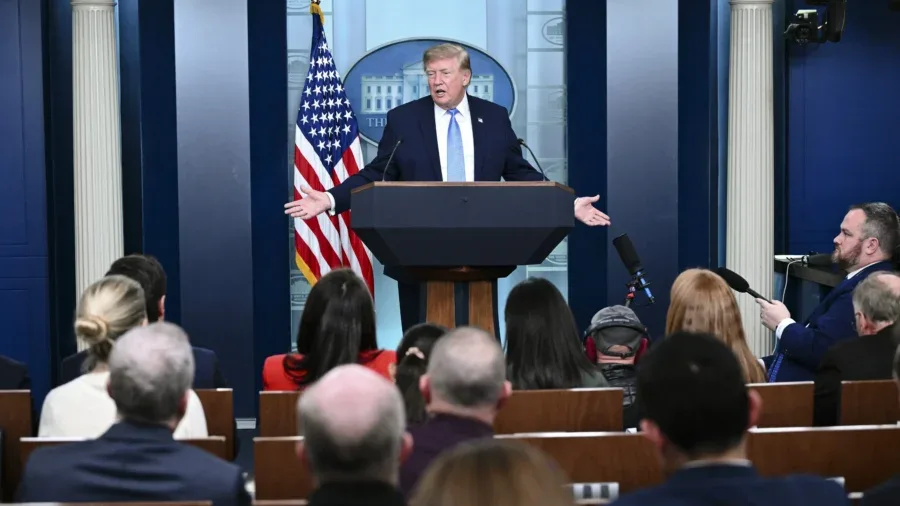
US President Donald Trump told reporters on Monday that he believes the war in Iran militarily is effectively over, signaling a potential pivot away from the intensive bombardment that has rattled global energy markets for months. The president made a surprise visit to the White House briefing room after holding closed-door discussions with Qatar’s Prime Minister and Foreign Minister Sheikh Mohammed bin Abdulrahman bin Jassim Al Thani and US Vice President JD Vance.
Writing on his Truth Social platform and speaking directly to the press, Trump asserted that the Iranian military has been decapitated and that the regime is effectively neutralized. Iran militarily is effectively over,
Trump said, adding, We’re just keeping it the status quo, and we’re doing that really at the behest of countries that are their neighbours.
That diplomatic opening follows high-level talks in Washington and confidential regional proposals aimed at defusing the long-running confrontation. Qatari officials presented proposals on Iran's nuclear program last week, according to two Middle East government officials familiar with the matter who spoke on condition of anonymity. Qatari Prime Minister Sheikh Mohammed hailed the progress on social media, writing, We discussed the situation in the region and ways to progress the US-Iran talks. Grateful for the positive discussions on reaching a deal and bringing peace to the region.
The White House declined to comment on the specifics of the proposal, though Trump alluded to ongoing indirect talks with Tehran. Despite the rhetoric of de-escalation, Trump gave no indication of a drawdown for the thousands of US troops stationed in the waters off Iran. He emphasized that the administration intends to maintain what he termed the greatest naval blockade in the history of the country, alongside the newly announced Task Force Iron Gate aimed at cutting off trade by land and through the Caspian Sea. We’re keeping it going. We have the greatest military blockade ever,
Trump said. He added that taking military action does not seem very necessary at the moment, but cautioned, We’re locked and loaded, ready to go for any reason that changes.
Beijing Confirms Contacts and Regional Pressures Shape the Lull
China confirmed on Monday that it is in communication with relevant parties about a possible meeting between the leaders of China, the United States, and Russia. Foreign Ministry spokesperson Guo Jiakun addressed the proposed gathering at a regular press briefing following remarks by Trump that the three leaders could meet next week to discuss ending the war. Asked about the proposed meeting in Shenzhen and its agenda, Guo stated, As for your specific question, I have no information to offer at the moment.
Guo also addressed a Washington Post report that the Trump administration had sought Beijing's help to end the conflict, calling for a diplomatic resolution without confirming the requested assistance. To prolong the conflict between the U.S. and Iran does not serve the common interest of the parties concerned and the international community,
Guo said, urging dialogue and negotiations to restore peace in the Middle East and Persian Gulf region.
The diplomatic push is driven in large part by Gulf Arab states urging Washington to maintain economic pressure. Trump noted that regional neighbors including Qatar, Saudi Arabia, the United Arab Emirates, Bahrain, and Kuwait prefer the status quo to protect their security. Israel and the entire Middle East are protected from Iranian danger and threats, and we’re seeing momentum toward the end of this conflict. I think it’s going to be ending fairly soon,
Trump said.
That cautious outlook is echoed inside the administration. US Secretary of State Marco Rubio told reporters on Sunday at Homestead Air Reserve Base in Homestead, Florida, before departing for a G7 Foreign Ministers' meeting in France, that a breakthrough is not imminent. I think you see some of these things that are out there; you have a number of countries that continue to engage them with different ideas. But I wouldn't say we're on the verge of a breakthrough,
Rubio said. He added, The President would always prefer to solve this and every problem diplomatically. Sometimes that's not possible, unfortunately. But if there's a chance to do it, we'll explore it.
Tehran Dismisses Remarks as Iran's Leadership Weighs Next Moves
Iranian officials rejected Trump’s declarations as a distraction. Iran’s Supreme National Security Council Secretary Mohsen Rezaei wrote on social media, The war on Iran has already wrecked the US government. But Washington flails like a desperate gambler. FOLD YOUR HAND. STOP manufacturing FAKE NEWS about imaginary talks.
Rezaei previously demanded that Washington meet seven conditions, including ending the US naval blockade, lifting all sanctions, unfreezing assets, issuing financial compensation for war damage, and halting hostilities throughout the region, including Israeli military operations in Lebanon.
Separately, Iranian President Masoud Pezeshkian stated that Supreme Leader Mojtaba Khamenei had called for an end to the situation, which Pezeshkian described as neither war nor peace. According to Iranian media, Pezeshkian added that Iran was open to further negotiations but would not be coerced, asserting, We will not surrender to force and bullying.
Since the conflict began on February 28, the war has spilled into surrounding countries and roiled international trade. Iran moved to shut down the Strait of Hormuz and responded to US and Israeli strikes with missile and drone fire on Gulf neighbors, targeting US military installations. Other conflicts emerged concurrently, including Saudi Arabia's renewed fight against the Iran-backed Houthis and Israel's occupation of southern Lebanon alongside deadly airstrikes. In recent days, the Trump administration announced minor strikes against Iran’s Qeshm Island and offered a $20 million reward for information about Iran’s nuclear program, facilities, equipment, and associated personnel. Following the Twelve-Day War in June 2025, Trump had claimed Iran’s uranium enrichment program was obliterated, but curtailing the nuclear program remains a central premise for the ongoing war.
Domestic Political Fallout and Military Readiness in Washington
The domestic political cost of the conflict has weighed heavily on the White House. Vice President JD Vance publicly cited the war on Iran as the primary driver behind Republicans losing both chambers of Congress to Democrats in last week's elections, which were overshadowed by voter dissatisfaction over surging fuel prices and global economic turbulence.
Internal dissent over the execution of the conflict has also reached a boiling point. Defense Secretary Pete Hegseth told reporters earlier on Monday that next steps are up to the president, suggesting Trump could tell Tehran, Hey, we're done, and we're going to watch your nuclear material. You better not move it.
Critics argue the administration launched the war without proper congressional authorization, violating the War Powers Resolution and subverting congressional war-declaring powers. Republican Rep. Thomas Massie of Kentucky moved on Monday to force a vote to impeach Hegseth over his handling of the military campaign.
Trump maintains that preventing Tehran from acquiring a nuclear weapon remains strictly non-negotiable, telling CNN in a phone interview on Sunday that as long as the US sees progress in negotiations and a strong agreement is signed, resuming strikes is highly unlikely. Yet the administration's military posture underscores that the threat of force has not been discarded. Trump revealed that the Pentagon has identified 38 specific infrastructure targets, including bridges, designated for immediate strikes if military operations resume. The US military demonstrated its readiness by carrying out strikes against Iranian air defenses at least twice over the past week and firing on and disabling a commercial ship on Saturday that officials accused of attempting to breach the naval blockade.
Timeline of Recent Developments
- June 2025: Following the Twelve-Day War, Trump claims Iran's uranium enrichment program was obliterated.
- February 28, 2026: The war on Iran begins, leading to the closure of the Strait of Hormuz and regional missile exchanges.
- August 19, 2026: Iranian parliament speaker Mohammad Bagher Ghalibaf meets with Iraqi Prime Minister Ali al Zaidi in Baghdad.
- November 4, 2026: Vice President JD Vance releases a statement on X citing the Iran war as the reason Republicans lost the midterm elections.
- November 9, 2026: President Donald Trump holds talks with Qatari Prime Minister Sheikh Mohammed bin Abdulrahman Al Thani in Washington and tells reporters in the White House briefing room that the military conflict is effectively over.
- November 10, 2026: Reports circulate detailing a Qatari-Pakistani proposal addressing uranium enrichment and frozen assets, China confirms communication regarding a potential Trump-Xi-Putin meeting, and Rep. Thomas Massie moves to impeach Defense Secretary Pete Hegseth.
As international mediators attempt to bridge the gap over uranium enrichment and frozen funds, the durability of this apparent lull depends entirely on whether indirect communications translate into a formal, verifiable accord before domestic political pressures force further maneuvers on November 10, 2026.
Updated 2 times since publication; last update 10 November 2026, 04:43.