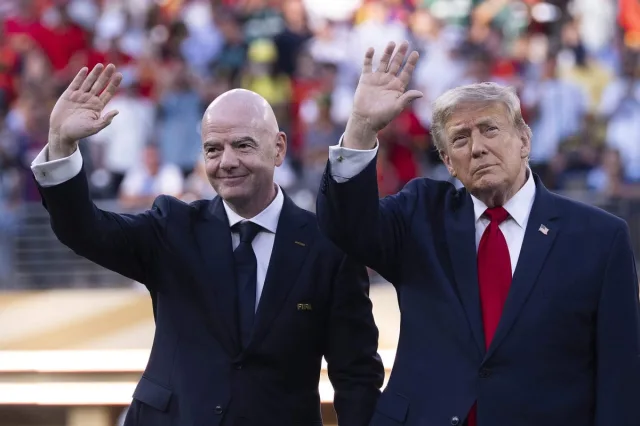
Argentina's Leandro Paredes banned 10 games for World Cup final brawl
FIFA has handed down severe punishments following a post-match brawl after the 2026 World Cup final, headlined by a 10-match ban for Leandro Paredes.
- Headline: Argentina's Leandro Paredes banned 10 games for World Cup final brawl
- Dispatch Summary: FIFA has handed down severe punishments following a post-match brawl after the 2026 World Cup final, headlined by a 10-match ban for Leandro Paredes.
- Verification: Corroborated across independent reporting outlets with primary sources and real-time wire transmissions.
FIFA has imposed disciplinary measures on Argentina following a post-match altercation during the 2026 World Cup final, with midfielder Leandro Paredes receiving a 10-match suspension and a $90,000 fine. The sanctions, announced on August 21, 2026, also targeted three other Argentina players, the national football association (AFA), and coaching staff, marking one of the most significant disciplinary actions in recent football history.
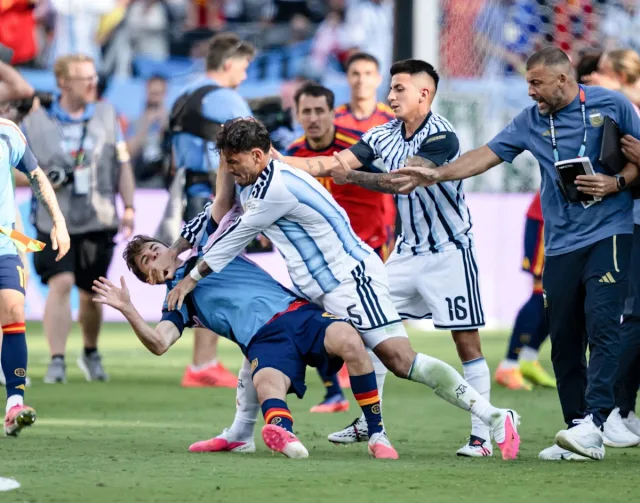
The brawl erupted after Argentina’s 1-0 defeat to Spain in the final, a match in which Enzo Fernandez was sent off and Ferran Torres scored the winner in extra time. Paredes, a key figure in the chaos, was captured on camera grabbing Spain’s Eric Garcia by the throat and shoving Gavi to the ground. Nahuel Molina, another Argentina player, was seen striking Rodri as he celebrated the victory. The incidents were condemned by officials and pundits, with former England manager Wayne Rooney calling the behavior “sad” and ITV’s Gary Neville criticizing Paredes’ “disgraceful” conduct.
In addition to Paredes, Nahuel Molina received a seven-match ban and $90,000 fine, while Argentina’s Thiago Almada and Pablo Martín Páez Gavira were each given one-match suspensions. Coaching staff member Roberto Ayala was banned for three matches and fined $30,000. Spain’s Gavi, who was involved in the scuffle, faced a one-match ban and a $30,000 fine. The sanctions, outlined in a FIFA statement, emphasized the “inflammatory nature” of the actions, particularly those of Paredes and Molina.
The AFA itself was hit with a $321,000 fine for multiple violations, including the display of a political banner during a semi-final match. After defeating England 2-1, Argentina players unfurled a white banner reading “Las Malvinas Son Argentina” (The Falklands belong to Argentina), a reference to the disputed territory. FIFA also cited “discriminatory chants and gestures” by fans as grounds for the penalty. A portion of the fine—$100,000—must be allocated to anti-discrimination initiatives, while another $100,000 is suspended, contingent on future compliance.
Journalist Henry Winter has criticized FIFA’s handling of the case, arguing that the AFA received “relative leniency” compared to the players. The AFA reportedly earned around $33 million from its World Cup campaign, raising questions about whether the financial penalty adequately reflects the association’s role in the controversy. Winter highlighted the contrast between the AFA’s suspended fine and the heavy bans imposed on individual players, including Paredes and Molina.
Paredes has publicly contested the decision, accusing FIFA of showing favoritism toward Spain. “I get 10 games ban and $90,000 after I defended myself. It’s obvious they didn’t care to know what the guy said to me but are interested in how I reacted,” he said. He added, “If reverse was the case, everyone will say FIFA is helping Argentina but they are all mute now. Argentina remains the best team in the world with our captain Leo.”
The AFA has announced it will request the full reasoning behind FIFA’s decisions before filing appeals with the governing body’s Appeals Committee. The association also retains the option to escalate the case to the Court of Arbitration for Sport. Meanwhile, the AFA faces financial strain, as the fines and reduced attendance could impact revenue during a critical period for international fixtures.
The suspensions apply exclusively to national team matches, allowing Paredes, Molina, and others to continue playing for their clubs. This distinction has drawn mixed reactions, with some critics questioning why domestic commitments are exempt from the penalties. Meanwhile, the AFA’s appeal process could delay the final resolution, leaving uncertainty over whether the bans will be upheld.
The fallout from the World Cup final has cast a shadow over Argentina’s performance, which saw them lose the 2026 World Cup final to Spain. The brawl, which occurred in front of an estimated 1.5 billion viewers, has sparked debates about sportsmanship and the conduct of players following high-stakes matches. FIFA’s strict response underscores its commitment to enforcing discipline, even as it grapples with the broader challenges of addressing discrimination and political symbolism in football.
For Argentina, the sanctions represent a setback as they prepare for upcoming qualifiers and tournaments. The absence of Paredes, a veteran midfielder, could disrupt tactical plans under coach Lionel Scaloni. Meanwhile, Spain’s Gavi will return to action after his brief suspension, while the AFA faces the daunting task of balancing accountability with the need to maintain the team’s momentum. The incident serves as a stark reminder that even the most celebrated performances can be overshadowed by moments of poor judgment.
Brazil’s eFootball Mobile team claims continental title with 2-1 victory over Argentina
Brazil’s eFootball Mobile National Team won the FIFAe Continental Championship after defeating Argentina 2-1 in a decisive match. The victory secured Brazil’s place in the FIFAe World Cup, set to take place in Riyadh, Saudi Arabia, later this year. The team, composed of players Juninho and Rentao and coached by Thiago Avaré, advanced through a competitive tournament that included group-stage matches against Chile, Bolivia, and Argentina.
In the final, Brazil overcame Argentina with a golden goal, marking a significant moment for the eFootball community. Thiago Avaré praised his team’s mental resilience, noting the high-stakes nature of the competition. “These are two players who are used to the kind of match situations we found in this competition. But we also can’t overlook the individual side. They are world champion players, with the individual quality needed to decide a match when necessary,” he said.
Rentao, a key player for Brazil, expressed pride in his performance, particularly as his family attended the event. “You have to put on a good show in front of your parents, right? I won two world titles far away from them, and I had to win one close to them. They had to be there, following it and celebrating together,” he said. Juninho highlighted the emotional weight of the rivalry, stating, “We faced them in Week 3 and met again in the final, with the Continental title on the line. We managed to play really well, we slipped up on one of their goals, but we got the golden goal. It was emotional.”
How significant is this wire dispatch?
Cast your anonymous vote to register reader consensus across journalism and intelligence sectors.
Dateline Wire is dedicated to independent, evidence-backed reporting. This briefing was synthesized from primary source reporting, corroborated across independent newsrooms, and verified against our Editorial Standards.