Trump greets Xi Jinping at airport to start three-day US state visit
President Donald Trump greeted Chinese President Xi Jinping on the tarmac at Joint Base Andrews to begin a three-day state visit.
- Headline: Trump greets Xi Jinping at airport to start three-day US state visit
- Dispatch Summary: President Donald Trump greeted Chinese President Xi Jinping on the tarmac at Joint Base Andrews to begin a three-day state visit.
- Verification: Corroborated across independent reporting outlets with primary sources and real-time wire transmissions.
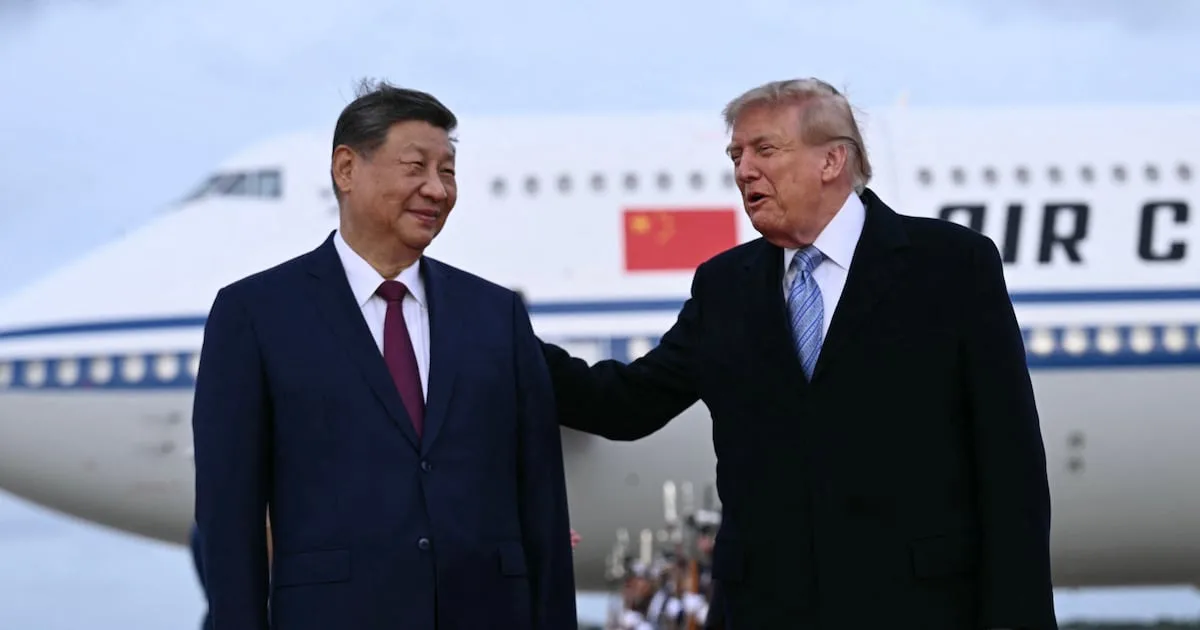
Trump greets Xi at airport in rare ceremonial gesture
U.S. President Donald Trump made history on Wednesday by personally greeting Chinese President Xi Jinping on the tarmac at Joint Base Andrews, a rare and highly symbolic gesture that underscored the significance of the three-day state visit. The event, held just outside Washington, D.C., featured a 100-foot-long red carpet, a 21-person honor guard, and a military flyover by two B-1 bombers, marking the first time since 1962 that a U.S. president has welcomed a foreign leader at an airport rather than the White House.
Xi’s arrival at 5:39 p.m. local time (3:09 a.m. IST) was met with a formal welcome that included a presentation of the national flags and anthems of both countries. Trump and First Lady Melania Trump exchanged handshakes with Xi and his wife, Peng Liyuan, before the two leaders walked down the red carpet flanked by U.S. service members. Two American children presented bouquets of yellow flowers to the Chinese delegation, while a U.S. Air Force band played as the ceremony unfolded.
| Detail | Information |
|---|---|
| Red carpet length | 100 feet (30 meters) |
| Honor guard size | 21 personnel |
| Military flyover | Two B-1 bombers |
| Arrival time | 5:39 p.m. local time, Wednesday |
| State dinner guests | Executives from OpenAI, Apple, xAI, Microsoft, Nvidia, Meta |
Ceremonial pageantry amid geopolitical tensions
The arrival ceremony was part of a broader effort to mirror the grandeur Xi experienced during his May 2026 visit to the U.S., when Trump hosted him with a red carpet and military honors. This visit, however, comes at a time of heightened tensions between the two nations, particularly over trade, artificial intelligence (AI) development, and China’s military ambitions. Despite the ceremonial warmth, U.S. officials and lawmakers have expressed skepticism about the diplomatic value of the encounter.
Republican Senator Roger Wicker, chairman of the Senate Armed Services Committee, criticized the “lavish welcome” as inappropriate given China’s “brutal, unelected and oppressive” governance. He urged Trump to address issues such as China’s military buildup and support for Iran during the visit. Meanwhile, U.S. Secretary of State Marco Rubio emphasized the necessity of high-level engagement, stating that the U.S. and China “must interact at the highest levels” due to their economic and military clout.
The visit also highlights the growing rivalry in AI development. Trump has repeatedly asserted that the U.S. is leading the global race, dismissing concerns about the technology’s risks. “WHOEVER WINS AI, WINS!” he wrote on Truth Social, framing the competition as critical to U.S. global dominance. However, tech executives like Elon Musk and Sam Altman have called for regulatory caution, a stance Trump has largely ignored.
State dinner and closed-door talks
Following the airport welcome, Xi will participate in a formal arrival ceremony at the White House on Thursday, including a 21-gun salute and a review of troops. The state dinner that evening will feature a roster of tech industry leaders, including Nvidia CEO Jensen Huang and SpaceX’s Elon Musk, whose combined net worth exceeds $2.2 trillion. The event is expected to focus on AI, trade, and security issues, though expectations for substantive progress remain low.
Private discussions between Trump and Xi will address contentious topics such as U.S. arms sales to Taiwan, the Russia-Ukraine war, and the U.S.-China trade truce. The two leaders will also tour the National Archives on Friday, where they will view historical documents underscoring the bilateral relationship. However, analysts note that the visit is more symbolic than substantive, aimed at maintaining “strategic stability” rather than resolving deep-seated disputes.
The visit concludes with Xi and Peng Liyuan returning to the White House for a private tea with the Trumps before departing Washington. As the U.S. and China navigate their complex relationship, the event underscores the delicate balance between cooperation and competition in global geopolitics. The next major milestone will be the state dinner on Thursday, where the two leaders will face the challenge of addressing their nations’ divergent priorities amid a rapidly evolving international landscape.
How significant is this wire dispatch?
Cast your anonymous vote to register reader consensus across journalism and intelligence sectors.
Dateline Wire is dedicated to independent, evidence-backed reporting. This briefing was synthesized from primary source reporting, corroborated across independent newsrooms, and verified against our Editorial Standards.