Spain Holds Snap Parliamentary Elections Amid Right-Wing Coalition Prospects
Over 38.6 million Spanish voters head to the polls in a high-stakes snap election that could replace Prime Minister Pedro Sánchez's minority government with a right-wing coalition.
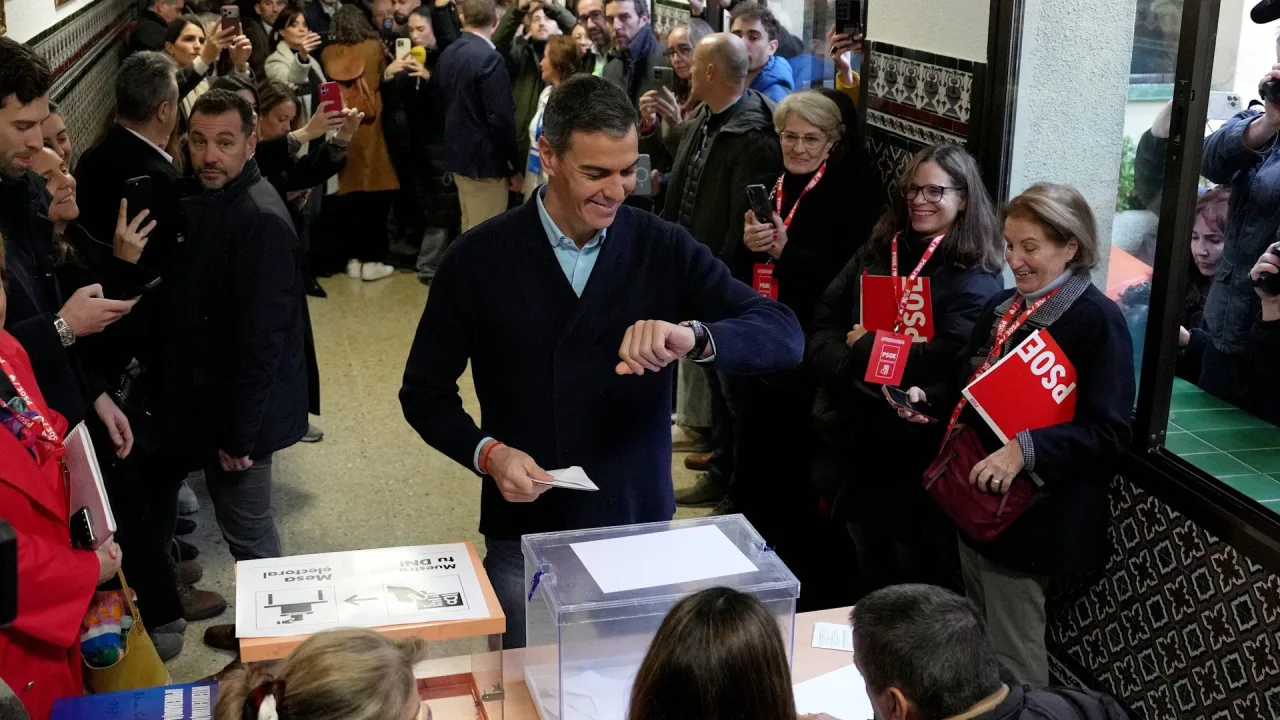
Voters across Spain are going to the polls on Sunday, Nov. 29, in an early parliamentary election that could replace Prime Minister Pedro Sánchez’s Socialist-led minority government with a right-wing coalition, Reuters reported. More than 38.6 million people are eligible to vote, including around 2.6 million Spanish citizens living abroad, across approximately 22,500 polling stations operating from 9:00 a.m. to 8:00 p.m. local time. Prime Minister Pedro Sanchez has cast his vote at a polling station in Madrid, as the nation decides whether his administration survives or gives way to a conservative and far-right alliance.
The snap election was called after parliament on October 2 rejected Sánchez’s decrees to address growing anger over rising rents and evictions. He had pitched the measures after a wave of protests over the eviction and subsequent death of 87-year-old Maricarmen Abascal, after the monthly rent on her longtime home in Madrid was raised to €1,650 ($1,806) from €570 ($624). Following the legislative defeat and subsequent protest momentum, Sánchez announced on October 5 his decision to call snap parliamentary elections, pushing the contest forward from a regularly scheduled date in 2027. The Spanish Ministry of the Interior has deployed more than 100,000 law enforcement officers to maintain security during the election.
Why Did Spain Call an Early Election Now?
The call was widely seen as an attempt to harness the momentum of housing protests and repair political damage from a migration crisis in Spain’s North African enclave of Ceuta, a deadly train crash in January and corruption probes involving Sanchez’s inner circle. Another train crash occurred on Oct. 28 and, so far, Sanchez’s plan to mobilise the left appears to be falling short. Scarce, unaffordable housing has been arguably the hottest subject of pre-election debates, with Sanchez in favour of rent caps and short-lease bans and his main opponent touting deregulation. Yet, the strategy collided with overlapping political vulnerabilities. These included a migration crisis in Spain’s North African enclave of Ceuta, corruption probes involving Sanchez’s inner circle and family — though Sanchez has repeatedly denied any wrongdoing — and deadly train crashes in January and on Oct. 28.
The rejection of the housing decrees in parliament proved to be the breaking point for the minority government. Rather than attempting to limp through further legislative stalemates, Sánchez chose to dissolve parliament. However, pollsters indicate that his plan to mobilise the left appears to be falling short. Fragmentation on the left has further complicated his standing, as a swathe of parties to PSOE’s left have failed to agree on a common candidate list, reducing the chances of a leftist coalition staying in power. Spain’s electoral system disadvantages smaller parties running separately. Some parties, such as Podemos, former junior coalition partners to the PSOE, risk losing their parliamentary representation, polls show. The Broad Front, a platform comprising several parties in the minority government, is expected to garner more than 5% of the vote. Meanwhile, the country’s historically distinct regions feature four separatist parties, most of them left-leaning: EH Bildu in the Basque Country, BNG in Galicia, and in Catalonia – ERC and right-leaning Junts, adding further complexity to the legislative arithmetic.
Will Alberto Núñez Feijóo and Santiago Abascal Form a Majority?
Practically all opinion polls point to a potential coalition between the conservative People’s Party and far-right Vox, as the only combination likely to win an absolute majority in the 350-seat lower house of parliament. The PP is seen as the largest party at around 31%, while Vox stands at roughly 18%, propelled by younger and male voters, pollsters predict. Alberto Núñez Feijóo, 65, former president of the region of Galicia, has led the PP since April 2022. In Galicia, Feijoo built a reputation as a moderate and pragmatic administrator, an image he has pitched nationwide. Santiago Abascal’s Vox stands at roughly 18%, propelled by younger and male voters who favor tougher immigration controls, the recentralization of state powers, lower taxes and the reversal of many progressive social policies.
A potential PP-Vox coalition could give a cabinet role to a far-right party for the first time since the death of Francisco Franco in 1975. By contrast, Sanchez’s Socialist Party (PSOE) is mostly expected to come a close second. Despite a recent modest rise to almost 30%, Sanchez is running again for the PSOE, having led the party since 2017. After eight years in office, he is already the second-longest-serving premier since Spain’s return to democracy in 1978, having repeatedly proven his ability to surprise those who had written him off. He has presided over years of Spain’s economic outperformance in Europe and kept Spain in the international spotlight by opposing US President Donald Trump’s pressure for more military spending and denying him the use of Spanish airspace in the war on Iran, Sánchez faces a formidable right-wing bloc.
This snap election will decide whether his socialist led government survives, or like some surveys suggest, may be replaced by a far right coalition.
Al Jazeera
The electoral stakes are defined by two sharply contrasting visions for Spain's future. Immigration has been another defining issue, both for Sanchez, as one of Europe’s loudest advocates of immigration’s benefits for the economy, and for Vox, which wants far tighter controls. As voters decide the composition of both chambers, with 350 members to be elected to the lower house, the Congress of Deputies, and 208 of 266 Senate seats (plus remaining senators designated by regional parliaments), the outcome will determine whether Spain remains one of Europe's last leftist-led governments or pivots sharply to the right.
What Is the Timeline for Forming the Next Government?
The mechanics of government formation begin immediately as polling stations close and election results are tabulated across both parliamentary chambers. The vote determines the allocation of all 350 seats in the lower house on closed party lists, as well as 208 of 266 Senate seats. Only the lower house chooses the prime minister. The remaining senators are designated by regional parliaments.
- October 2: Parliament rejects Prime Minister Pedro Sánchez’s housing decrees amid rent protests.
- October 5: Sánchez announces his decision to call snap parliamentary elections.
- October 28: A deadly train crash occurs in Spain, adding to earlier infrastructure tragedies from January.
- November 29: Voters cast ballots across approximately 22,500 polling stations in the general election.
- December 23: The new lower house will meet and elect a speaker.
Following the new lower house meeting on December 23 to elect a speaker, King Felipe will then nominate a candidate for the premiership, usually the leader of the party with the most votes. The nominee needs an absolute majority of at least 176 seats in the investiture vote, or a simple majority in a second round. Coalition talks have no deadline, but a new government must be formed within two months of that vote to avoid another election.