China launches Shenzhou-24 carrying first Pakistani astronaut
China successfully launched the Shenzhou-24 spacecraft on Wednesday carrying Muhammad Zeeshan Ali, the first foreign national to visit the Tiangong space station.
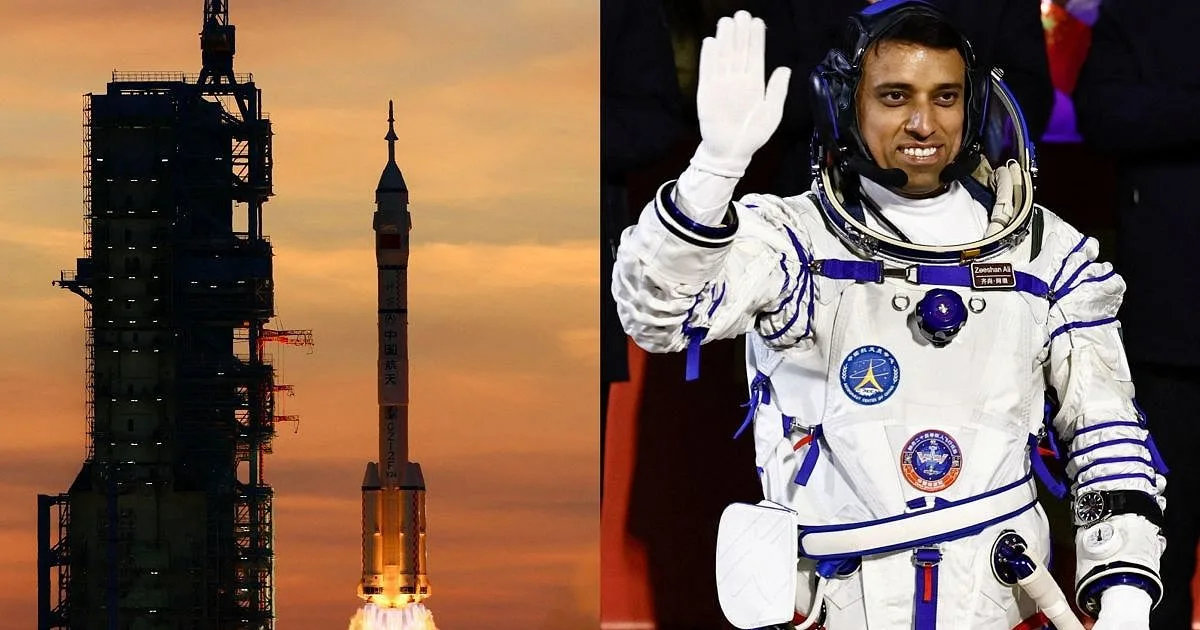
Ordinary citizens in Pakistan watched live on television across homes and restaurants on Wednesday as their nation crossed a historic threshold in orbit. China successfully launched the Shenzhou-24 spacecraft from the Jiuquan Satellite Launch Centre in northwest China, carrying a three-press crew that includes Muhammad Zeeshan Ali, the first foreign national to visit the Tiangong space station. Blasting off atop a Long March-2F carrier rocket on Wednesday morning, the spacecraft separated from its launcher and entered its predetermined orbit.
The mission marks a major milestone for China's crewed space programme, which built its own space station after it was reportedly excluded from the International Space Station over concerns about the involvement of its military, the People's Liberation Army, in its space programme. For the 40-year-old Ali, a former Pakistan Air Force pilot serving as a payload specialist, the flight represents the realization of an agreement the two countries signed in February 2025. Ali flew alongside mission commander Tang Hongbo, 51, and flight engineer Wu Yi, 39, in what stands as the first joint flight of Chinese and foreign astronauts in the history of China's crewed space programme.
Training across cultures and conducting orbit research
Preparing for the flight required overcoming distinct hurdles. At a press conference on Tuesday, mission commander Tang Hongbo noted that differences in language, culture, and psychology made learning to work together more challenging, though he emphasized that efforts were ultimately paying off. Ali demonstrated that linguistic bridge-building during pre-launch events by speaking Mandarin, citing a line of Chinese poetry about climbing higher to see farther, and offering a personal assessment reported by the Times of India: It's like my daily training. Day after day, reaching new heights.
Switching to English, Ali said he hoped cooperation would grow from one astronaut on one flight to multiple joint missions and eventually to the Moon, Mars and beyond. He also added another quote: To every child who's watching while I'm in orbit: Look up at the sky and remember that I am up there with your dreams.
While Ali and Wu are embarking on their first spaceflight, Tang is set to become the first astronaut to board Tiangong three times, according to state broadcaster CCTV.
- February 2025: China and Pakistan sign the bilateral space cooperation agreement underpinning the joint mission.
- May 2025: China launches Shenzhou 23, which carried three astronauts, including one crew member who was set to remain in space for about a year.
- Tuesday, November 24, 2026: The flight crew holds a press conference in China, and Prime Minister Shehbaz Sharif posts pre-launch remarks on X.
- Wednesday, November 25, 2026: The Shenzhou-24 spacecraft blasts off from Jiuquan at dawn.
Once aboard the station, the combined crew will carry out more than 90 scientific experiments and technology tests. These investigations cover space life sciences, materials science, microgravity fluid physics, combustion science, fundamental physics, space medicine and new space technologies. Ali himself is scheduled to run an experiment on photosynthetic cyanobacteria. Unlike the Chinese crew members, who typically stay at the station for about six months, Ali's journey is a short-term mission; he will spend about a week in orbit before returning to Earth aboard the Shenzhou-23 spacecraft.
National pride in Islamabad and rising geopolitical stakes
The launch triggered immediate celebrations across Pakistan, where crowds and officials gathered at the national space agency's headquarters to watch the ascent live. Prime Minister Shehbaz Sharif praised the event on X, writing: This is not just one astronaut's journey, but the journey of 240 million Pakistanis.
In an earlier post on Tuesday, he added that Pakistan-China friendship is surpassing the heights of the Himalayas in its journey to outer space.
Planning Minister Ahsan Iqbal echoed those sentiments while speaking to reporters at the agency, stating that the sky is no longer our limit; it is our launching pad.
Iqbal also thanked President Xi Jinping, China's leadership and its scientists and engineers, and when asked whether Pakistan could eventually send astronauts on its own, he replied Certainly that day will come.
This expansion of crewed spaceflight occurs against a backdrop of intensifying competition beyond Earth. China is preparing to land astronauts on the Moon by 2030. Meanwhile, the United States is widely seen as its main rival, with NASA aiming to put astronauts on the lunar surface in 2028. For Beijing, incorporating a foreign national into its active station operations demonstrates diplomatic reach and technical maturity, cementing alliances that bypass traditional Western-led consortia. Observers watching the program should monitor the timeline for Ali's return aboard the Shenzhou-23 capsule next week, alongside future announcements from Beijing and Islamabad regarding whether subsequent joint missions will follow the framework established by the February 2025 accord.