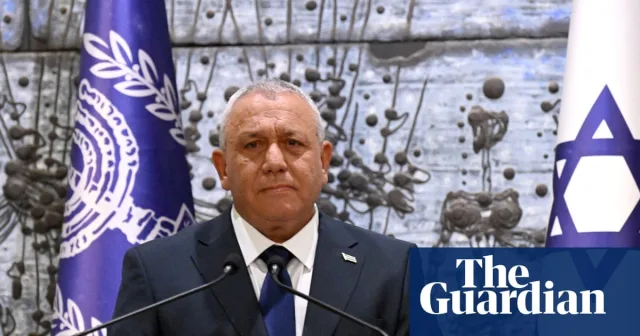
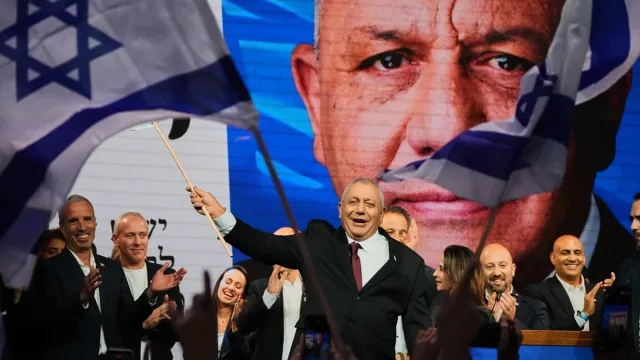
Joint List backs Israel opposition leader Eisenkot to form new government
The Joint List has backed opposition leader Gadi Eisenkot to form a government, securing him 67 recommendations in the 120-seat Knesset. Despite this support, significant ideological divisions and the fragility of a potential minority government pose major obstacles.

Joint List backs Israel opposition leader Eisenkot to form new government
The path to replacing Prime Minister Benjamin Netanyahu has reached a critical juncture, as the Arab-led Joint List announced on Thursday that it would recommend that Gadi Eisenkot be tasked with forming the government,
granting Eisenkot the backing of 67 lawmakers in the 120-seat Knesset.
For the average voter watching a paralyzed political system, the endorsement represents a significant shift: Arab political factions are moving from the sidelines to active participants in the struggle for the premiership. However, while the arithmetic now favors Eisenkot, the path to a functioning government remains obstructed by deep-seated ideological divides and the refusal of key opposition figures to formalize a partnership with Arab parties.
Will 67 recommendations translate into a stable cabinet?
The Joint List’s decision follows Wednesday's endorsement by Ra’am, another Arab-led party holding eight seats. Together, the two parties hold a record 19 seats. According to a report by Yedioth Ahronoth and its website, Ynet, Eisenkot has allowed discussions to explore a plan to establish a minority government. Under this plan, an Eisenkot-led administration could be sworn in with 49 votes — the 48 members of the opposition bloc plus one from Ra’am — provided that 25 other members, including those from the Joint List, Ra’am and the ultra-Orthodox United Torah Judaism party, abstain from the confidence vote.
This strategy relies on a specific parliamentary procedure where a candidate needs only more votes in favor than against to secure office. Yet, even if this maneuver succeeds, the resulting government would be inherently fragile. Every major policy decision, from budget approvals to security operations, would require fresh, precarious negotiations. The Joint List has made it clear that they are prepared to support an opposition government from outside the governing coalition, rather than take ministerial positions, as they have opposed joining a government while Israel continues its occupation of Palestinian territory.
The reality is that Eisenkot has successfully gamed the presidential consultation process, but he has not yet demonstrated he can govern. An opposition leader with a theoretical majority is not the same as a prime minister with a stable legislative program.
What are the demands of the 19 Arab-led seats?
The Joint List’s leadership has been transparent about its motivations. As Ahmad Tibi, a senior member of the bloc, told the Associated Press, the goal is to dismantle what he called a criminal government
and address the local needs of citizens, such as curbing violent crime. The decision to support Eisenkot, who has previously rejected the idea of a Palestinian state, is a pragmatic, if uncomfortable, choice. The Joint List has faced internal pressure to remain in opposition, yet they argue that remaining passive would only serve to keep Netanyahu in power.
For their part, Jewish-led opposition parties, including those led by Naftali Bennett and Avigdor Lieberman, remain deeply wary. Lieberman, in particular, has stated he would not join a government that relies on the support of Arab parties, even if he supports handing the initial mandate to Eisenkot. This leaves Eisenkot with a paradox: he has the majority needed to be asked to form a government, but he may lack the consensus required to actually seat one.
The tension here is structural. Arab parties are seeking to exert influence without the political liability of being part of a government, while Eisenkot’s Zionist allies are fearful that even tacit reliance on Arab support will alienate their own electoral base. It is a fragile compromise that threatens to collapse before the first cabinet meeting.
Why is United Torah Judaism walking away?
The political maneuvering has extended to Netanyahu’s former allies as well. United Torah Judaism (UJT), which holds seven seats, decided on November 5 not to recommend either candidate to the President. This move effectively strips Netanyahu of his core support base and pushes his recommendations down to 46 seats. The UJT’s primary grievance is the desire to secure guarantees regarding exemptions from military service for students at religious schools.
Eisenkot faces a direct conflict on this front as well. A central pillar of his own supporters, including figures like Lieberman, demands the expansion of military conscription. Any deal to bring the UJT into the fold would require Eisenkot to abandon one of his own movement's most vocal campaign promises. The Jerusalem Post noted that by refusing to commit, the ultra-Orthodox parties have maximized their leverage, forcing both major blocs to bid for their favor while the legislative deadlock continues.
The ultra-Orthodox are playing a game of high-stakes indifference, and it is a strategy that leaves Netanyahu more isolated than at any point in the post-election aftermath.
Can the legitimacy of the process be protected?
Amid the negotiations, Netanyahu has launched a campaign alleging that Arab parties engaged in election fraud with foreign backing. He and his Likud party have repeatedly warned that any cooperation with Arab factions constitutes a move dangerous to Israel.
However, these accusations remain unsubstantiated. The chairman of the Central Elections Committee, Supreme Court Justice Noam Sohlberg, has made clear that the integrity of the electoral process has not been compromised. President Herzog has also publicly condemned the rhetoric, defending the legitimacy of the participation of Arab parties in the parliamentary process.
It is clear that Netanyahu is attempting to move the debate from the halls of the Knesset to the arena of national identity. By casting the opposition’s reliance on Arab parties as a threat to Israel’s character, he is attempting to make the cost of such a government prohibitively high for his rivals.
As President Herzog prepares to finalize his consultations by the November 11 deadline, voters should track the following developments:
- The President’s choice for the initial mandate to form a government, expected by November 11.
- Public statements from Naftali Bennett and Avigdor Lieberman regarding their willingness to enter a government that relies on Arab support.
- Any formal coalition agreements or written "outside support" documents between the Joint List, Ra’am, and Eisenkot’s party.
- The status of discussions between Eisenkot and the ultra-Orthodox United Torah Judaism party regarding the military exemption issue.
The mandate to lead is now within reach for Eisenkot, but a sustainable path forward remains nowhere in sight.