Judge orders Trump to restore White House access for three news outlets
U.S. District Judge Tim Kelly has issued a temporary restraining order blocking the Trump administration's ban on three news outlets, citing First Amendment protections.
- Headline: Judge orders Trump to restore White House access for three news outlets
- Dispatch Summary: U.S. District Judge Tim Kelly has issued a temporary restraining order blocking the Trump administration's ban on three news outlets, citing First Amendment protections.
- Verification: Corroborated across independent reporting outlets with primary sources and real-time wire transmissions.
Judge orders Trump to restore White House access for three media outlets
A federal judge has ordered President Donald Trump to immediately restore White House access for journalists from CNN, MS Now, and Politico, ruling that the president’s ban on the outlets was likely unconstitutional. The decision, issued by U.S. District Judge Tim Kelly on September 24, 2026, is a notable legal setback for the administration and underscores tensions over press freedom and executive authority.
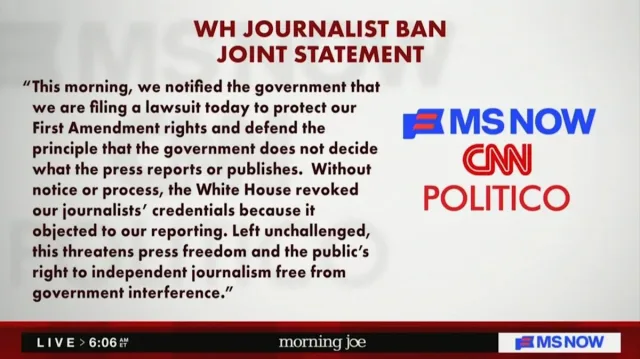
The ban, announced by Trump on September 18, revoked the outlets’ “hard passes” — credentials granting unrestricted access to the White House — following allegations of “fake news” and “negative” reporting. The outlets sued the administration, alleging violations of the First Amendment and due process rights. Judge Kelly’s order temporarily halts the ban for 14 days, requiring the Trump administration to return the revoked press passes and prohibiting enforcement of the restriction during the litigation.
| Detail | Information |
|---|---|
| Outlets affected | CNN, MS Now, Politico |
| Judge’s ruling | Temporary restraining order to restore press passes; ban blocked for 14 days |
| Legal basis | First Amendment protections, due process rights, and constitutional scrutiny of viewpoint-based restrictions |
| Administration’s argument | Access is a privilege, not a right; national security justifications for the ban |
| Judge’s skepticism | Found no factual support for national security claims; noted Trump’s public criticism of the outlets’ reporting |
Judge rejects national security rationale, highlights procedural flaws
Judge Kelly’s ruling focused on the procedural fairness of the ban, emphasizing that the White House failed to provide the outlets with advance notice or an opportunity to contest the revocation of their press passes. Citing precedents from the U.S. Court of Appeals for the District of Columbia Circuit, the judge stated that journalists are entitled to “pre-deprivation notice and an opportunity to be heard” before their access is suspended.
The administration argued in court filings that the ban was justified on national security grounds, but Kelly found no evidence to support this claim. “The record lacks factual support for defendants’ contention that the revocation of plaintiffs’ hard passes will in fact protect national security or that national security will be endangered if the court orders their passes reinstated while this litigation proceeds,” the judge wrote. He also noted that Trump himself had attributed the ban to the outlets’ “alleged lack of truthfulness and negativity” in their reporting, not national security concerns.
The Justice Department’s legal team defended the ban as a legitimate exercise of presidential authority, asserting that access to the White House is a privilege, not a constitutional right. However, Kelly rejected this argument, stating that the D.C. Circuit’s precedents “bind this court” and require due process protections for media outlets seeking access.
Coalition of press freedom groups backs outlets in legal challenge
The lawsuit has drawn support from a broad coalition of press freedom organizations and media outlets, including the Reporters Committee for Freedom of the Press, Reuters, the Washington Post, and Fox News. In a legal brief filed on September 23, these groups argued that stripping journalists of access based on perceived editorial viewpoints violates decades of Supreme Court jurisprudence.
“Stripping journalists and news outlets of their rights because of perceived editorial viewpoint violates decades of supreme court jurisprudence,” the brief stated. The coalition emphasized that the First Amendment protects the media’s right to scrutinize government actions, including national security policies, and that retaliatory bans undermine democratic accountability.
The legal battle has intensified amid broader concerns about the Trump administration’s relationship with the press. The president has repeatedly criticized media outlets for “fake news” and “biased reporting,” and the ban on CNN, MS Now, and Politico follows a pattern of restricting access for outlets that publish critical coverage. In response to the ruling, the remaining members of the White House television pool announced they would suspend coverage of Trump, signaling further tensions between the administration and the press.
Frequently Asked Questions
What did the judge order Trump to do?
The judge ordered the Trump administration to immediately restore press passes for journalists from CNN, MS Now, and Politico, blocking enforcement of the White House ban for 14 days. The ruling requires the administration to return revoked credentials and prohibits further restrictions on the outlets’ access.
Why is the ruling significant?
The decision highlights the legal limits of executive power to restrict media access and reinforces constitutional protections for press freedom. It also underscores the judiciary’s role in ensuring due process for journalists, particularly when bans are based on perceived editorial viewpoints rather than clear legal justifications.
What happens next in the case?
The temporary restraining order will remain in effect for 14 days while the court reviews the case. The Justice Department may appeal the ruling, and the legal battle could set a precedent for future disputes over media access to the White House. The outcome may also influence broader debates about the balance between executive authority and constitutional rights.
The ruling comes as the Trump administration faces mounting scrutiny over its handling of media relations, with the legal challenge occurring just weeks before the November 3 midterm elections. As the court continues to evaluate the case, the conflict between the White House and the press remains a focal point of national debate over the role of journalism in democratic governance.
How significant is this wire dispatch?
Cast your anonymous vote to register reader consensus across journalism and intelligence sectors.
Dateline Wire is dedicated to independent, evidence-backed reporting. This briefing was synthesized from primary source reporting, corroborated across independent newsrooms, and verified against our Editorial Standards.