Hera spacecraft images reveal stadium-sized crater on DART-struck asteroid
Close-up photographs from the ESA Hera spacecraft reveal that NASA's DART collision left the asteroid Dimorphos with a stadium-sized crater and a chaotic spin.
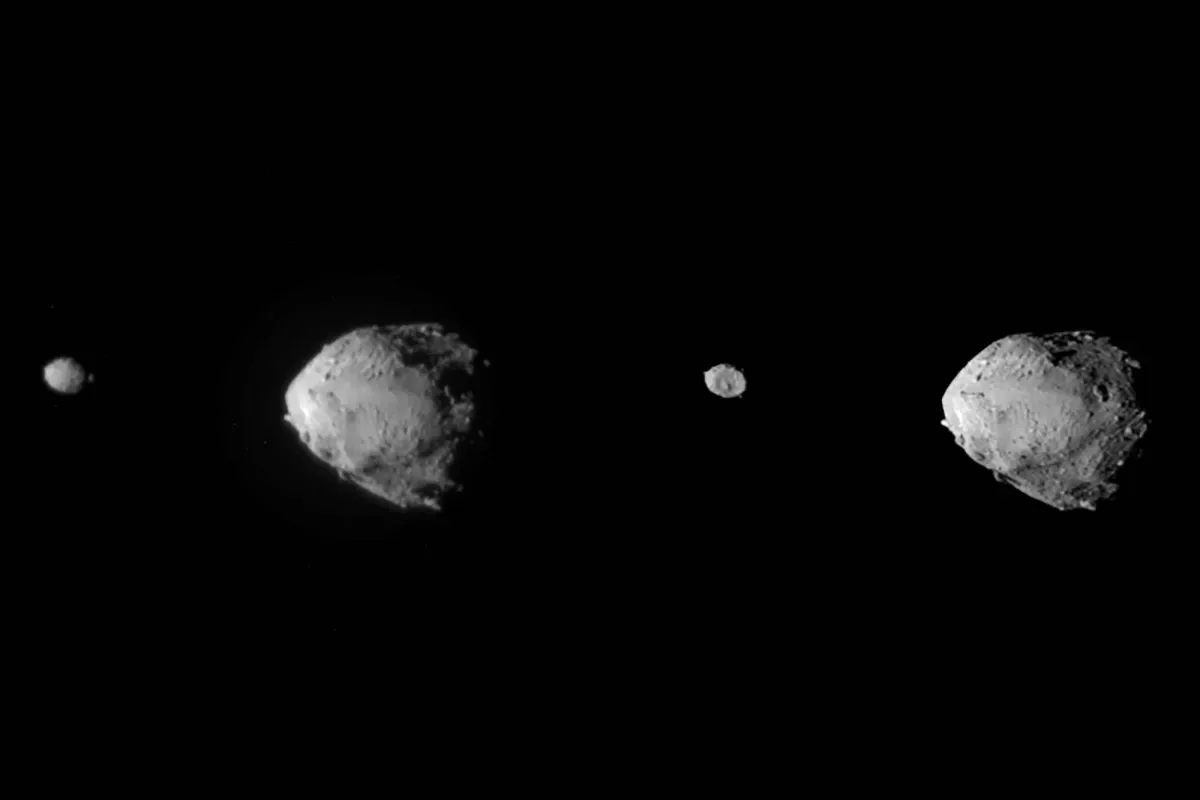
Four years after a spacecraft deliberately rammed an asteroid in humanity's first test of planetary defense, the European Space Agency has unveiled the first close-up photographs showing what the collision actually did. Released on November 25, 2026, during a presentation at the Museum für Naturkunde Berlin, images from the Hera spacecraft reveal that the small asteroid Dimorphos was left with one side flattened by a stadium-sized crater that spans its entire width, while the asteroid itself is now tumbling in a chaotic way.
The pictures answer a lingering question from the September 2022 impact of NASA's Double Asteroid Redirection Test, or DART. While ground telescopes and space observatories confirmed at the time that the kinetic impactor successfully altered the orbit of the roughly 151-meter-wide moonlet—slowing its 11-hour and 55-minute journey around its larger companion Didymos by roughly 32 to 33 minutes—they could not show the physical damage to the asteroid itself. Hera's arrival at the binary system, currently located about 120 million miles or 193.5 million km from Earth, finally brings that aftermath into sharp focus.
A Stadium-Sized Crater and a Wildly Tumbling Moonlet
The newly unveiled images, including a shot taken on November 7 from a distance of 29 kilometers by Hera's Asteroid Framing Camera, show that DART did far more than simply leave a minor dent. The impact site covers nearly the entire front side of Dimorphos, creating the visual impression that a piece of the asteroid was sliced off or cut away. Inside the crater, scientists noted unusual features, including an elongated, cigar-shaped structure near the center.
Yet the rest of the oblong-shaped moonlet remains largely unaltered. The boulder fields covering the side opposite the impact look identical to the images DART captured right before contact in 2022. That stark contrast stunned researchers.
Scientists debated whether Dimorphos had sustained an impact crater, changed its shape, or stayed the same. Much to our surprise, the answer turns out to be all three at once! The face struck by DART has been flattened into an impact crater the size of a sports stadium, which extends across the asteroid's entire width,
said Hera principal investigator Patrick Michel, as reported by Newsweek.
Beyond the surface deformation, the collision shattered the asteroid's rotation. Hera's observations revealed that the shock wave knocked the moonlet into a chaotic tumble. Furthermore, the spacecraft spotted hundreds of loose boulders orbiting the binary system.
That combination of a pulverized face, an intact rear, and a chaotic spin cycle forces a re-evaluation of how rubble-pile asteroids absorb high-speed kinetic impacts. If a deflection mission hits an asteroid and unexpectedly sets it tumbling while liberating an invisible halo of orbiting shrapnel, mission planners will need to account for those secondary dynamics before trying the technique on a genuinely threatening object.
From Proof of Concept to Engineering Recipe
The DART mission launched on November 23, 2021, and struck Dimorphos at about 14,000 miles per hour or 22,530 kph on September 26, 2022. Telescopes immediately tracked a vast plume of debris streaming from the moonlet like a comet tail. That escaping material acted like a rocket exhaust, providing an extra push that amplified the collision's effectiveness well beyond the momentum of the spacecraft alone. Researchers measure this boost using the momentum enhancement factor, or beta, with early estimates ranging from 2.2 to 4.9.
Pinning down the exact mass and internal structure of Dimorphos is the central task of the Hera mission, which launched on October 7, 2024, aboard a SpaceX Falcon 9 rocket and reached the asteroid pair in November 2026. Without those precise measurements, scientists cannot separate the energy delivered by the spacecraft from the recoil provided by the blasted ejecta.
- November 23, 2021: NASA launches the DART spacecraft on a SpaceX Falcon 9 rocket.
- September 26, 2022: DART intentionally collides with Dimorphos at about 22,530 kph.
- October 7, 2024: ESA launches the Hera spacecraft aboard a SpaceX Falcon 9 rocket.
- March 2025: Hera performs a Mars gravity assist maneuver and images Deimos.
- November 2026: Hera arrives at the Didymos and Dimorphos asteroid system.
- November 25, 2026: ESA unveils the first close-up images of the stadium-sized crater in Berlin.
That missing mass figure is the barrier standing between a successful demonstration and a reliable engineering tool. A kinetic impactor is only as good as its predictability; if space agencies cannot calculate how much a given mass will shift a porous rubble pile, a poorly executed deflection attempt could risk fracturing an incoming hazard rather than safely nudging it off a collision course.
Next Steps for the Hera Mission
Germany stands as the mission's largest financial contributor, providing roughly 130 million euros, which accounts for about 37 percent of the total cost. The spacecraft itself was built by OHB in Bremen, while its Asteroid Framing Camera was supplied by Jena Optronik with scientific leadership from the DLR Institute of Space Research in Berlin.
The investigation is scheduled to accelerate rapidly in the coming weeks. Hera is currently observing the system from a distance of about 15 to 19 miles or 25 to 30 km. Next month, the spacecraft is slated to approach within 8 miles or 13 km of the pair, securing higher-resolution images to map Dimorphos in three dimensions.
In January, Hera is due to deploy two shoebox-sized miniature satellites, called CubeSats, named Milani and Juventas. Equipped to investigate surface materials and subsurface structures, these probes will approach even closer for further study.
| Spacecraft / Probe | Primary Role | Key Instrument or Target |
|---|---|---|
| DART | Kinetic impactor test | DRACO camera |
| Hera | Orbital survey and mapping | Asteroid Framing Camera |
| Juventas & Milani | Subsurface and interior analysis | Radar and thermal infrared imager |
We knew that the DART mission impacted Dimorphos successfully and that it changed its orbit. But we did not know what happened to Dimorphos itself. The investigation of what the impact did to Dimorphos and the characterisation of it in general is needed to be able to apply the kinetic impactor technique to another asteroid, should we find one on a collision course with Earth,
Michael Kueppers, ESA's Hera mission scientist, told Reuters.
While more than 42,000 near-Earth objects are currently known with no known impact threats, surveys remain incomplete, particularly for objects smaller than 140 meters. Nasa's upcoming NEO Surveyor infrared space telescope, targeted for launch no earlier than September 2027 on a Falcon 9 with a launch service cost of about 100 million dollars, aims to find at least two-thirds of those near-Earth objects larger than 140 meters.
The harder question is whether the chaotic tumbling and structural deformation revealed by Hera will complicate future deflection efforts against more densely packed or structurally volatile asteroids. As Hera spends the next six months mapping the Didymos system, planetary scientists will find out if Dimorphos is an anomaly or a standard template for how celestial bodies react when human technology punches back.