Apple unveils Mac Studio with M5 Max and M5 Ultra chips for AI workloads
Apple's new Mac Studio and Mac Mini feature M5 Ultra and M6 chips designed for AI workloads and professional computing tasks.
- Headline: Apple unveils Mac Studio with M5 Max and M5 Ultra chips for AI workloads
- Dispatch Summary: Apple's new Mac Studio and Mac Mini feature M5 Ultra and M6 chips designed for AI workloads and professional computing tasks.
- Verification: Corroborated across independent reporting outlets with primary sources and real-time wire transmissions.
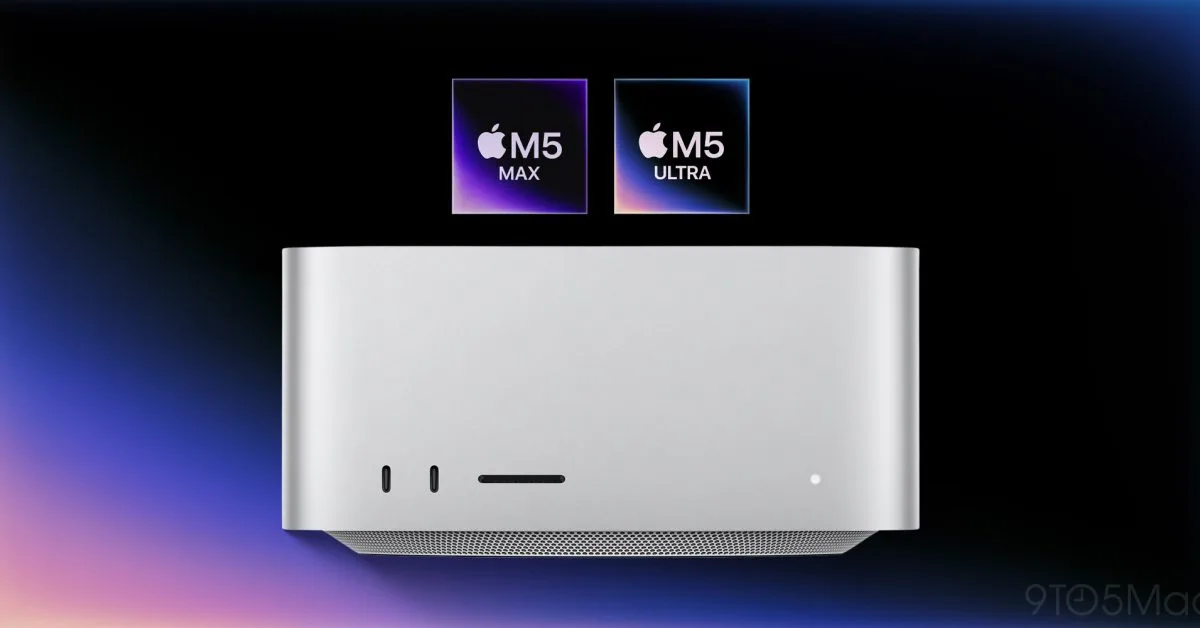
Apple has unveiled a refreshed lineup of its Mac Mini and Mac Studio desktop computers, featuring the latest M6 and M5 Ultra chips designed to enhance AI workloads and professional computing tasks. The announcements, made on August 25, 2026, mark a significant shift in Apple’s strategy to position its desktops as critical tools for developers, researchers, and creatives engaged in complex artificial intelligence projects.
Apple’s M5 Ultra Chip: A Leap in AI and Computational Power
The Mac Studio’s flagship offering is the M5 Ultra chip, which Apple describes as its “most powerful chip ever.” This quad-die processor combines two dual-die M5 Max chips, delivering a 36-core CPU, 80-core GPU, and 1.2TB/s of unified memory bandwidth. The M5 Ultra’s architecture includes Neural Accelerators integrated into the GPU, enabling faster AI inference and processing of large language models directly on the device. According to Apple, the chip supports real-time 8K color grading and can handle tasks such as running complex 3D rendering and AI model training without relying on external hardware.
The M5 Ultra’s performance gains are substantial. Apple claims up to 4.3x faster AI performance, 2x faster storage, 1.8x faster graphics, and 1.3x faster CPU performance compared to previous generations. The chip’s 80-core GPU is the most powerful Apple silicon GPU to date, while its 36-core CPU offers multithreaded performance improvements of up to 1.3x over the M3 Ultra. The M5 Ultra also features a Media Engine with twice the video encode and decode blocks of the M5 Max, supporting up to 33 simultaneous streams of 8K ProRes video.
Mac Studio’s Memory and Connectivity Upgrades
The Mac Studio with the M5 Ultra configuration supports up to 512GB of unified memory, a significant jump from the M3 Ultra’s 96GB limit. This expansion allows users to run large AI models entirely on the device, reducing reliance on cloud-based solutions. The system also includes Wi-Fi 7, Bluetooth 6, and Thunderbolt 5 ports, which enable clustering of multiple Mac Studio units for distributed AI inference. Apple claims that such clusters can deliver up to three times the performance of a single system.
For the M5 Max variant, the Mac Studio features an 18-core CPU, up to a 40-core GPU, and 128GB of unified memory. Both the M5 Max and M5 Ultra models start at $2,499 and $5,499, respectively. The M5 Ultra’s 512GB memory configuration, however, is slated for a late October release, according to Apple.
Mac Mini’s M6 Chip: A Focus on AI and Efficiency
The Mac Mini received its own upgrade with the M6 chip, Apple’s first 2-nanometre processor. The M6 features a 12-core CPU, 12-core GPU, and a dual 16-core Neural Engine, offering up to 40% faster CPU performance and 4x faster AI task execution compared to the previous M5 chip. The M6 also includes 170GB/s of memory bandwidth, allowing it to run local AI models efficiently. An M5 Pro variant is available, providing up to 64GB of memory and Thunderbolt 5 connectivity.
The Mac Mini’s price has increased to $899 for the base M6 model, up from $799 for the previous M4 model. The M5 Pro version starts at $1,699, with education pricing available. Apple emphasized the Mac Mini’s role in “always-on, deskside agentic computing,” positioning it as a compact yet powerful tool for AI developers and remote workloads.
Market Context and Supply Chain Challenges
The refresh comes amid ongoing global memory and storage shortages, which have forced Apple to raise prices and limit high-end configurations. The Mac Mini’s $200 price hike reflects supply chain pressures, while the Mac Studio’s M5 Ultra configuration faces extended availability due to component constraints. Bloomberg and MacRumors have noted that premium models may remain scarce into late 2026, with wait times for the current generation already exceeding 10 weeks.
Apple’s focus on AI-optimized silicon aligns with broader industry trends. Competitors like Nvidia and AMD have dominated data center and cloud training segments, but Apple’s unified memory architecture and on-device processing capabilities offer a unique value proposition. The company’s emphasis on privacy and security—highlighted by its on-device AI workflows—could differentiate its products in a market increasingly concerned with data protection.
Availability and Developer Ecosystem
The new Mac Mini and Mac Studio models are available for pre-order starting August 25, 2026, with shipments beginning on September 22. Apple has also updated its developer tools to optimize performance across the CPU, GPU, and Neural Engine, enabling developers to fine-tune large AI models locally. The M6 and M5 Ultra chips are designed to work with Apple’s Foundation Models and App Intents, providing a streamlined environment for building AI applications.
Despite the price increases, Apple’s latest desktops underscore its commitment to professional and AI-driven workflows. With the M5 Ultra’s unprecedented performance and the M6’s efficiency, the company aims to solidify its position as a leader in the high-end computing market, even as supply chain challenges and competition from other tech giants persist.