UK urges FIFA to investigate Argentina over Falklands banner at World Cup
British officials are calling for a thorough FIFA investigation after Argentine players displayed a banner regarding the disputed Falkland Islands. The governing body could issue fines for the incident, which has reignited tensions over the territory.
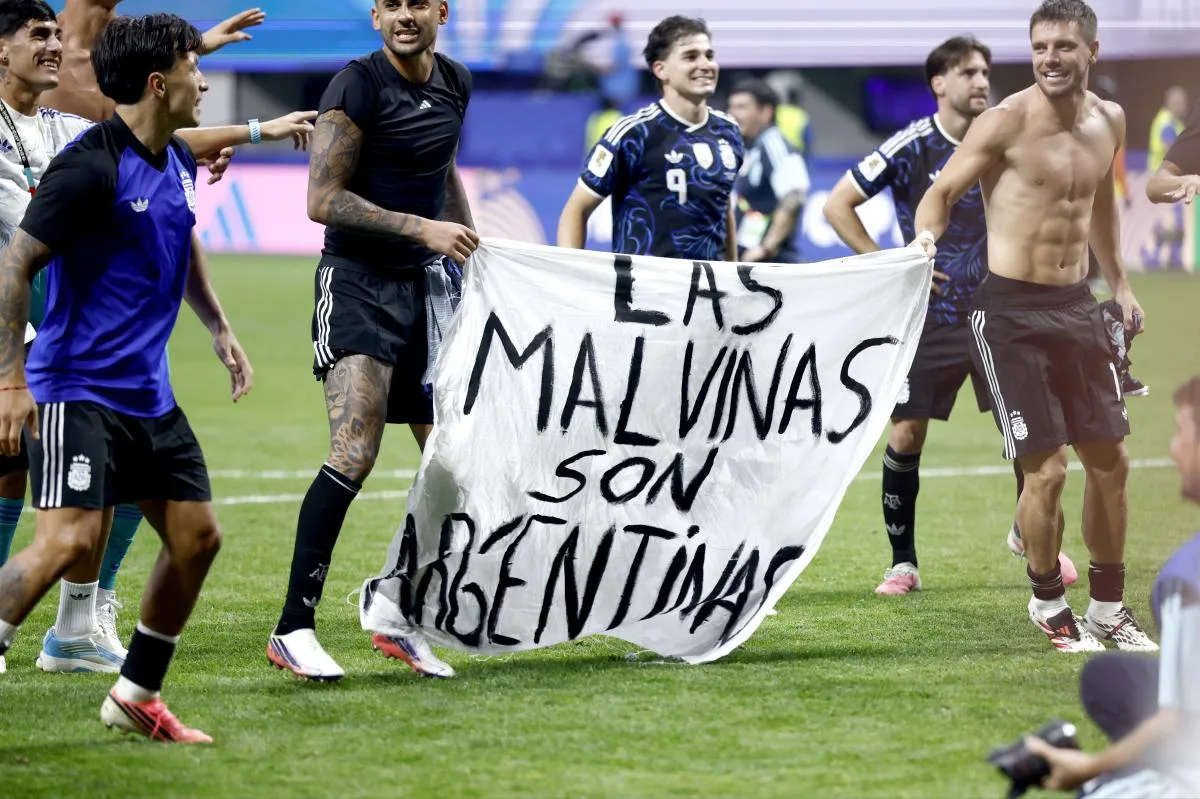
The United Kingdom has called on FIFA to investigate Argentina after players celebrated their 2-1 World Cup semifinal victory over England with a banner reading “Las Malvinas son Argentinas” — “The Malvinas are Argentine.” The incident, which occurred during post-match celebrations at Mercedes-Benz Stadium in Atlanta on July 15, 2026, has reignited tensions over the Falkland Islands, a British overseas territory disputed by Argentina.
British Business Secretary Peter Kyle described the players’ actions as “entirely inappropriate” and urged FIFA to “do its investigation thoroughly.” A spokesperson for Prime Minister Keir Starmer reiterated the UK’s stance, stating, “The World Cup might not be ours, but the Falkland Islands definitely are.” The statement underscored the historical and political significance of the archipelago, which Argentina refers to as the Islas Malvinas.
The Falklands War of 1982, a 10-week conflict that resulted in 649 Argentine deaths, 255 British fatalities, and three islander casualties, remains a sensitive issue. Argentina invaded the territory in 1982 under its military dictatorship, prompting a British counteroffensive. The UK reasserted control, and the islands have remained a self-governing British territory since. A 2013 referendum saw 99.8% of Falkland Islanders vote to retain their status as a British overseas territory.
FIFA’s disciplinary code prohibits “any message that is not appropriate for a sports event,” including political, ideological, or religious slogans. The governing body could fine Argentina’s players or federation, with penalties ranging from $5,000 to $20,000. Previous cases include a 2012 London Olympics incident where a South Korean player was banned for holding a banner claiming the disputed Dokdo islands, and a 2022 World Cup fine against Serbia for a Kosovo-related banner.
Argentina’s President Javier Milei acknowledged the players’ “emotional” gesture but stated he expected a fine. “What the players do is understandable; they get carried away by their emotions,” he said, adding that the banner “reflects a sentiment shared by all Argentines.” Argentine midfielder Leandro Paredes described the banner as a tribute to those who died in the 1982 conflict, saying, “We knew we were playing for them, too.”
The UK’s call for an investigation comes amid broader scrutiny of FIFA’s handling of political issues. The organization faced criticism after its president, Gianni Infantino, allowed U.S. player Folarin Balogun to play in the round of 16 despite a red card, a decision seen as influenced by pressure from former U.S. President Donald Trump. Infantino is set to attend the World Cup final alongside Milei, further complicating the context of the dispute.
Argentina’s banner was not the first of its kind. In 2014, the team displayed the same slogan during a warm-up game ahead of the World Cup, leading to a $37,000 fine. The current investigation could result in similar penalties, though FIFA’s disciplinary committee is reviewing match reports, with a decision expected soon.
The incident highlights the enduring link between football and geopolitics, particularly in matches between England and Argentina. Historical grievances, from the 1986 World Cup “Hand of God” goal to recent clashes, have fueled a rivalry steeped in cultural and political tension. As the World Cup final approaches, the Falklands dispute remains a flashpoint, underscoring the challenges of separating sport from the broader currents of history and identity.
Dateline Wire is dedicated to independent, evidence-backed reporting. This briefing was synthesized from primary source reporting, corroborated across independent newsrooms, and verified against our Editorial Standards.