UK urges FIFA to investigate Argentina over World Cup Falklands banner
British officials have condemned Argentina's use of a 'Las Malvinas son Argentinas' banner as an unacceptable violation of FIFA's political neutrality regulations.
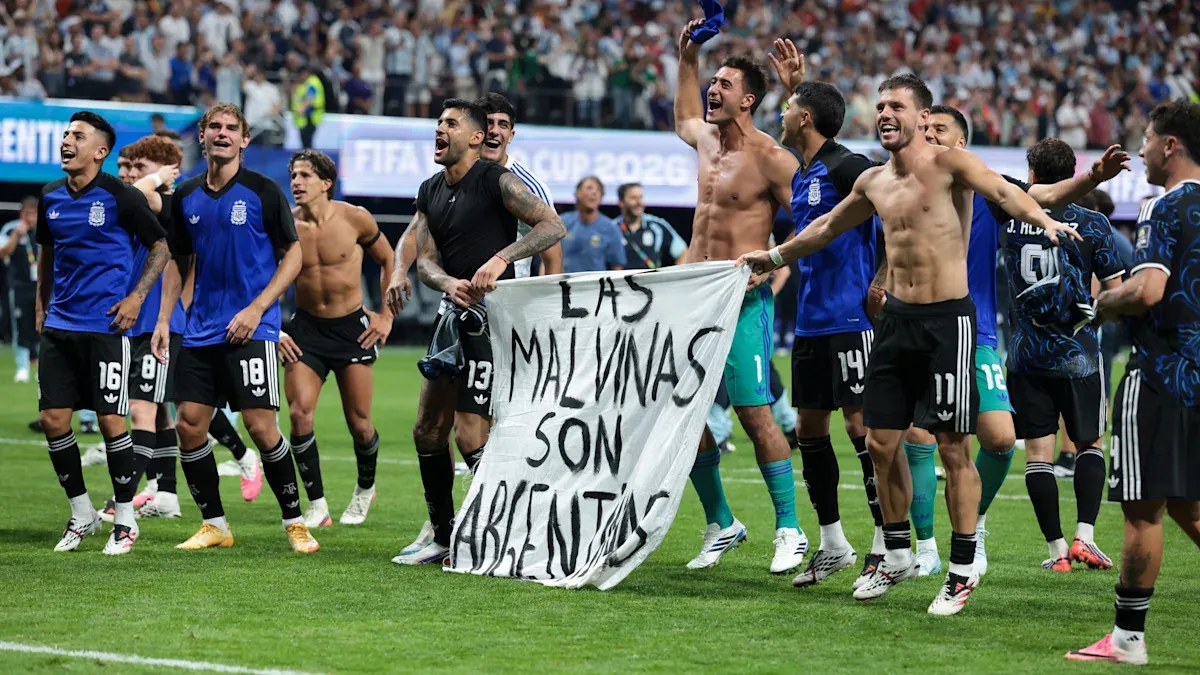
The United Kingdom has reiterated its call for FIFA to investigate Argentina’s use of a Falklands Islands banner during its World Cup semifinal victory over England, with new details emerging about potential fines, historical precedents, and heightened diplomatic tensions. The dispute, rooted in the 1982 Falklands War, has drawn fresh scrutiny as Argentina’s players displayed the slogan “Las Malvinas son Argentinas” (“The Malvinas are Argentine”) after their 2-1 win in Atlanta on July 15, 2026.
British Prime Minister Keir Starmer’s office reiterated its stance, stating, “The World Cup might not be ours, but the Falkland Islands definitely are,” while Business Secretary Peter Kyle condemned the banner as “entirely inappropriate.” FIFA’s disciplinary code prohibits “political, ideological, religious or offensive” messages at matches, with fines ranging from $5,000 to $20,000 for such violations. The UK’s renewed pressure follows a 2014 incident where Argentina was fined 30,000 Swiss francs ($37,000) for a similar banner, according to new sources.
Argentina’s foreign minister, Pablo Quirno, escalated tensions by filing a formal protest over the presence of the British warship HMS Medway near the Falklands. In a diplomatic note dated July 13, Buenos Aires accused the vessel of violating bilateral agreements, marking a rare instance of direct military posturing in the decades-old dispute. The HMS Medway, based in the Falklands, was alleged to have entered Argentine territorial waters without proper notification, according to the protest.
Argentine President Javier Milei defended the banner as “perfectly valid,” stating the message “reflects a sentiment shared by all Argentines.” However, he acknowledged that FIFA might impose a fine, noting, “What the players do is understandable; they get carried away by their emotions.” Vice President Victoria Villarruel amplified the rhetoric, posting a social media image of players holding the banner with the caption: “The Malvinas are Argentine! They banned us from bringing (signs) into the stadium, forgetting that we carry them in our blood and in our hearts.”
FIFA’s handling of political issues has faced criticism, particularly after its president, Gianni Infantino, allowed U.S. forward Folarin Balogun to play in the round of 16 despite a red card, deferring his suspension for a year of probation. This decision, which sparked controversy, has raised questions about FIFA’s enforcement of neutrality. Infantino is set to meet with U.S. President Donald Trump and Argentine President Javier Milei at the World Cup final on July 17, further intertwining political and sporting dynamics.
The Falklands War of 1982, which resulted in 649 Argentine and 255 British deaths, remains a sensitive historical flashpoint. Argentina claims the islands were illegally taken in 1833, while the UK asserts its sovereignty dates to 1765. The banner’s display has drawn sharp criticism from British officials, including former Prime Minister Margaret Thatcher’s legacy, as the conflict ended during the 1982 World Cup in Spain. British television networks had previously avoided broadcasting Argentina’s matches during that tournament.
Argentina’s players have defended the banner as a symbol of national pride. Midfielder Leandro Paredes acknowledged the “sad part of our history” but emphasized the team’s intent to honor those affected by the Falklands War. “We knew we were playing for them too,” he said, referencing the conflict’s legacy. Forward Lisandro Martínez, who plays for Manchester United, added, “We couldn’t let the Argentine people down.”
FIFA’s disciplinary history includes cases such as the 2012 London Olympics, where South Korea’s Park Jong-woo was banned for two 2014 World Cup qualifying games after holding a territorial banner. At the 2022 World Cup, Serbia was fined 20,000 Swiss francs ($24,800) for a Kosovo-related banner in a locker room. These precedents underscore the governing body’s enforcement of political neutrality, though critics argue inconsistencies persist.
The controversy highlights the enduring intersection of sport and geopolitics. For Argentina, the Falklands banner is a rallying cry for a nation still grappling with the war’s legacy. For the UK, it is a reaffirmation of its territorial sovereignty. As FIFA reviews the incident, the clash of identities—football and history—continues to shape the global stage. The outcome of the disciplinary process, expected to conclude before the final against Spain on July 17, remains uncertain, but the incident has already deepened the political undercurrents of the tournament.
Dateline Wire is dedicated to independent, evidence-backed reporting. This briefing was synthesized from primary source reporting, corroborated across independent newsrooms, and verified against our Editorial Standards.