Major US banks face online banking outages due to technical issue
A software bug in JPMorgan Chase's on-premise hardware systems triggered widespread online banking disruptions and transaction delays across major US banks.
Chase Fixes On-Premise Hardware Bug as Banks Resume Normal Operations
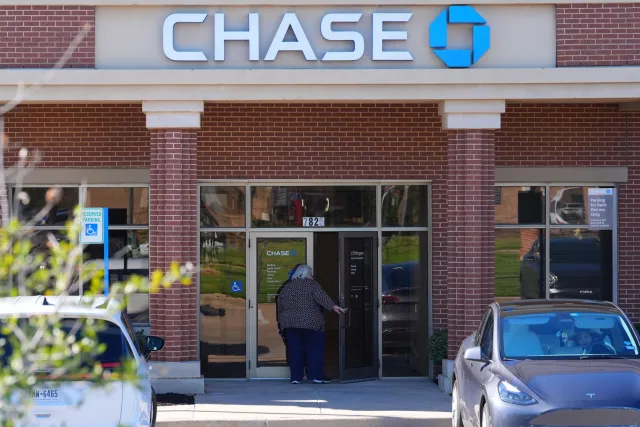
Normal services have resumed following an internal software bug in on-premise hardware systems at JPMorgan Chase that triggered cascading transaction delays across major U.S. financial institutions on Monday. Joe Evangelisti, a spokesperson for Chase, explained that Other banks may have been impacted by slowness in transactions only to the extent that they were a party to a transaction with us,
clarifying that competitors experienced friction solely when transacting with the nation's largest financial institution by total assets. The bank confirmed that full service was restored by the end of the day on Monday, with customer accounts and funds remaining secure throughout the disruption.
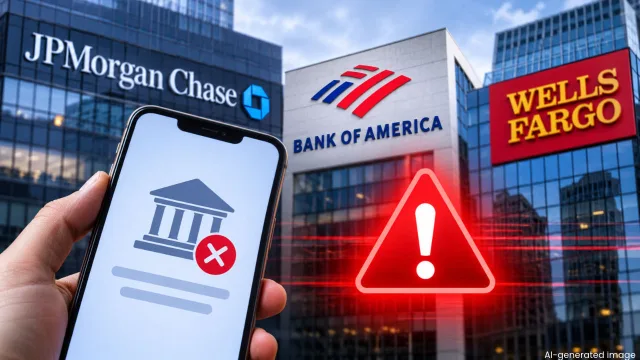
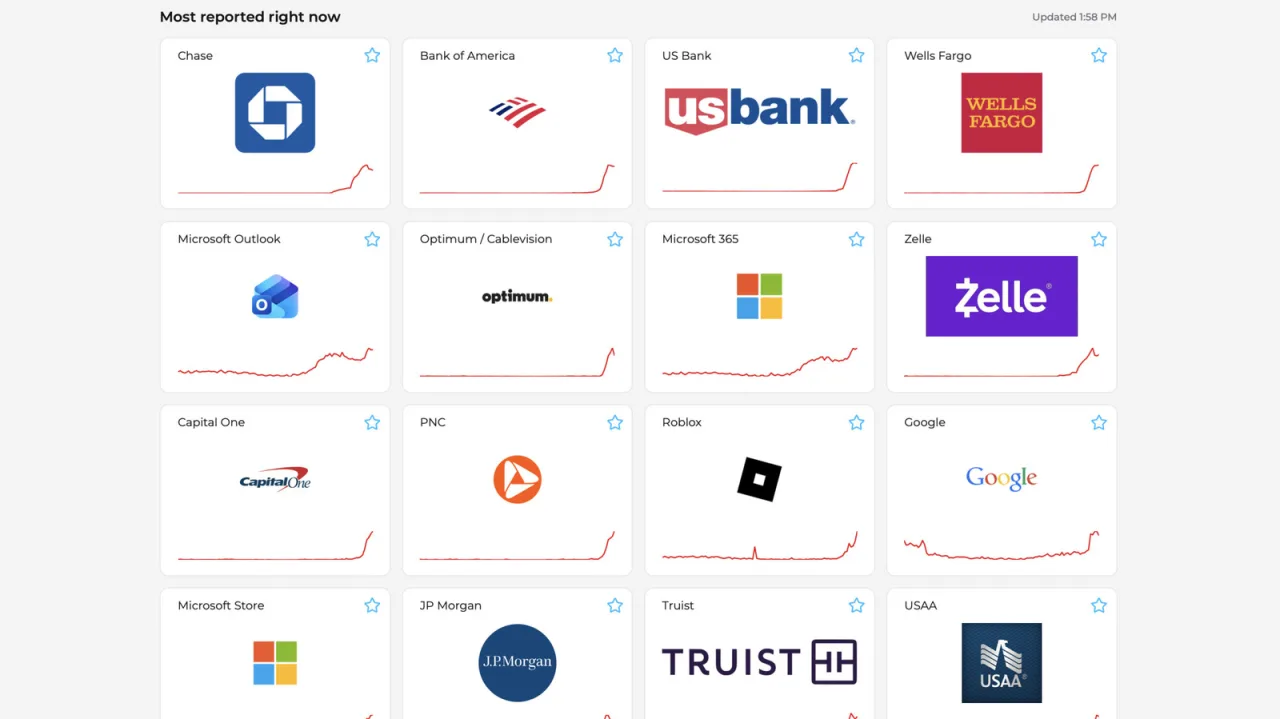
That resolution brings to a close a frantic 24-hour window that saw crowdsourced tracking sites flood with error reports. The technical disruptions began on Monday morning, with error reports climbing steadily around 10:00 AM ET and 12:00 PM ET across popular outage-tracking platforms. By mid-afternoon, tracking data recorded a peak of more than 4,800 reports for JPMorgan Chase over a 24-hour window. Al Jazeera noted that at Wells Fargo, more than 800 customers reported issues, including problems with logins, account balances, and fund transfers, while 50 percent of the nearly 5,000 complaints logged against Chase specifically involved account balances and transactions. TRT World reported that Downdetector recorded more than 4,600 reports involving Chase and over 1,500 concerning Bank of America as of 1845GMT.
Engadget noted that Chase, Bank of America, US Bank, and Wells Fargo emerged as the top four services with issues, while Zelle, Capital One, PNC, JPMorgan, and Truist also registered spikes in unavailability. Users attempting to access Chase accounts were greeted by an unyielding error notification stating, Some services aren’t available. We’re working on them. Please try back later.
This central failure was not born of a hostile digital assault or systemic banking collapse. JPMorgan Chase clarified to Mashable that the disruptions stemmed specifically from a temporary issue related to a software bug in on-premise hardware systems, adding that full service should be restored by the end of the day. A source familiar with the matter similarly told CNBC, as reported by TRT World and Al Jazeera, that there was no indication that malicious actors were involved. Chase reiterated that the technical problem was not the result of a cyberattack, stressing that it was an isolated incident and not related to anything other than a bug.
Why Did Bank of America and US Bank Appear Down?
The central reading of Monday's event is that a single point of failure at JPMorgan Chase manufactured an illusion of widespread multi-bank insolvency. While crowdsourced tracking sites lit up with complaints bearing the names of competing financial institutions, the institutions themselves insisted their core systems remained fundamentally sound. Mashable pointed out that during major digital disruptions, Downdetector frequently registers elevated user error reports at organizations that are functioning normally, simply because those entities happen to be transacting with a compromised platform. US Bank explicitly confirmed to CBS that its own systems were not directly impacted, explaining that external clients attempting to send or receive peer-to-peer transfers with another financial institution experienced unavoidable transaction delays. Customers at Bank of America, Citigroup and other banks trying to transact with Chase may similarly have seen their transactions slow, even though those banks were not having issues with their services.
The peer-to-peer payment network Zelle found itself at the epicenter of these secondary ripples. Zelle is owned by Arizona-based Early Warning Services, a consortium backed by major financial institutions including Bank of America, Capital One, JPMorgan Chase, PNC Bank, Truist, US Bank, and Wells Fargo. A spokesperson for Early Warning Services maintained that the Zelle network was fully operational, stating that an issue at the financial institutions may be delaying Zelle payments for some of their customers. Zelle was not directly affected by the Chase glitch, though customers at other banks experienced transaction delays while trying to send or receive Zelle payments involving a Chase customer.
This distinction matters profoundly for understanding systemic risk. The core ledger systems of institutions like Bank of America and Citigroup were not failing; rather, their digital perimeter was temporarily bottlenecked whenever an account holder attempted to communicate with Chase. As Joe Evangelisti emphasized, Other banks may have been impacted by slowness in transactions only to the extent that they were a party to a transaction with us.
Bank accounts remained intact, but the digital highways connecting them had temporarily narrowed to a crawl.
Recommended Steps for Affected Account Holders
- Verify account balances and recent transactions through official mobile applications or branch ATMs, keeping in mind that in-person bank transactions and online tools may experience processing slowness.
- Avoid panic-deleting banking apps or resetting credentials, as the issue stems from server-side hardware and software bugs rather than compromised individual passwords.
- Expect temporary delays if sending or receiving money through Zelle, and contact your financial institution directly if transaction statuses remain unconfirmed after services are fully restored.
Are These Outages Connected to Microsoft and FAA Failures?
The timing of the banking disruptions could not have been more unnerving for a public already on edge. The technical glitch arrived just days after two major, unrelated infrastructure outages battered other vital sectors of the American economy. As outlined by Asiainsurancepost and Livemint, a massive Microsoft outage began on Thursday and lasted for hours, severely disrupting cloud-dependent services including Outlook, Teams, and the Copilot AI assistant, with repercussions felt globally. That tech giant has said there is no indication
that the disruptions were caused by malicious activity, such as a cyberattack or due to action by artificial intelligence agents, explaining that the issue emerged during an upgrade. That digital breakdown was immediately followed on Friday by an equipment failure within the nation's air traffic control system that forced the U.S. Federal Aviation Administration to issue a ground stop for all commercial flights across the country, creating cascading travel chaos over the weekend. Government officials and company leaders have confirmed that another outage affecting the nation's air traffic control system on Friday, which grounded all U.S. flights for several hours and disrupted domestic air travel over the weekend, was caused by a router that malfunctioned and overwhelmed the ageing air traffic control system.
While internet commentators and social media speculation rapidly linked the Monday banking blackout to Friday's aviation and tech crises, reporters and corporate statements established no technical link between the events. The FAA grounding stemmed from aging air traffic control equipment, while the Microsoft disruption involved cloud software infrastructure. By contrast, the banking freeze was traced directly to an internal software bug residing within JPMorgan Chase's own on-premise hardware systems. Nevertheless, the close succession of three major infrastructure failures across aviation, cloud computing, and banking within a span of four days provoked widespread anxiety regarding the vulnerability of automated systems.
What Do Critics and Observers Say About the Ripple Effect?
Skeptics might argue that dismissing these events as isolated incidents ignores a troubling pattern of institutional fragility. When critical services across computing, travel, and finance stumble within a 96-hour window, the argument that these are purely coincidental software bugs offers little comfort to consumers stranded at airports or locked out of their bank accounts. The sheer reliance on centralized software platforms means that a single glitch in a single hardware rack in New York can instantly manifest as a nationwide financial tremor.
Countering this view, industry representatives emphasize that redundancy protocols worked as intended. Funds were never inaccessible, customer deposits remained secure, and core ledgers avoided corruption. Unlike a cyberattack or a liquidity crisis, a software bug in on-premise hardware represents a mechanical failure with a known patch and a predictable recovery timeline. The rapid transparency from institutions like Chase, which explicitly ruled out cyber threats early in the afternoon, helped stem the kind of panic that historically preceded traditional bank runs.
Yet the episode underscores how deeply integrated digital plumbing has become. When Zelle operates at peak efficiency but fails to deliver funds because the receiving bank's hardware is tied up in a software loop, the end user experiences a system-wide failure regardless of corporate boundaries.
As financial institutions worked through Monday evening to clear the transaction backlog, Al Jazeera reported that other major players adopted a different posture toward the unfolding crisis. While JPMorgan Chase issued detailed technical explanations regarding its on-premise hardware bug and representatives for US Bank and Zelle actively clarified their operational status to the press, Al Jazeera noted that several other major impacted institutions did not respond to requests for comment as the digital disruption unfolded.
Updated 1 time since publication; last update 17 November 2026, 13:31.