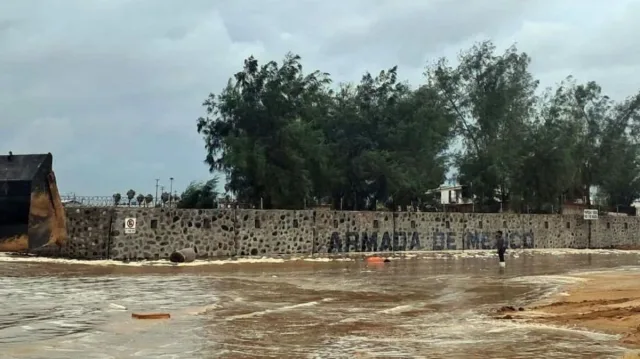
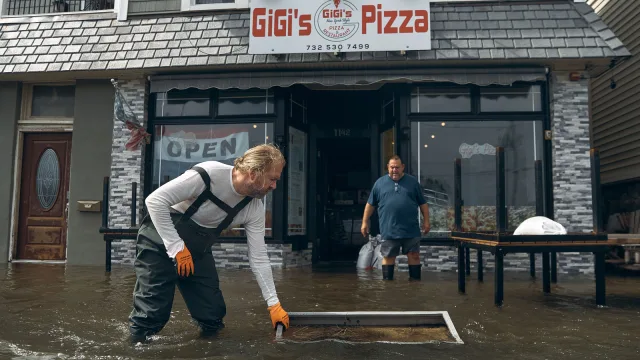
Hurricane Isaias leaves hundreds of thousands without power after Florid…
Hurricane Isaias made landfall near Destin, Florida, leaving hundreds of thousands without power and triggering emergency declarations across multiple states.
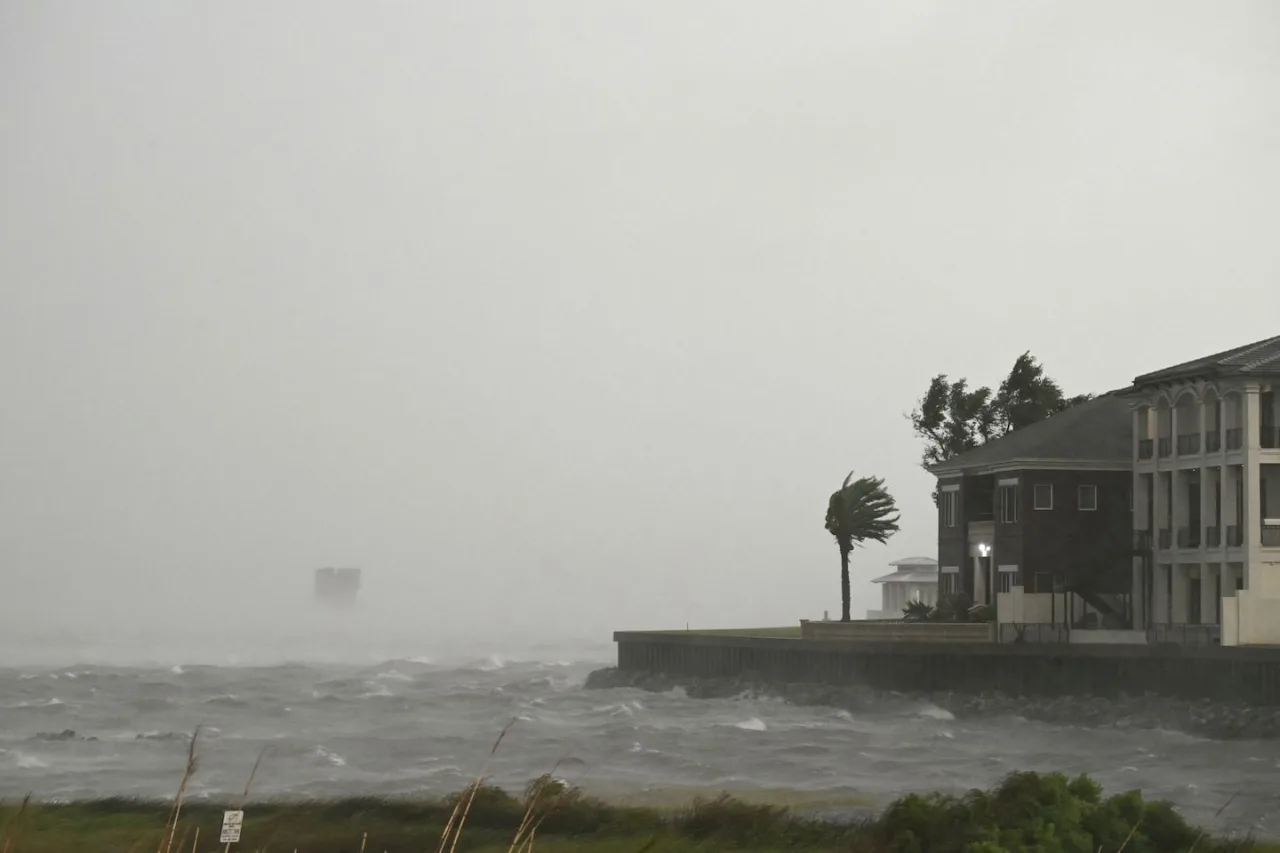
Four dead and hundreds of thousands without power as Hurricane Isaias lashes the US South
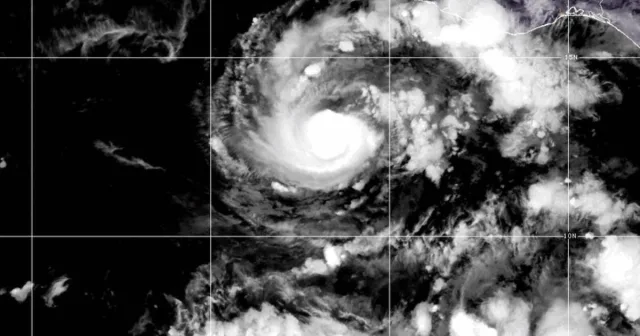
Four people have died and hundreds of thousands of residents across Alabama and the Florida Panhandle woke up in the dark early Saturday as Hurricane Isaias barrelled inland, leaving flooded coastal roads, and downed trees in its wake. The storm made landfall Friday near Destin, Florida, as the first hurricane of the Atlantic season, with maximum sustained winds of 105mph (168km/h) before being downgraded to a post-tropical cyclone.
While officials had braced for the storm, the resulting surge and wind speeds caught low-lying beachfront communities unawares, prompting mandatory evacuation orders and emergency declarations across multiple states. Governors in Florida, Alabama, and Mississippi declared states of emergency ahead of landfall to ensure federal resources are available, as Homeland Security Secretary Markwayne Mullin noted in a post on X. President Donald Trump told reporters at the White House late Friday night that officials were watching the storm closely and that the situation was under control, while scrapping his plans to attend a Saturday football game between the University of Georgia and the University of Alabama in Tuscaloosa so as not to disrupt emergency response efforts.
Yet on the ground, the contrast between official warnings and reality was stark: while some residents fled coastal zones after Senator Rick Scott urged them on social media to DO NOT WAIT! Get out NOW!
others chose to stay put behind boarded-up windows.
Fatalities, Rescues, and Power Outages Across the Region
The human toll of the storm turned tragic with four confirmed deaths across Florida and Alabama, including people killed when trees fell on their houses. Two fatalities were reported in Florida's Escambia County. Local Sheriff Chip Simmons said a woman was killed when a tree fell on her house. Joey Williams told NewsNation his wife had died in the storm. The couple went outside to snap pictures of the damage, but when they went back into their home, a tree fell through the roof and trapped them.
I was able to squeeze out. My wife didn't make it.
Joey Williams via NewsNation
Sheriff Simmons also reported that a man died from carbon monoxide poisoning after running a generator in a garage that was not properly ventilated, while four other people in the same house were taken to the hospital. In neighbouring Alabama, Governor Kay Ivey announced in a post on X that two Alabamians had lost their lives, without providing further details. An Alabama sheriff was also injured when a tree fell on him while responding to a car crash.
By midday Saturday, about 670,000 customers across Florida, Alabama, Georgia, and Mississippi remained without power, according to tracking firm PowerOutage.us. Breakdown figures showed:
- About 420,000 customers in Florida
- 190,000 in Alabama
- 43,000 in Georgia
- 17,000 in Mississippi
Emergency responders carried out dramatic rescues as vehicles became submerged in floodwaters. The Florida National Guard shared pictures of a truck stuck in a flood ditch, stating that soldiers stopped, swam to the vehicle and pulled its occupants to safety.
In Pensacola, government employee Jonathan Ramos watched from a hotel as howling winds ripped roofs from nearby buildings. Things are flying really fast, and I’ve never seen wind this fast before, so it’s intense, it’s scary. I don’t recommend people coming down here for fun to do this,
Ramos said. In Pensacola, Tim Mowry rode out the storm from home, listening to winds that sounded like a train whistle before losing power around 4:30 p.m. As far as Pensacola-wise, we really got fortunate,
Mowry said, despite losing parts of his fence to standing backyard water.
The severity of Isaias was also underscored when dozens of Waffle Houses in the Florida Panhandle closed, according to the company’s website. The Waffle House Index is an informal metric used by emergency managers and locals in the American South to gauge natural disaster severity, where restaurant closures indicate catastrophic levels. Kelsei Frazier, a resident of Pace, noted the psychological weight of those closures. We joke because if Waffle House is still open, then you know it’s not a bad hurricane, but all the Waffle Houses that I know of within at least a normal range from us are closed. Which is a pretty big deal,
Frazier said. Meanwhile, state authorities mobilized heavily, with Florida’s National Guard deploying roughly 5,000 soldiers and airmen, and Uber partnering with the state to offer free round-trip rides up to $40 each way to evacuation shelters.
Florida Governor Ron DeSantis told a press conference in Tallahassee that authorities had received no search-and-rescue requests shortly after landfall, a sign of limited initial impact. They're going to make assessments this morning, and I think that'll give us a good sense about the future for the rapidity of the power restoration,
DeSantis said, adding that some 16,000 utility linemen had prepared to respond.
Post-Tropical Downgrade and Inland Flooding Threats
As Isaias tracked north into Alabama and weakened to a post-tropical cyclone, the threat shifted from wind to water. According to the National Hurricane Center, storm surges, flash flooding, damaging winds, and a risk of tornadoes remained active across parts of the US Southeast, including the Florida Panhandle, Georgia, and the Carolinas. In Alabama, the state’s emergency management agency posted on X that due to the impacts of Hurricane Isaias, all Houston County roads are closed until further notice,
remaining in effect until conditions are safe for travel amid hazards from downed trees and power lines.
Governor Ivey warned that officials were concerned about spinoff tornadoes in Alabama from strong winds and heavy rain. Meteorologists warned of 4 to 8 inches (10 to 20 centimeters), with the National Oceanic and Atmospheric Administration warning that the Carolinas and Georgia could see floods from up to 10 inches (25cm) of rainfall. Melissa Watson, a Florida-based meteorologist at the National Weather Service, urged remaining residents to stay indoors and maintain multiple ways to receive tornado warnings as storm bands pushed inland. In Charleston, South Carolina, officials asked people to stay home on Saturday night as high tide was expected to reach 7.5ft (2.3m). After dark, floodwater is much harder to see and it's impossible to judge how deep it is from behind the wheel,
the city stated.
For travelers, disruption was immediate. The storm grounded most Friday flights at several panhandle airports, including all flights into and out of Destin-Fort Walton Beach Airport. With the center of Isaias forecast to cross Alabama and into the Tennessee Valley over the weekend, residents in its path face days of clearing blocked roads and waiting for utility crews to restore power.
Energy Market Impacts and Strategic Release
The storm's passage through the Gulf of Mexico severely impacted offshore energy infrastructure. Oil and gas producers Shell and Chevron began efforts to redeploy personnel to platforms including Mars, Olympus, Ursa, Vito, and Appomattox over the weekend. However, the Marine Minerals Administration reported that about 69% of oil output and 57% of natural gas production in the U.S. Gulf of Mexico remained shut on Saturday, with 113 production platforms—representing 30% of the total—remaining evacuated.
To address hurricane-related supply disruptions, the U.S. Energy Department authorized an emergency release of up to 4 million barrels of crude oil from the Strategic Petroleum Reserve on Saturday.
Updated 1 time since publication; last update 9 November 2026, 11:58.