Egypt Train Collision Kills Seven and Injures Over 112 Near Cairo
A rear-end train collision in Egypt's Giza province has left at least seven dead and over 112 injured, prompting official investigations into network safety.
Egypt Train Collision Kills Seven and Injures Over 125 Near Cairo
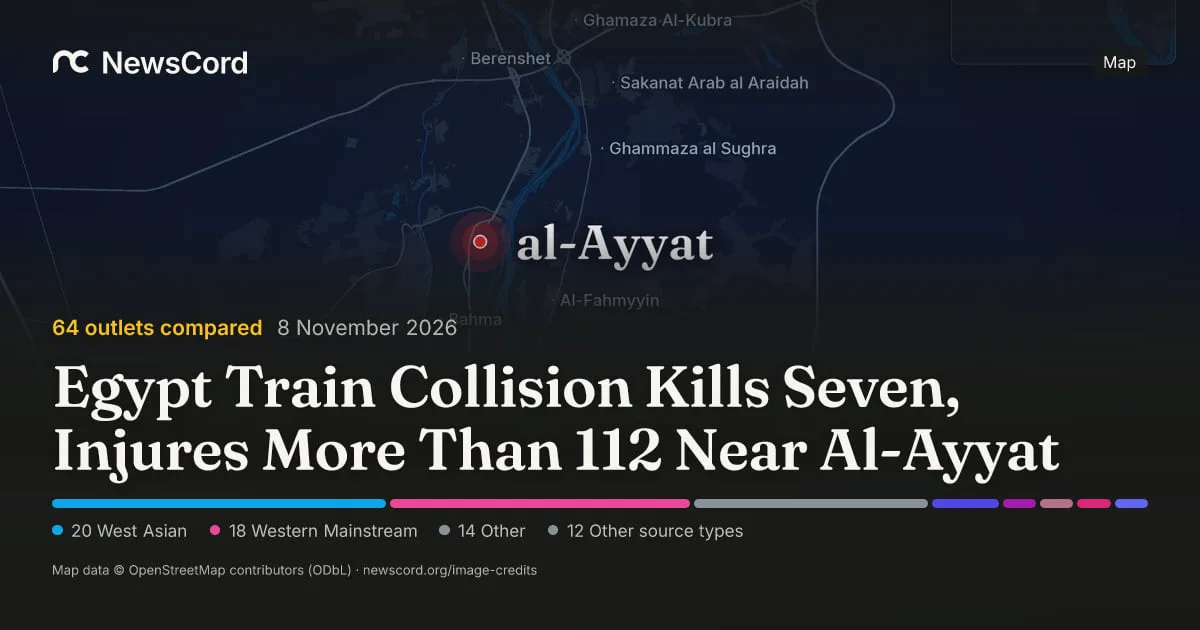
A passenger train travelling between Giza and Fayoum ran into the rear of another train on the Cairo-to-Aswan route on Sunday. The collision occurred in the district of al-Ayyat in Egypt’s Giza province, roughly 76 km or 47 miles south of Cairo, according to Reuters and the National Railways Authority of Egypt. The impact caused several cars to derail onto a countryside road between Kafr ʿAmmār and al-Raqqah stations. The National Railways Authority identified the moving train as Train No. 134, named Taḥiyya Miṣr, on the Giza–Fayoum regional line, and the preceding train as Train No. 2010 on the Cairo to Aswan route.
New figures from the Health Ministry placed the toll at at least seven people killed and more than 125 injured, updating initial reports of four dead and 88 injured. Private sources confirmed to aggregators that the number of injured actually exceeds 140. Among those killed was one of the train's conductors, according to Egypt's Chief Prosecutor’s office and the Health Ministry.
That latest upward revision in casualties reflects the chaotic reality on the ground as emergency teams sifted through the wreckage, and it shifts the pressure directly onto regional medical facilities struggling to absorb a sudden surge of trauma cases. For travelers and families searching for missing relatives, official communication has been fragmented across competing government tallies.
What Witnesses Saw on the Al-Ayyat Tracks
Witnesses described chaotic rescue efforts after the collision, as villagers, first responders and railway workers scrambled to reach passengers trapped inside overturned carriages.
Abdel Wahed Mohamed, 31, who was sitting at a nearby cafe when the collision occurred, said the Aswan-bound train had stopped, when the Fayoum-bound train crashed into it.
The train overturned at around 1:30 pm [11:30 GMT]. Six carriages overturned
Abdel Wahed Mohamed, via Al Jazeera
He added that victims suffered a range of injuries, including head wounds and broken limbs. Another witness, Ahmed Moussa, 25, said rescuers dug beneath one overturned carriage to reach trapped passengers.
There were people piled on top of each other inside
Ahmed Moussa, via Al Jazeera
He added that he saw two women among the dead. Taha Abdel Tawab, 43, said he saw a young man leaving the train carrying his dead father
.
Where Were the Wounded Taken and How Are Hospitals Responding?
Egypt’s Ministry of Health deployed 72 ambulances to transport and evacuate the injured from the crash site to nearby medical facilities across multiple governorates. The evacuation effort distributed casualties across at least four distinct hospitals in the region:
- 49 injured transferred to Al-Wasiti Hospital in Beni Suef
- 29 injured transferred to Al-Wayattia Hospital
- 10 injured transferred to Atfih Hospital in Giza
- 2 bodies transferred to Al-Wasiti Hospital
Emergency rescue teams and cranes were dispatched directly to the scene to clear the debris and restore train services on the Cairo-Upper Egypt line as soon as possible, according to the Egyptian National Railways. The Public Prosecution sent a team to inspect the site and determine operating causes, while technical authorities began examining the wreckage.
The speed of the medical mobilization points to a well-practiced disaster response protocol in a country sadly familiar with rail disasters. Yet spreading dozens of severe trauma patients across smaller regional facilities like Al-Wasiti and Al-Wayattia puts an immediate strain on local medical staff who must handle sudden surges of critical care patients.
Who Is Holding Whom Accountable for the Al-Ayyat Crash?
Egyptian President Abdel Fattah el-Sisi ordered a rapid investigation and accountability following the collision, stating via social media and presidential statements that he is following the incident with great concern
. I have directed state agencies to provide the necessary medical care, promptly investigate the circumstances of the accident and hold accountable anyone found to have been negligent,
President Abdel-Fattah el-Sissi wrote. He also extended his deepest condolences to the families of those who lost their lives.
Egypt's public prosecutor's office initiated formal investigations to determine the technical reasons behind the crash and inspect operating procedures. The Transportation Ministry and the Egyptian Railway Authority coordinated the clearance of the line, while noting that the al-Ayyat district has seen similar incidents recently. Last September, a train driver and his assistant were injured after two freight trains collided in this exact same district.
The swift vows of accountability from the presidency stand in stark contrast to the systemic vulnerabilities of the rail network. Blaming individual negligence or a deceased conductor ignores the recurring nature of collisions in the al-Ayyat corridor, pointing instead to deeper operational bottlenecks.
Why Does Egypt's Railway Safety Record Persist Despite Billions in Spending?
Egypt operates one of the oldest and largest railway networks in the region, serving a population of 110 million people who depend heavily on rail transport. Al-Ayyat district, where the collision happened, is also the site of previous major rail tragedies. In 2002, more than 370 people were killed when a fire swept through a train carrying holiday travellers south of Cairo. In 2009, multiple train crashes in the area killed dozens.
Over the past decade, the government has poured billions of dollars into updating transport infrastructure, including new highways and high-speed rail lines, but has yet to overhaul much of its dated train services.
Despite these massive investments, accidents involving casualties remain common because much of the ageing cross-country network still awaits a complete overhaul. Investigative reporting by Al-Arabi Al-Jadeed linked the current tragedy to a World Bank loan of $421.2 million intended to upgrade signaling and operating systems:
| Metric | Baseline (Dec 2020) | Latest Review (Dec 2025) | Project Target (Mar 2027) |
|---|---|---|---|
| Fatalities and serious injuries per billion passenger-km | 0.56 | 0.56 | 0.44 |
The World Bank’s latest review of the railway safety project in Egypt, published in August 2026, showed zero progress on the main indicator measuring fatalities and serious injuries related to train use. That static indicator reveals the immense difficulty of reforming a legacy transit system on a national scale. Billions spent on shiny new infrastructure projects mean little to commuters on regional lines if the core signaling and safety metrics refuse to budge.
Will the public prosecutor's technical investigation lead to structural overhauls on the Cairo-to-Aswan route, or will the tragedy fade before the World Bank's March 2027 target date for safety improvements?
Updated 1 time since publication; last update 10 November 2026, 03:44.