Judge temporarily blocks construction of Trump's 250-foot arch
A federal judge has halted plans for President Trump's controversial 250-foot triumphal arch near Arlington National Cemetery following a legal challenge.
President Trump understands as president and a superb builder that it’s important to our national identity to display who we are through grand monuments,
Mark Paoletta, the commission’s chairman and general counsel for the White House Office of Management and Budget, said on Thursday night, November 5, 2026. Those words came just hours before a federal judge stepped in to halt the project entirely, setting up a high-stakes legal battle over the physical shape of the nation’s capital.
The clash over President Donald Trump’s proposed 250-foot triumphal arch marks a profound escalation in the administration’s efforts to remake Washington, D.C., during his second term. While past presidents have largely adhered to established municipal review boards and traditional architectural styles, the current administration has systematically deployed executive power to push through massive construction projects, from renovating public golf courses to threatening to demolish the John F. Kennedy Center for the Performing Arts. But unlike those domestic alterations, the arch project has triggered a multi-pronged legal revolt uniting local governments, veterans, and federal judges in an immediate challenge to executive authority.
A marathon hearing and an 8-4 vote
The path to the courtroom showdown began with a grueling 9 1/2-hour online meeting held by the National Capital Planning Commission on Thursday. The remote call-in hearing suffered repeated technical crashes during its first few hours and featured a nearly universally negative comment section. More than 100 witnesses testified in opposition to the project, with scores of speakers condemning the design as an ego-driven intrusion. Despite the overwhelming public pushback, the commission voted 8-4 to approve plans for the 76-metre structure. The vote broke strictly along federal and local lines, with those in favor working for the administration or connected to the president, who was pushing for immediate construction.
Opponents at the hearing and protesters gathered at the site painted a starkly different picture of the monument. Rep. Jared Huffman (D-Calif.) told the panel that this arch would dishonor America,
calling the proposed monument a tribute to Donald Trump,
rather than veterans. Susan Douglas, an activist testifying virtually from an anti-arch protest, told the commission, The arch is illegal. It is obscene. It is nothing more than a monument by and for a leader whose legacy will be vilified, as will those who support him.
Veterans and family members of service members buried at nearby Arlington National Cemetery also spoke out. Jamie Langston, a Gulf War veteran whose father-in-law is buried at Arlington, said she was appalled by the vulgar disregard for our fallen heroes who rightly deserve to rest in peace.
Martha O’Connell, whose brother rests in the cemetery, warned that the massive building would cast a literal shadow over thousands who earned their right to rest in peace.
Immediate judicial intervention in Washington
The administration’s triumph at the planning commission proved remarkably short-lived. Late Thursday, U.S. District Judge Tanya Chutkan issued a temporary restraining order indefinitely blocking the administration from beginning construction on the arch for at least 14 more days. The ruling arrived in response to a consolidated lawsuit brought by the attorneys general of Washington, D.C., and Virginia, alongside a separate challenge filed by a group of veterans. The plaintiffs argued that the project would create severe traffic bottlenecks at a major artery between D.C. and Virginia, produce pollution and stormwater runoff in the Potomac River, interfere with emergency services, and proceed without required congressional authorization.
In her 33-page order, Judge Chutkan, an Obama appointee, described the proposed site in flowery detail: That circle serves as a central link in a mile long ceremonial, historic route that runs from the Lincoln Memorial, across the river, and down Memorial Avenue to the gates of Arlington National Cemetery. Memorial Circle’s construction began in 1940, and the land within it has remained undeveloped green space, affording an unobstructed view of Arlington Cemetery, for more than 85 years.
Chutkan determined that the district and the state had met all requirements for the restraining order, writing that All four factors — the likelihood of success on the merits, irreparable harm, public interest, and the balance of the equities — favor the District and Virginia.
Earlier in the week, on Monday, November 2, 2026, Chutkan had already complicated the administration's timeline by ordering that she be notified within an hour of any decision by the planning commission, the National Park Service, or the Department of the Interior, after Justice Department attorneys disclosed that a contractor had performed unauthorized site preparation work on October 31, 2026.
An evolving design and shifting justifications
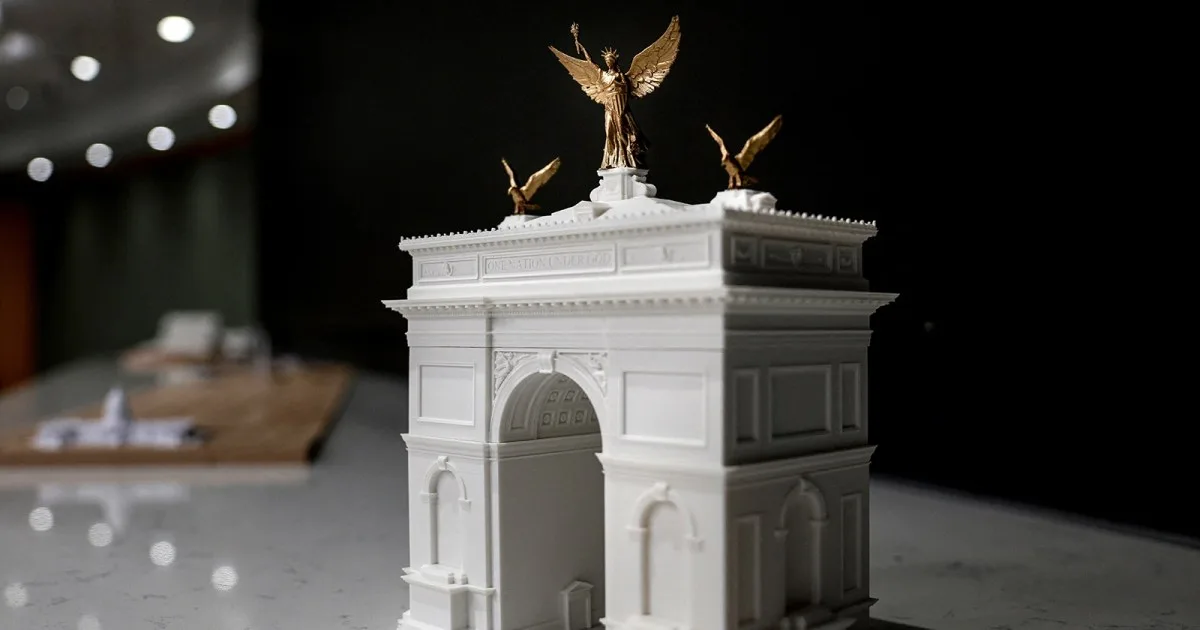
Trump first unveiled plans last October for a 250-foot Arc de Triomphe-style monument in honor of the country’s 250th anniversary, featuring a towering, gilded structure that would dwarf the nearby 99-foot Lincoln Memorial. As legal challenges mounted, the stated purpose of the arch shifted. The administration included sworn declarations from Defense Secretary Pete Hegseth and Homeland Security Secretary Markwayne Mullin in court filings to support the national security rationale. However, the final plans submitted to the planning commission contained no mention of a military complex or national security purpose.
There will be no facility like this anywhere in the world.
Donald Trump, via NY Post
During commission proceedings, Mark Paoletta defended the project by insisting it was a national disgrace
that a memorial arch had not been placed at Memorial Circle despite a 1925 law designating the site for such a memorial. Government submissions last week outlined a 106-page plan featuring a structure more than 12 storeys high, complete with a huge bronze statue of Lady Liberty with wings carrying a torch with an eternal flame, an observation deck, two mezzanines, program spaces, offices, elevators, and a fire command centre. Meanwhile, Robert Stander, an administration lawyer, argued in court that the arch was absolutely a high-priority project
and any delay would impede government work. Beyond the federal lawsuits, the Arlington County Board in Virginia filed a separate suit earlier this month alleging the administration bypassed the full review process, and a judge has yet to rule on that complaint.
With the temporary restraining order active for at least 14 more days, readers and travelers passing through the national capital region should watch for upcoming hearings in U.S. District Court as Judge Chutkan weighs whether to convert her restraining order into a preliminary injunction, alongside pending decisions in the separate lawsuits filed by the Arlington County Board and military veterans.