Four Dead and 88 Injured in Egypt Train Collision
Two trains collided in Egypt's Giza province on Sunday, resulting in four deaths and 88 injuries. President Abdel-Fattah el-Sissi ordered an investigation into the tragedy.

Seven Dead and at least 125 Injured in Egypt Train Collision
Seven people were killed and at least 125 others were injured on Sunday when two passenger trains collided in Egypt's Giza province, the Chief Prosecutor’s office said in a statement. The train’s conductor was among those killed, the office said. The Health Ministry gave the casualty toll, saying in a statement that over 70 of the injured were discharged after receiving treatment.
The Crash in Al-Ayyat
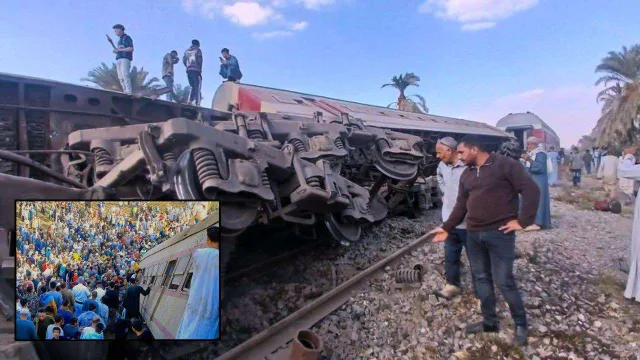
The tragedy unfolded on Sunday, when a train traveling to southwestern Fayoum province crashed into the rear of another train heading to the southern province of Aswan, according to the Transportation Ministry. According to Egyptian authorities cited by The Times of India, the train running from Giza to Fayoum rammed into the rear of the train running from Cairo to Aswan. The Chief Prosecutor’s office said late Sunday its investigators had arrived at the site. An inspection indicated that the crash took place when the Giza-Fayyoum train collided with the last car of the Cairo-Aswan train, which was stationary on the same track and traveling in the same direction, officials said. Authorities have not yet announced the cause of the collision.
The impact occurred in the al-Ayyat district, approximately 52 kilometers (32 miles) south of Cairo, on the outskirts of the capital. Several carriages derailed, drawing crowds of bystanders alongside members of the public who pitched in to pull survivors from the wreckage. Ayman Gamal, a resident of Kafr Girza in al-Ayyat where the crash happened, said people living nearby rushed to the scene, pulled out survivors and called ambulances. Gamal said that he saw around 80 of the injured being taken by ambulances to nearby hospitals. Some passengers were trapped inside one of the cars of the stationary train and were dead when they were pulled out, he said.
Giza province is famous for being home to Egypt’s ancient pyramids. The al-Ayyat district is located near the Nile River in the south of Giza. Last September, a train driver and his assistant were injured after two freight trains collided in the same district.
Emergency Response and Conflicting Casualty Counts
The immediate aftermath saw a massive deployment of emergency resources, though initial local reports differed on the exact scale of the human toll. While the Chief Prosecutor’s office said seven people were killed and at least 125 were injured, and the Health Ministry said over 70 of the injured were discharged after receiving treatment, some local media reports cited a higher injury toll of 120, and Egypt's Health Ministry initially confirmed that 64 people had been injured in the accident without immediate information on deaths. NBC News reported that three of the victims died at local hospitals while one was declared dead at the scene.
Medical facilities in Giza and the neighboring Beni Suef governorate were placed on high alert as rescue operations got underway. The Health Ministry deployed 72 ambulances to the site for evacuation purposes, though Times Now reported around 50 ambulances were deployed. The wounded were transported to three different hospitals, with specific figures showing 54 injured passengers taken to Al-Wasta Hospital and another 10 admitted to Al-Ayyat Hospital.
Outside al-Wasta Central Hospital in Beni Suef province, where some of the injured were taken for treatment, survivors said passengers were in shock and struggling to breathe because of all the dust that was kicked up. Nearby villagers eventually got them out, they said. Farha Gamal, a survivor who was inside the Fayyoum train, said she saw some of the passengers who appeared dead and others were struggling to find their way out of the car. There were other cars that were completely mangled, she said in an interview. There were other cars that were completely mangled,
she told the AP.
President Abdel-Fattah el-Sissi said in a social media post that he ordered a prompt investigation into the crash. He added that authorities had been ordered to investigate the circumstances of the tragedy and to hold accountable anyone who proves their negligence. Times Now reported that Egyptian prosecutors have launched an investigation into the accident and police have been directed to conduct inquiries and question witnesses and injured passengers.
Clearing the Wreckage and Restoring the Line
Emergency teams and cranes were dispatched to the scene to clear the wreckage and restore train services to their normal schedule as soon as possible, the Egyptian Railway Authority said.
The incident has once again drawn attention to railway safety in Egypt, where train derailments and crashes are common, where the railway system has a history of mismanagement and poor maintenance of equipment, and where the government has announced modernization initiatives in recent years. The recurrence of accidents in the same district — following last September's collision between two freight trains in the same Al-Ayyat district that left a train driver and his assistant injured, highlights persistent vulnerabilities in regional rail operations. Egypt’s deadliest train crash was in 2002, when more than 300 people were killed after a fire broke out on an overnight train journeying from Cairo to southern Egypt. As investigators examine the situation to establish the cause of Sunday's collision, the immediate priority remains clearing the wreckage and restoring the service.
Updated 3 times since publication; last update 9 November 2026, 02:23.