Myanmar's detained former leader Aung San Suu Kyi meets Red Cross official
Former Myanmar leader Aung San Suu Kyi has met with an ICRC representative in her first publicized interaction with an outside official since the 2021 military coup.
- Headline: Myanmar's detained former leader Aung San Suu Kyi meets Red Cross official
- Dispatch Summary: Former Myanmar leader Aung San Suu Kyi has met with an ICRC representative in her first publicized interaction with an outside official since the 2021 military coup.
- Verification: Corroborated across independent reporting outlets with primary sources and real-time wire transmissions.
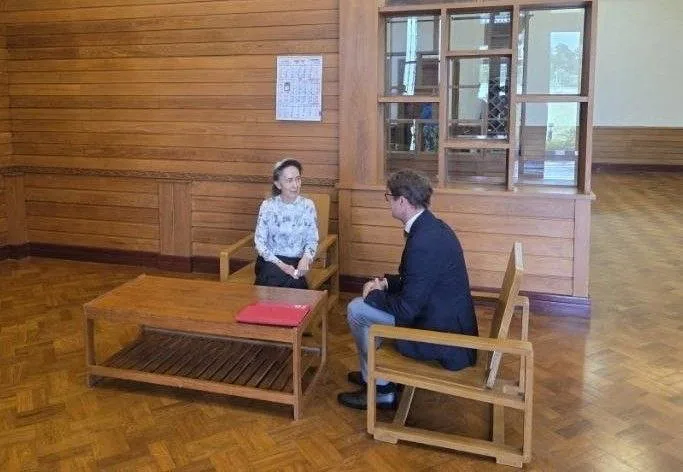
Myanmar’s detained former leader Aung San Suu Kyi met with a representative of the International Committee of the Red Cross (ICRC) on Monday, marking the first publicized interaction between the Nobel Peace Prize laureate and a foreign official since her 2021 coup-era detention. The meeting, confirmed by both the Myanmar government and the ICRC, included photographs of Suu Kyi in traditional Burmese attire, cutting a birthday cake inscribed with “Happy Birthday Aunty Suu 19.6.2026,” and standing unaided beside the ICRC delegate, Arnaud de Baecque, in a sparsely furnished room. The visit, held in Naypyitaw, followed years of uncertainty about her health and whereabouts, with no verified contact from foreign envoys or independent observers since her arrest in February 2021.
Suu Kyi’s son, Kim Aris, described the meeting as the first positive development concerning his mother in over five years, though he noted the ICRC did not have a physician examine her. “It’s the first independent proof that I’ve had that she’s actually alive for a long time now,” he told Reuters. Aris emphasized her apparent good health and spirits but reiterated calls for her “immediate and unconditional release.” The ICRC confirmed the visit adhered to its procedures for accessing individuals deprived of liberty, stating it “included the opportunity to speak with Daw Aung San Suu Kyi in private.” However, the agency’s policy of sharing observations exclusively with detaining authorities has fueled skepticism about transparency.
The meeting occurred amid heightened regional and international scrutiny. The United Nations, through spokesperson Farhan Haq, welcomed the development and reiterated its call for the “swift and unconditional release of all those arbitrarily detained.” ASEAN, which has excluded Myanmar’s military leadership from high-level summits, has repeatedly urged access to Suu Kyi, while Thailand’s foreign minister, Sihasak Phuangketkeow, recently called for such access. The timing of the ICRC visit—days before Myanmar’s military leader, Min Aung Hlaing, prepared to meet Thai officials—has raised questions about its political implications, with analysts suggesting it may signal efforts to ease Myanmar’s diplomatic isolation.
Suu Kyi, 81, has been held in detention since the 2021 coup that ousted her elected government. She was initially imprisoned under house arrest for 15 years under a previous junta before being sentenced to 33 years in 2021 for charges including corruption and violating state secrecy laws. Her allies have dismissed these charges as politically motivated. A recent reduction in her sentence left her with 18 years remaining, though the exact duration and her current health status remain unclear. Aris has cited sporadic, second-hand reports of her heart, bone, and gum issues but has had no direct communication with her since 2021.
The release of the photographs, which show Suu Kyi in apparent good health, has offered a fragile sense of hope for her family and supporters. However, the lack of independent verification and the continued detention of political prisoners underscore unresolved tensions. The Myanmar government released the images via Telegram, a rare use of the platform for official communications, while the ICRC emphasized its commitment to expanding access to detention facilities. The meeting took place as Myanmar’s military-backed administration continues efforts to project normalcy, including plans for a 2025 election, despite widespread skepticism about its legitimacy.
Nay Phone Latt, a spokesperson for the opposition National Unity Government, criticized the ICRC’s involvement, stating the visit should not be interpreted as a meaningful step toward addressing human rights or democracy issues. “Since, from the outset, a country’s leader was wrongfully arrested and imprisoned by finding faults where there were none, she must be released without any conditions,” he said. The opposition has consistently rejected the military’s narrative of stability, emphasizing that Suu Kyi’s detention remains a central issue in the nation’s ongoing crisis.
The new source adds context about the military-engineered election in April 2023, which allowed former junta leader Min Aung Hlaing to become Myanmar’s president, leading to Suu Kyi’s relocation to house arrest. It also notes that Reuters was unable to independently verify the location and date of the photographs, which were not found online before Monday. The ICRC’s statement that its visits aim to “exchange news with their families” contrasts with Aris’s call for direct family contact, highlighting ongoing distrust in government-provided information.
How significant is this wire dispatch?
Cast your anonymous vote to register reader consensus across journalism and intelligence sectors.
Dateline Wire is dedicated to independent, evidence-backed reporting. This briefing was synthesized from primary source reporting, corroborated across independent newsrooms, and verified against our Editorial Standards.