Nobel Peace Prize 2026 awarded to Navanethem Navi Pillay
The 2026 Nobel Peace Prize has been awarded to 85-year-old South African jurist Navi Pillay in a powerful defense of the global judiciary amid intense international friction and U.S. sanctions.
- Headline: Nobel Peace Prize 2026 awarded to Navanethem Navi Pillay
- Dispatch Summary: The 2026 Nobel Peace Prize has been awarded to 85-year-old South African jurist Navi Pillay in a powerful defense of the global judiciary amid intense international friction and U.S. sanctions.
- Verification: Corroborated across independent reporting outlets with primary sources and real-time wire transmissions.
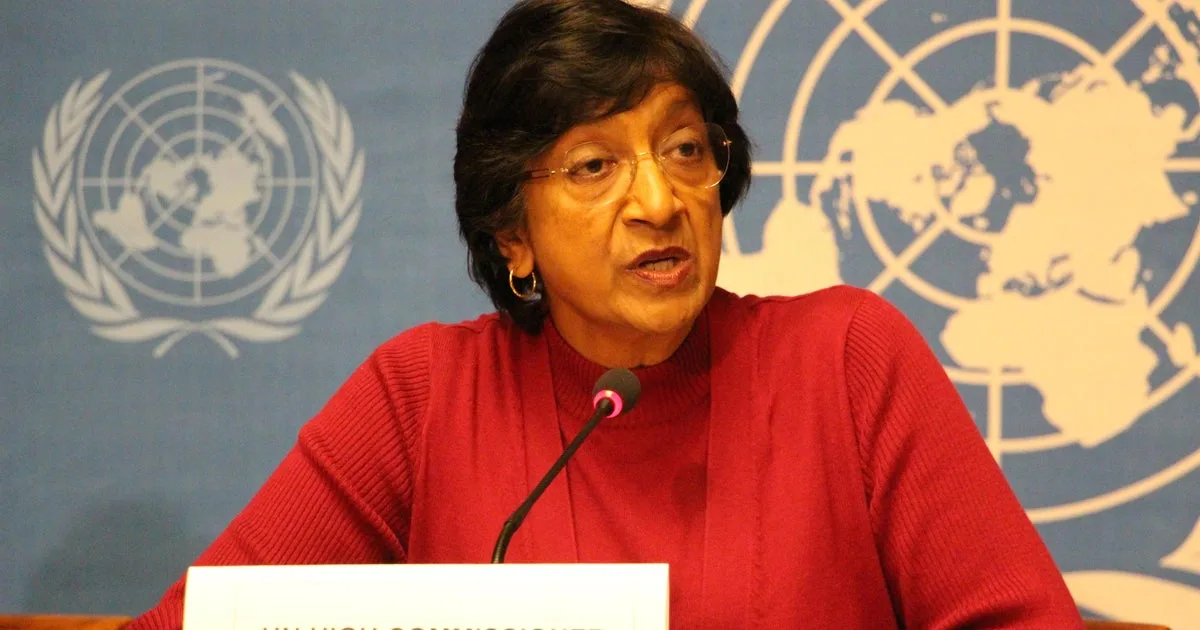
Navanethem Navi Pillay, the 85-year-old South African human rights pioneer, former U.N. human rights chief, and International Criminal Court judge, received the news of her 2026 Nobel Peace Prize on Friday while attending the Nuremberg Forum, a gathering to discuss international law in Nuremberg, Germany, the location of the trials of Nazi war criminals that helped lay the foundations of international law.
Receiving the news to a standing ovation, Pillay told the audience at the venue: Firstly, at this venue, your applause means a great deal to me. You know, you don't want to receive an award, prize or anything unless the public agrees that you deserve this.
Joking, she added: But being a lawyer and a judge, I still want to verify this information.
Announced by Jørgen Watne Frydnes, chair of the Norwegian Nobel Committee in Oslo, Norway, the 125th Nobel Peace Prize marks a milestone anniversary since the prize was first awarded in 1901. The award comes with prize money of 12 million Swedish kronor (about $1.2 million). The Norwegian Nobel Committee recognized Pillay for her efforts to promote peace and international law, specifically praising her work ensuring that war crimes, crimes against humanity and genocide are prosecuted and describing her as a trailblazing jurist and one of the most courageous and important legal experts of our time.
Defending the Rule of Law Against Power Politics
The honor directly confronts mounting political attacks and sanctions leveled against global courts, most notably the United States' recent actions against the International Criminal Court. Jørgen Watne Frydnes stated from the podium that the award is a direct message to those undermining international systems, warning of a dangerous global shift toward power politics at the expense of legal frameworks. That dynamic pits independent judicial bodies against powerful sovereign states, creating high stakes for jurists who enforce global accountability.
The committee noted that the decision arrives at a time of severe global friction, serving as an explicit rebuke to geopolitical forces challenging the global judiciary. In awarding the prize to Pillay, the committee is drawing a sharp line between rule-of-law advocates and political leaders seeking to dismantle those exact frameworks.
With this year's award, the Norwegian Nobel Committee wants to remind the world that the rule of law, national and international, underpins the system we have set up to ensure peace and resolve conflicts non-violently, Jørgen Watne Frydnes said on Friday.
That system of international law is under tremendous pressure, and its institutions are under attack, Frydnes added. We see a shift towards power politics at the expense of legal frameworks and global respect for law and justice, he said. Whenever might overtakes right, it undermines stability, trust and peaceful co-existence.
He continued: History has shown that a world operating without the rule of law is unjust, unwise and inhumane. The judges – those who guard the thin red line between order and chaos – are therefore highly deserving of our praise. But today, as these same judges are sanctioned, and their institutions are under attack, we need people of courage, vision and determination – qualities that Navi Pillay demonstrates in her work on the bench.
This is a message that international law and its institutions are the cornerstone of a more peaceful world. So of course, we hope that this prize also will strengthen the institutions, the individuals, not only Navi Pillay, but particularly her, Frydnes said.
The committee further emphasized in its statement: At a time of existential challenges – including more wars and conflicts than the world has seen in a long time – international law is no longer just a supplement to peace and security. It is an absolute necessity.
The consequences of this year's award ripple directly through international diplomacy and the protection of jurists operating in hostile geopolitical environments. The International Criminal Court has faced intense pressure from the Trump administration over the past year. Following the ICC's 2024 issuance of an arrest warrant for Israeli Prime Minister Benjamin Netanyahu, the United States imposed sanctions against the United Nations court. President Trump accused the court of illegitimate and baseless actions targeting America and its close ally Israel. In response, the ICC condemned the U.S. sanctions against its staff, stating they were intended to harm the court's independent and impartial judicial work.
U.S. President Donald J. Trump had heaped extraordinary pressure on the Norwegian committee to give him the award, despite his ongoing war on Iran that has devastated the global economy and provoked wider instability in the Middle East. Ahead of Friday's announcement, he said he believed he deserved the recognition but acknowledged uncertainty over the committee's decision. The White House reacted furiously to Trump's snub and berated the Norwegian Nobel Committee for placing politics over peace. On the same day, Pakistan announced it had nominated Trump for the prize once again for playing a historic role in advancing peace in South Asia. Prime Minister Shehbaz Sharif wrote on X on Friday: His timely intervention helped bring Pakistan and India back from the brink and secure a ceasefire, that is holding till today.
For observers tracking the pulse of international relations, the tension is palpable:
- The Norwegian Nobel Committee chose to spotlight judicial independence over conventional political figures or leaders coveted by prognosticators.
- The International Criminal Court and the International Court of Justice find their institutional legitimacy reinforced by the prize amid direct U.S. sanctions and political hostility.
- Human rights advocates and victims of violence gain renewed moral backing, even as national governments push back against tribunal oversight.
- Global jurists face heightened scrutiny and professional risks while navigating cases involving genocide, war crimes, and state leaders.
This institutional clash contrasts sharply with last year's award. In 2025, Venezuelan opposition leader María Corina Machado, a democracy and peace activist who sought to replace the Venezuelan government, won the Nobel Peace Prize for her struggle to achieve a democratic transition in the South American nation, winning recognition as a woman who keeps the flame of democracy burning amid a growing darkness.
Machado later handed her medal to President Trump in a symbolic gesture as a recognition for his unique commitment with our freedom, shortly after the United States ousted then-dictator Nicolás Maduro. However, the award itself remained hers, as the Nobel Committee has stated the honor cannot be transferred. By contrast, awarding Pillay signals a rigid defense of institutional international law rather than partisan democratic transitions.
This year's Nobel prize announcements span multiple disciplines, highlighting scientific discovery alongside human rights. Earlier in the week, the medicine prize went to three scientists for a light-based brain research tool, physics recognized neutrino research, and chemistry honored mirror-image molecule discoveries. Anne Carson won the literature prize on Thursday for bold and inventive
works that fuse the classical and the modern and blur the boundaries of poetry and prose, while the economic sciences prize is scheduled for Monday. The 2026 peace prize race attracted 287 nominations, including individuals and organizations. Other contenders included the International Space Station, emergency teams in Sudan following major cuts to USAID and a reduction in international support for aid operations, children's advocates in Ukraine, and two top international courts.
A Lifetime on the Front Lines of Justice
Born on September 23, 1941, in Durban, South Africa, into a family of Indian Tamil origin, Navanethem Pillay grew up under apartheid where racial segregation shaped every aspect of life. Her father worked as a bus driver, and she faced intersectional hardships, deep structural discrimination, segregation, and exclusion. Despite racial and gender barriers, she studied law at the University of Natal. In 1967, she made history as the first woman to start a law practice in Natal Province, defending anti-apartheid activists, political detainees, and others who stood up against apartheid. She later earned a Master of Law and a Doctor of Juridical Science degree from Harvard University in 1988.
Pillay's career is marked by pioneering judicial roles across major international tribunals:
| Role or Institution | Years Active | Key Contributions |
|---|---|---|
| High Court of South Africa | 1995–1999 | Appointed as the first Black woman judge and first non-white woman on the court following the end of apartheid. |
| International Criminal Tribunal for Rwanda | 1995–2003 | Served as judge and president (1999–2003); established that rape and sexual violence constitute genocide and crimes against humanity, and pioneered propaganda-based incitement charges in the Akayesu case, overseeing major rulings regarding the role of media and hate speech in inciting mass violence. |
| International Criminal Court | 2003–2008 | Served as a judge in the Appeals Division, upholding independent international judicial standards and contributing to the establishment and early judicial operations of the permanent international court for war crimes. |
| United Nations High Commissioner for Human Rights | 2008–2014 | Advocated globally for human rights protection, expanded the global focus on marginalized groups, advocated strongly for universal human rights standards, openly challenged governments and national leaders over violations of international law, and was ranked by Forbes as the 64th most powerful woman in the world in 2009. |
| International Court of Justice | 2019–Present | Serving as an ad hoc judge in the genocide case against Myanmar, alongside her tenure chairing the UN Independent International Commission of Inquiry on the Occupied Palestinian Territory from 2021 to 2025, which concluded last year that Israel has committed genocide in Gaza (a report dismissed by Israel as scandalous). |
Reflecting on her legacy, the Nobel Institute noted that a common thread runs from her early work defending Nelson Mandela and others who stood up against apartheid to her service as a judge in some of the key international court cases of our time. Co-founder of the international women's rights organization Equality Now in 1985, and a member of the Women's National Coalition where she contributed significantly to drafting South Africa's post-apartheid Constitution with a focus on equality clauses, Pillay has consistently held states and national leaders accountable and brought hope to victims of violence and conflict while holding firm a moral compass in her long career. Jørgen Watne Frydnes stated from the podium that the committee had been unable to reach Pillay on Friday morning to inform her of the win, broadcasting a public appeal for her to pick up her phone if she saw a call from a Norwegian number before she ultimately received the news at the Nuremberg Forum in Nuremberg, Germany.
Updated 3 times since publication; last update 9 October 2026, 13:42.