T. rex fossil Gus sells for record $50.1m at auction
A T. rex skeleton named Gus has set a record for the highest price paid for a dinosaur at auction. The sale has sparked debate among paleontologists concerned that private ownership may limit access to the fossil for scientific research.
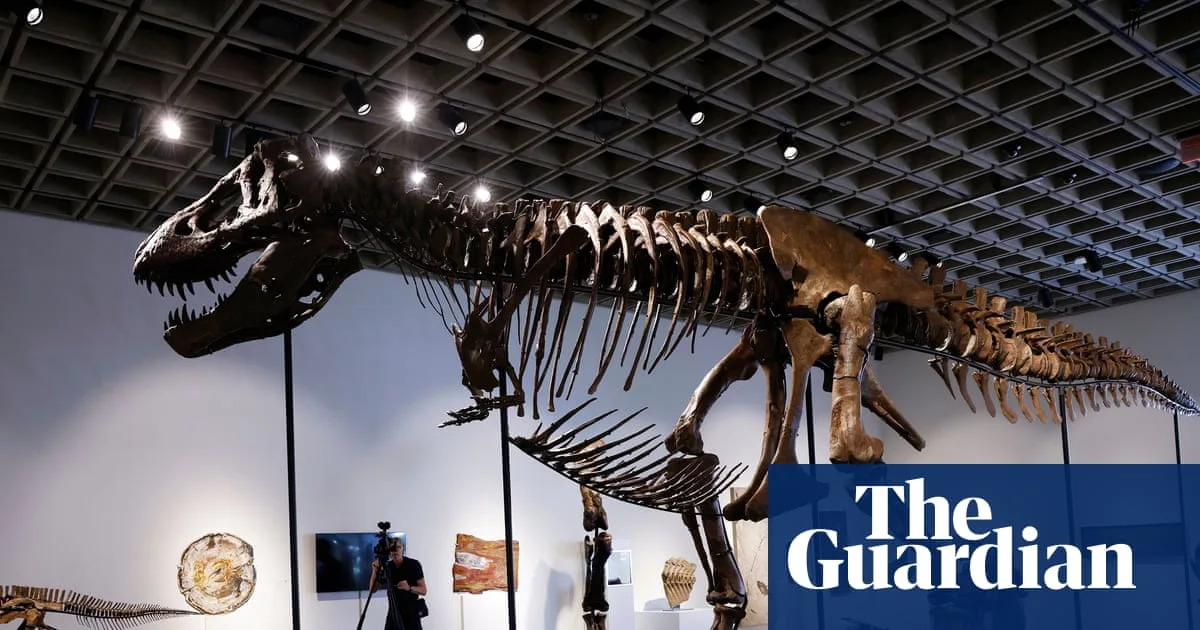
A Tyrannosaurus rex fossil named “Gus” has set a new record for the highest price ever paid for a dinosaur at auction, selling for $50.1 million at Sotheby’s in New York on Tuesday, July 14, 2026. The sale, which exceeded the auction house’s pre-sale estimate of $20 million to $30 million, surpassed the previous record of $44.6 million for a stegosaurus called Apex, sold in 2024. The fossil, described as one of the largest and most complete T. rex skeletons ever discovered, was auctioned after a 10-minute bidding battle involving seven participants, with the winning bidder remaining anonymous.
Unearthed in 2021 on a ranch in Harding County, South Dakota, Gus was excavated over three years by the commercial fossil outfit Theropoda Expeditions, with permission from the land’s owner, Gary “Gus” Licking. The skeleton, estimated to be 67 million years old, measures 12.5 feet tall and 38 feet long, with 183 fossilized bones and 30 rarely mounted gastralia (belly ribs). Sotheby’s described the specimen as 61% complete by bone count and 75 to 80% complete by bone mass, with an “exceptionally preserved skull” that includes all six dentitions. The auction house also highlighted its “exceptional” preservation, noting pathologies such as healed fractures and bite marks on the skull and post-cranial elements, likely from combat or scavenging.
Gus was named in honor of Licking, who died during the excavation process. The skeleton was displayed publicly at Sotheby’s New York headquarters from July 1 to 14, with its massive head — too heavy to mount on the skeleton — placed in the lobby as a striking visual. The auction house emphasized the specimen’s rarity, noting that only two other T. rex fossils, Sue and Stan, are confirmed to be over 60% complete. Sue, housed at the Field Museum in Chicago, and Stan, displayed at the Natural History Museum in Abu Dhabi, are the only other T. rex specimens of similar completeness.
The sale has sparked significant concern among paleontologists, who argue that private ownership of such fossils limits access for scientific research. Professor Richard Butler of the University of Birmingham warned that the trend of auctioning fossils as “status symbols” risks excluding museums, which cannot compete with the financial power of private collectors. “A fossil not in a recognized museum collection cannot be studied and is therefore lost to research,” he said. Similarly, Professor Stephen Brusatte of the University of Edinburgh acknowledged the legal permissibility of the sale in the U.S., where landowners can control discoveries on their property, but expressed unease over the implications for science.
Sotheby’s vice-chairman Cassandra Hatton defended the auction, stating that Gus’s “exceptional” preparation and documentation justified its market value. She emphasized the role of commercial fossil companies in recovering and preserving specimens that might otherwise remain buried. However, critics argue that such sales prioritize profit over public access. Thomas Carr, a paleontologist at Carthage College, stressed that fossils in private collections lack the permanence of museum holdings, risking their availability for future study. “A fossil in a public trust is a win for science and society,” he said, contrasting it with the “hoarding” of specimens by wealthy individuals.
The auction also highlighted the growing commercialization of dinosaur fossils. While some private buyers have donated specimens to museums, such as the stegosaurus Apex, loaned to the American Museum of Natural History, others have kept them in private collections. The sale of Gus has reignited debates over the ethics of fossil ownership, with scientists urging legal protections to ensure that rare specimens remain accessible for research. As one expert noted, the $50.1 million price tag underscores the tension between market forces and scientific priorities.
Dateline Wire is dedicated to independent, evidence-backed reporting. This briefing was synthesized from primary source reporting, corroborated across independent newsrooms, and verified against our Editorial Standards.