Gus the T. rex fossil sells for record $50.1 million at auction
A 67-million-year-old T. rex skeleton named Gus has become the most valuable dinosaur fossil ever auctioned after selling for $50.1 million. The sale has prompted concerns from paleontologists regarding the impact of private ownership on scientific study.
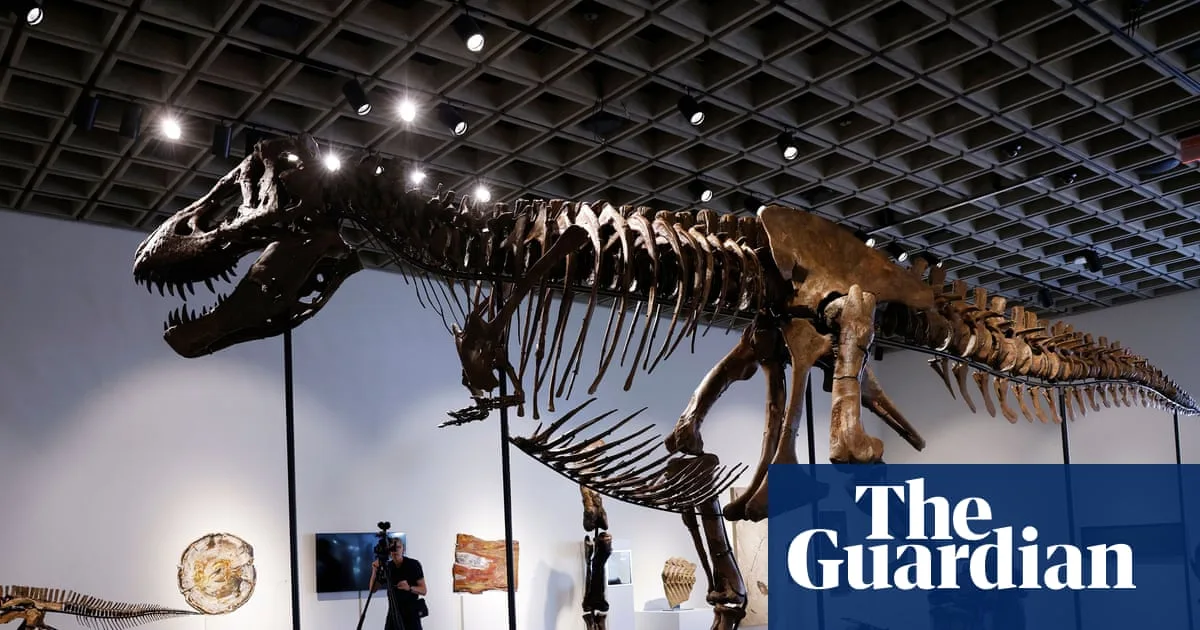
A Tyrannosaurus rex fossil named “Gus” has set a new record after selling for $50.1 million at a Sotheby’s auction in New York, becoming the most valuable dinosaur fossil ever auctioned. The 67-million-year-old skeleton, described as one of the largest and most complete ever discovered, was sold to a mystery bidder on Tuesday, July 14, 2026, far exceeding its pre-sale estimate of $20 million to $30 million.
Standing 12.5 feet tall and 38 feet long, Gus is composed of 183 fossilized bone elements, including rare structures like gastralia (belly ribs) and a furcula (wishbone). The specimen is approximately 61% complete by bone count and 75 to 80% complete by bone mass, with an “exceptionally preserved” skull featuring all six dentitions. Sotheby’s highlighted its rarity, noting that only two other T. rex fossils—“Sue” and “Stan”—are confirmed to be over 60% complete.
Gus was discovered in 2021 on a ranch in Harding County, South Dakota, by Thomas Heitkamp and his team at Theropoda Expeditions. The fossil was named in honor of Gary “Gus” Licking, the rancher who had long suspected the presence of significant remains on his land. Licking died during the excavation, which spanned five years, including three summers of fieldwork and three years of preparation and mounting. The skeleton was later displayed at Sotheby’s Breuer building in New York, where it drew public attention ahead of the auction.
The sale surpassed the previous record for a dinosaur fossil at auction, which was held by a stegosaurus named Apex, sold for $44.6 million in 2024. It also eclipsed the $32 million paid for another T. rex, “Stan,” in 2020. Sotheby’s vice-chairman and global head of science and natural history, Cassandra Hatton, called Gus “an exceptional find” and credited its value to meticulous excavation, documentation, and preparation. “The market responds when great specimens are taken care of in the right way,” she said.
The auction, which lasted 10 minutes, saw seven bidders compete, with the final price far exceeding expectations. Sotheby’s described the fossil as a “monumental item” requiring special handling due to its size and fragility. The skeleton’s head, too heavy to mount on the body, was displayed separately in the auction house’s lobby, a nod to its imposing presence.
Palaeontologists, however, raised concerns about the sale. Richard Butler, a vertebrate palaeontologist at the University of Birmingham, warned that private ownership could hinder scientific research. “A fossil not in a recognised museum collection cannot be studied and is therefore lost to research,” he said. Stephen Brusatte of the University of Edinburgh noted that while the sale was legal in the U.S., it raised ethical questions about the commercialization of fossils. The Society of Vertebrate Paleontology urged the new owner to donate Gus to a museum, emphasizing the importance of public access for scientific advancement.
Gus’s history includes signs of a violent life, with bite marks on its skull and healed fractures in its ribs and gastralia, likely from combat or scavenging. Its discovery site, a complex fossil bed, was preserved alongside flora and fauna from the Late Cretaceous, offering insights into the ecosystem of the time. The fossil’s sale has reignited debates about the balance between private collecting and academic preservation, particularly in countries where fossils are state-owned, such as Brazil and Mongolia.
While the auction house emphasized the specimen’s scientific and cultural value, the anonymity of the buyer leaves unanswered questions about its future. For now, Gus’s record-breaking price underscores the growing intersection of paleontology, art, and commerce, where ancient history commands staggering sums in a market driven by rarity and spectacle.
Dateline Wire is dedicated to independent, evidence-backed reporting. This briefing was synthesized from primary source reporting, corroborated across independent newsrooms, and verified against our Editorial Standards.