US adds Megaspeed to trade blacklist amid Nvidia espionage probe
The U.S. Department of Commerce has added Megaspeed Ltd to its trade blacklist amid an investigation into the diversion of Nvidia AI chips to China. Experts are questioning the effectiveness of the move, noting the absence of the foreign-produced direct product rule in the listing.

The U.S. Department of Commerce has added Singapore-based Megaspeed Ltd and its subsidiary, Speedmatrix, to its trade blacklist, an action taken on Monday following the reinstatement of Nvidia CEO Jensen Huang. The move arrives as the federal government ramps up its response to allegations that Megaspeed functioned as a conduit for funneling high-end Nvidia artificial intelligence chips into China, violating export restrictions that have been in place since 2022.
For ordinary readers and tech investors, the development marks a shift in how Washington monitors the global AI supply chain, even as the political optics of the decision remain complex. Megaspeed’s inclusion on the Entity List ostensibly blocks the firm from acquiring sensitive American technologies without a federal license. However, the practical effect of this specific designation is under sharp debate, with critics arguing the move lacks the necessary legal teeth to actually halt the transfer of chips.
From Personal Scandal to Policy Pressure
The spotlight on Megaspeed intensified in October, when public reports revealed that Alice Huang, a former executive at the firm, had engaged in a romantic relationship with Nvidia CEO Jensen Huang. U.S. intelligence agencies reportedly identified Alice Huang as a Chinese intelligence asset, though the Chinese government has dismissed these claims as a pretext for imposing a technological blockade
on its AI industry. Jensen Huang publicly characterized his interactions with her as routine business, stating, Our relationship, our interactions, have been related to Megaspeed, and it was all completely normal and not unusual.
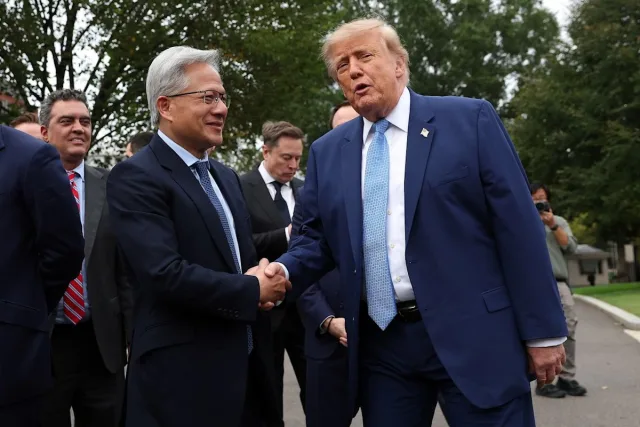
The scandal surrounding the relationship — coupled with reports of a second extramarital affair with an Nvidia employee — triggered a volatile sequence of events. On November 12, Jensen Huang resigned from Nvidia, causing the company’s share price to drop by more than 30% at market open. By the following week, the board faced mounting pressure from shareholders and, according to President Donald Trump, direct intervention from the White House. On Monday, after Trump told CNBC he had convinced
the company and made the deal
to facilitate Huang's return, the board reinstated him. Following his return, the stock rallied, though it remained below its pre-scandal valuation.
The Department of Commerce now finds itself under fire for the timing and efficacy of its blacklist action. Treasury Secretary Scott Bessent previously told CNBC that while other federal agencies had supported blacklisting Megaspeed for months, the Commerce Department, led by Secretary Howard Lutnick, held the ultimate authority. The Commerce and Justice departments stated they have been investigating Megaspeed since 2024, a process that included site checks, record requests, and interviews. Despite this, experts contend the latest enforcement may be functionally hollow.
- Nvidia shareholders: Impacted by stock volatility tied to the leadership crisis and ongoing federal scrutiny.
- Megaspeed Ltd: Now restricted from acquiring sensitive U.S. technology without federal licensing.
- U.S. National Security Officials: Working to curb Chinese access to advanced chips through illicit supply chains.
- Tech industry observers: Monitoring whether the administration’s focus on individual companies will lead to broader, systemic changes in export control policy.
The Question of Enforcement Efficacy
Chris McGuire, former deputy senior director for technology and national security at the National Security Council, characterized the Commerce Department's action as having ZERO effect.
According to McGuire, the specific regulatory language chosen for the Megaspeed listing failed to include the foreign-produced direct product rule (FDPR). This provision is typically essential for extending U.S. export controls to items manufactured in third-party countries, such as Taiwan, where Nvidia chips are produced, using American technology. Without it, McGuire asserts, the ban does not stop the shipment of these chips to Megaspeed.
The implications of this potential drafting error or strategic omission are significant. Every other Chinese company added to the Entity List due to concerns over AI chip access has had the FDPR applied, making the exclusion of Megaspeed notable. McGuire offered two stark possibilities for the oversight: The generous interpretation here is that Commerce intended this to be perceived as taking strong action against Megaspeed, and didn’t realize that its rule had a drafting error that prevented the rule from having any impact—which just shows how incompetent Commerce has been at administering export controls. The less generous interpretation is that this Entity Listing was intentionally weakened—I don’t know why Commerce would do that.
Meanwhile, the legal proceedings against those involved continue to widen. The Justice Department is currently leading an investigation into whether Megaspeed smuggled AI technology into China. Jensen Huang and Nvidia’s chief legal officer are set to appear next for a closed-door briefing with the House Foreign Affairs Committee. Nvidia’s board, for its part, continues to maintain that its internal inquiry will examine all available information regarding the company’s exposure to foreign intelligence efforts, stating that while they have no reason to believe that either national security or NVIDIA secrets were compromised, the probe remains ongoing.
The Chinese government maintains that Megaspeed operates lawfully. Foreign Ministry spokesperson Guo Jiakun stated on November 9 that the Chinese spy
allegation is purely unsubstantiated and directed at smearing China.