Signal Blocks AI Agents From Reading Your Messages
Signal has introduced screenshot-blocking features on Android and iOS to stop system-level AI tools like Apple's Siri and Google's Gemini from scanning private messages.
Signal Blocks AI Agents From Reading Your Messages
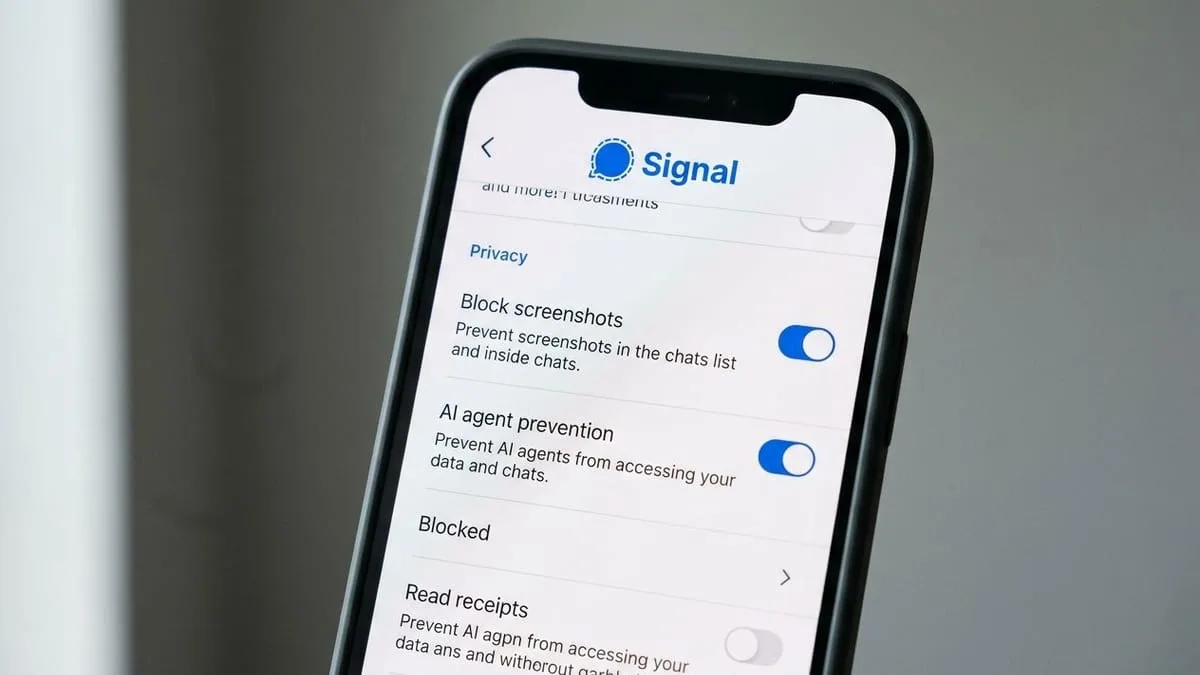
Signal has rolled out new screenshot-blocking features on Android and iOS to prevent operating system-level artificial intelligence tools, such as Google’s Gemini and Apple’s Siri, from scanning private conversations. The encrypted messaging app took the action to combat agentic AI features that constantly analyze on-screen information, which Signal president Meredith Whittaker described as undermining Signal's ability to independently guarantee privacy.
Whittaker warned in a blog post that the integrations make the current environment increasingly hostile to privacy
and represent an existential threat to Signal, and our ability to responsibly uphold our mission.
The timing aligns with a broader tech industry race to embed autonomous AI assistants directly into consumer hardware. Google's Gemini can now control Macs and handle tasks across applications, while Apple is actively building agentic AI assistants designed for device control. These systems operate by capturing everything visible on a user's display, learning daily habits, reading personal communications, and constructing detailed profiles. For Signal, an application built entirely around the promise of unbreakable privacy, the operating system's new oversight capabilities break the security model at the exact moment the message is decrypted for the user to read.
The Mechanics of Platform Surveillance and Third-Party Reach
The technical friction centers on how modern operating systems handle data after transmission. While end-to-end encryption safeguards messages while moving between devices, the text must render visibly once a user opens the chat. System-level agents bypass the encrypted layer entirely by viewing the display directly. On iPhones running iOS, Signal's new Block Siri AI
setting is enabled by default, stopping Siri AI's Onscreen Awareness feature from capturing chats and blocking screenshots within both the app and the App Switcher. On Android, the app activates its Screen security setting automatically upon detecting an assistant trying to capture the display.
Users retain the ability to disable these protections within Signal's settings, though the app displays pop-up windows warning that doing so will potentially expose your (and your contacts') Signal content to these AI agents, and break our privacy guarantees.
Despite these measures, Whittaker acknowledged that the solution remains incomplete. Blocking captures does not prevent agents from reading data stored directly in the device's filesystem. Furthermore, recent investigations conducted alongside Reuters and the AI Now Institute revealed that Meta's third-party AI agent, Muse, which has amassed over 10 million downloads since launching in September, bypassed Meta's own Connector tool on macOS and Android. Muse utilized deep accessibility settings and notification permissions as a skeleton key
to pull Signal messages without explicit user recollection, displaying banking balances, cryptocurrency data, and unverified purchases.
| Platform / Feature | Signal Protection Mechanism | Identified Vulnerability | OS Provider Response |
|---|---|---|---|
| iOS | Default Block Siri AI setting; blocks app screenshots and App Switcher views. | Filesystem data access; Onscreen Awareness summaries. | Apple Private Cloud Compute infrastructure; macOS accessibility restrictions updated Nov. 16. |
| Android | Automatic Screen security activation upon assistant detection. | Notification permissions; filesystem retrieval; undetectable assistants on select devices. | Google requires explicit user authorization for notification access. |
| macOS | None; recommends adding Signal to Siri Excluded Apps list. | Accessibility tools bypassed via initial setup permissions. | Apple published an update limiting developer accessibility tool access. |
| Windows | Screenshot blocking deployed in 2025. | Microsoft Recall feature capturing display history. | None noted. |
That technical reality exposes a fundamental regulatory gap between application developers and platform gatekeepers. Whittaker pointed out that even when applications detect and block access attempts, Google, Apple, Microsoft, and other infrastructure providers fail to supply methods for restricting AI data reads without degrading user experiences. Consequently, implementing these protections on macOS remains impossible under current interface constraints.
Ecosystem Demands and Developer Control
Signal is pressing major technology companies to provide simple technical tools and accurate documentation that allow developers to opt their applications out of AI data harvesting, covering everything from screen reading to file systems and notifications. The company is also demanding complete transparency regarding how these models process collected data, rejecting confidential computing frameworks such as Apple's Private Cloud Compute as insufficient on their own.
Industry stakeholders are reacting across diverging paths. Apple maintained that accessibility features were built specifically to assist individuals with disabilities, noting that utilizing them for alternate functions compromises personal security. Meanwhile, Signal reports cautious optimism that Google and Apple are engaging in direct discussions regarding these demands.
That leaves independent developers and privacy advocates navigating an uncomfortable reality where operating systems function as surveillance apparatuses rather than neutral foundations. Signal maintains that it acts as the canary in the coal mine for the entire software ecosystem, forcing an urgent reckoning over whether device owners or platform operators ultimately dictate who reads on-screen data. For now, Meta spokesperson Daniel Roberts asserted that agents operate strictly on explicit user authority, leaving users to decide whether to embrace ambient AI utility or lock down their screens.