Bypoll results LIVE: BJP widens lead in West Bengal; TVK leads in Tamil …
Bypoll results across four states and one union territory show the BJP widening its lead in West Bengal and TVK leading in Tamil Nadu.
- Headline: Bypoll results LIVE: BJP widens lead in West Bengal; TVK leads in Tamil …
- Dispatch Summary: Bypoll results across four states and one union territory show the BJP widening its lead in West Bengal and TVK leading in Tamil Nadu.
- Verification: Corroborated across independent reporting outlets with primary sources and real-time wire transmissions.
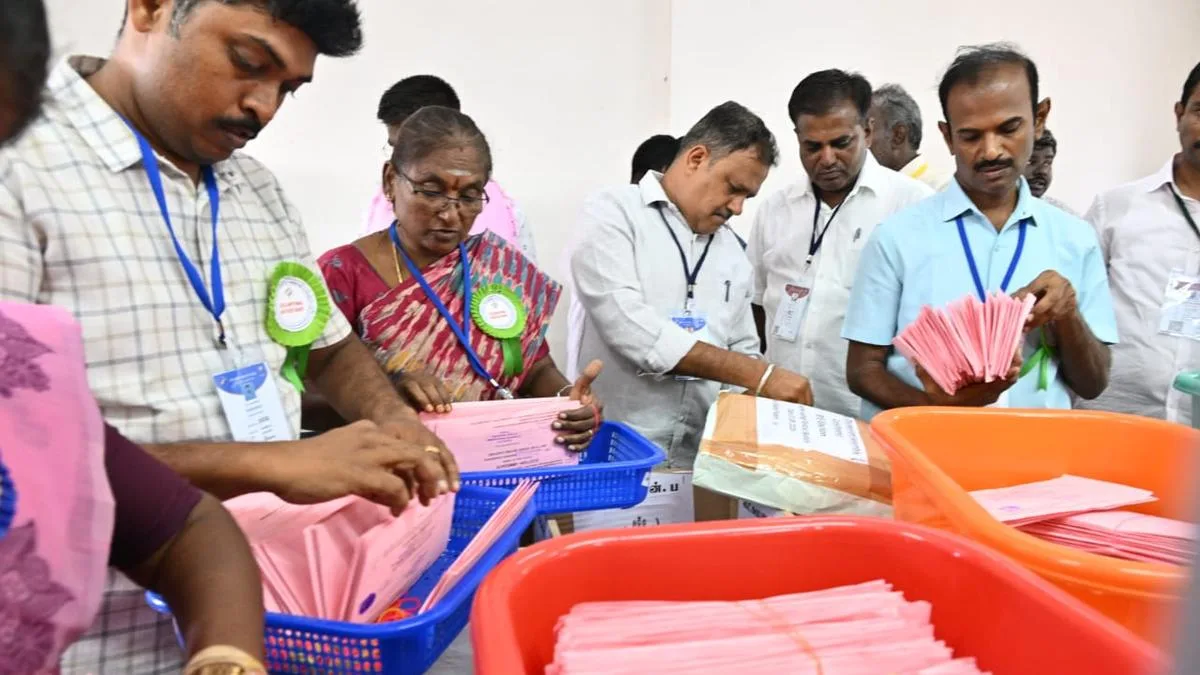
Ordinary readers watching Friday's byelection results across four states and one union territory are witnessing far more than routine ballot counting. They are seeing the first major test of newly established regional power dynamics. From the high-stakes Assembly contests in Tamil Nadu and West Bengal to the parliamentary battle in Assam and a decisive win in Puducherry, vote counting began under tight three-tier security and heavy police deployment on October 9, 2026. These elections follow major political realignments earlier this year, making the figures released by the Election Commission of India a vital barometer of public sentiment.
The central reading of this electoral exercise is that incumbent governments and ascendant new parties are firmly consolidating their recent gains, defying opposition hopes for a swift pendulum swing. The ruling All India N. R. Congress secured an early victory in Puducherry, while Tamil Nadu Chief Minister C. Joseph Vijay-led TVK and the Bharatiya Janata Party in West Bengal and Assam have translated their earlier momentum into commanding vote leads. While opposition parties point to procedural friction and local disputes, the electorate so far shows little appetite for overturning the shifts established in May.
Who is affected and how do the results shape regional politics?
The ripple effects of these bypolls touch voters and political players across multiple distinct regional arenas. The contests directly impact political representation and test the durability of coalitions formed after recent state elections.
- Voters in West Bengal's Nandigram and Rejinagar face a shifting opposition landscape as the BJP tests its strength after ending the Trinamool Congress's 15-year rule.
- Constituents in Tamil Nadu's Madurantakam and Dharapuram are measuring the four-month-old popularity of Chief Minister C. Joseph Vijay's TVK against the established reach of the DMK and AIADMK.
- Electors in Assam's Nagaon Lok Sabha seat are weighing a high-profile three-way contest following a parliamentary vacancy.
- Residents in Puducherry's Thattanchavady constituency see their local representation settled after Chief Minister N. Rangasamy vacated his second seat.
That leaves the opposition parties with shrinking room to maneuver as early tallies confirm their trailing positions. In West Bengal, the stakes are particularly symbolic. Nandigram carries immense political weight as the former center of the anti-land acquisition movement that brought the TMC to power in 2011, and as the seat where BJP's Suvendu Adhikari defeated Mamata Banerjee in 2021 before winning it again in 2026 and retaining Bhabanipur. The exit of Adhikari necessitated the current contest. Opposition figures like Congress Bengal in-charge Prakash Joshi alleged that Suvendu Adhikari must have felt such fear only when he saw the election slipping out of his grasp
and claimed that the administration and the Election Commission failed to maintain a neutral role amid reported intimidation and clashes, pointing out that the people of Nandigram understood the truth, specifically, how Suvendu Adhikari tried to influence the entire election.
How did the key electoral showdowns unfold across the states?
The timeline of events highlights the rapid pace at which leads widened after counting commenced on Friday morning, moving from postal ballots to Electronic Voting Machines under heavy scrutiny.
- On Tuesday, October 6, 2026, roughly 76% of electors voted in Assam's Nagaon Lok Sabha constituency, while Nandigram and Rejinagar recorded turnouts of 80.89% and 80.08% respectively.
- On Wednesday, October 7, 2026, Aam Janata Unnayan Party chief Humayun Kabir broke down in front of the media and hinted at early retirement after an arrest following a confrontation with police during polling in Rejinagar.
- Also on Wednesday, October 7, 2026, the Supreme Court refused to interfere with a Calcutta High Court decision granting interim bail to Congress Nandigram candidate Milan Pradhan.
- On Friday, October 9, 2026, counting began at 8 a.m. across all constituencies, starting with postal ballots under strict security, including at the Motilal Nehru Government Polytechnic College in Thattanchavady and LRG Government Arts and Science College in Dharapuram.
- Later on Friday, October 9, 2026, Election Commission trends showed AINRC candidate Ashok Anand winning Thattanchavady, while BJP and TVK candidates extended their leads in respective regional contests.
The counter-view from the opposition insists that these numbers mask deep local friction. In Rejinagar, the arrest of AJUP chief Humayun Kabir and a tense polling cycle prompted predictions from Kabir that the BJP would capture the Muslim-majority constituency in Murshidabad district even as he hinted at quitting electoral politics. Similarly, in Madurantakam, Independent candidate Dr. G. Moorthy alleged EVM malfunction during counting of votes, claiming that his written requests to inspect VVPAT machines were ignored before security personnel pushed him out of the counting center. Opposition leaders argue these flashpoints undermine the legitimacy of the process, though election officials proceeded with the count under multi-tier security protection.
What do the numbers reveal about the shifting balance of power?
Official tallies from the Election Commission demonstrate substantial margins for the leading contenders. In Puducherry, AINRC candidate Ashok Anand secured victory in the Thattanchavady Assembly seat with 13,358 votes, defeating Congress candidate E. Vinayagam, who garnered 4,876 votes, and DMK's K. Sethu alias Sethuselvam, who took 2,664 votes, handing the ruling coalition an 8,482-vote victory margin. In Assam's Nagaon Lok Sabha seat, BJP candidate Devasish Sharma extended his lead over nearest rival Mohammed Badruddin Ajmal of AIUDF, with Congress candidate Sibamoni Bora at a distant third.
In West Bengal, the BJP established firm control over both assembly seats. In Nandigram, BJP candidate Hasi Rani Rath leads with a margin of 31,943 votes against Congress’s Milan Pradhan. In Rejinagar, BJP’s Sankharav Sarkar is leading by a margin of 20,257 votes against Aam Janata Unnayan party’s Golam Nabi Azad (Robin). Meanwhile, in Tamil Nadu, the ruling TVK demonstrated its electoral viability in two SC-reserved constituencies. In Madurantakam, TVK candidate K. Maragatham Kumaravel is leading, followed by DMK's I. Paranthamen. In Dharapuram, TVK candidate P. Sathyabama continues to lead, with DMK trailing by 6,420 votes and AIADMK in the third spot.
That leaves the opposition with little empirical support for claims of a widespread popular backlash against the ruling parties. The data confirms that voters are largely sticking with the political architecture they constructed earlier in the year. As the final rounds conclude, the results cement the transition of power from old guards to newly dominant regional entities.
The decisive outcomes in Puducherry and the expanding leads in West Bengal, Assam, and Tamil Nadu prove that recent electoral realignments possess durable roots that local opposition campaigns failed to dislodge.