CNN, Politico and MS NOW sue Trump administration over White House ban
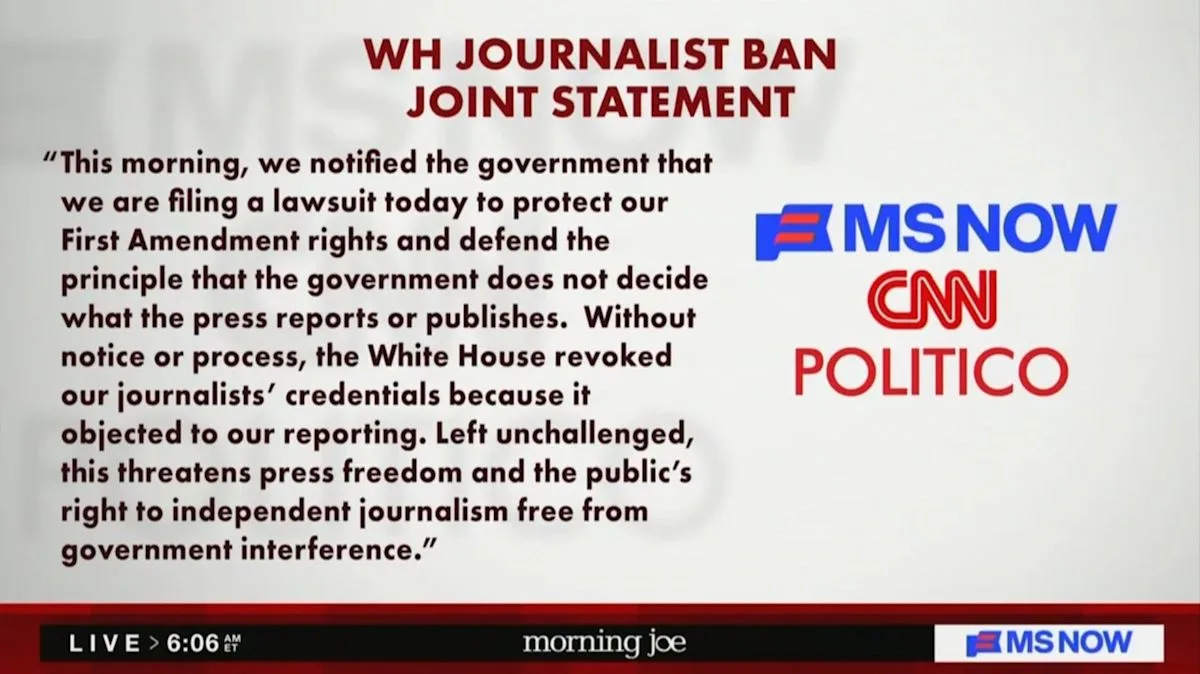
CNN, MS NOW, and Politico have filed a federal lawsuit against the Trump administration, alleging constitutional violations after being barred from the White House.
- Headline: CNN, Politico and MS NOW sue Trump administration over White House ban
- Dispatch Summary: CNN, MS NOW, and Politico have filed a federal lawsuit against the Trump administration, alleging constitutional violations after being barred from the White House.
- Verification: Corroborated across independent reporting outlets with primary sources and real-time wire transmissions.
Outlets Sue Trump Over White House Press Ban, Citing Constitutional Violations
CNN, MS NOW, and Politico have filed a federal lawsuit against the Trump administration, accusing the president of violating the First Amendment and Due Process Clause by barring their journalists from the White House. The three news organizations allege the ban, announced by Trump on Friday, was retaliatory and aimed at stifling critical coverage, marking one of the most significant clashes between the administration and the press in recent years.
The lawsuit, filed in the U.S. District Court for the District of Columbia, seeks to block the ban immediately and restore press credentials to affected journalists. It argues that the White House is a "nonpublic forum" where access must not be restricted based on viewpoint, and that Trump’s actions constitute unlawful retaliation against protected newsgathering. The complaint states that the president "expressly" targeted the outlets for their "negative" reporting, violating constitutional principles by denying them access without notice or process.
"This ban could not be a more direct assault on the First Amendment nor a more blatant violation of our most fundamental constitutional principles," the lawsuit says. The outlets also claim the ban has already "severely impeded" their ability to cover the administration, with journalists like MS NOW’s Akayla Gardner, CNN’s Betsy Klein, and Politico’s Cheyenne Haslett barred from entering the White House on Saturday. Their press badges were confiscated by the Secret Service, according to the complaint.
Trump’s Rationale and Political Backing
Trump announced the ban on Truth Social on Friday, accusing the outlets of "writing fiction and lies" and vowing to target "other Fake News Media Outlets" in the future. The president’s post cited "cumulative stories" by the targeted organizations, stating, "You get sick of it." He also mocked MS NOW, claiming it had "recently changed their name from MSNBC due to lack of viewership and credibility," and criticized Politico for receiving $8 million in government subsidies under President Joe Biden.
Trump’s actions received support from allies, including U.S. Ambassador to the U.N. Mike Waltz, who told CNN’s Dana Bash that the president’s move was "spot on" and that media outlets "don’t have an inherent right" to access government facilities. Republican Senator Tom Barrasso (WY) defended the ban on Sunday, arguing that the press has an "obligation to report fairly" and dismissing concerns about constitutional violations.
The lawsuit highlights the administration’s broader pattern of targeting media organizations. In 2025, Trump’s team barred Associated Press reporters from the Oval Office and Air Force One after the outlet refused to adopt his proposed name change for the Gulf of Mexico. A separate lawsuit by the AP remains pending, with a federal judge previously ruling that the ban violated the First Amendment.
Legal Arguments and Broader Implications
The lawsuit centers on two primary constitutional claims: First Amendment retaliation and Due Process violations. It asserts that Trump’s ban is a "viewpoint discrimination" that violates the principle that government cannot restrict access to a nonpublic forum based on the content of speech. The complaint also argues that the president failed to provide clear standards or an opportunity for the outlets to challenge the decision, violating the Fifth Amendment’s Due Process Clause.
The case names Trump, White House Chief of Staff Susie Wiles, Communications Director Steven Cheung, and Secret Service Director Sean Curran as defendants. It also references the White House’s recent removal of CNN from its scheduled pool rotation for the U.N. General Assembly, which the outlets claim exacerbates the harm caused by the ban.
The Knight First Amendment Institute at Columbia University has previously criticized Trump’s approach, stating that the president cannot "punish journalists because he doesn’t like their coverage." The institute noted that courts have repeatedly ruled against similar actions, emphasizing that the First Amendment protects the press from government interference based on content.
The White House and Justice Department have not commented on the lawsuit, but the case could set a precedent for future conflicts over press access. The White House Correspondents’ Association has urged the administration to restore access, warning that the ban risks establishing a dangerous precedent for other outlets.
Timeline of Key Events
| Event | Date |
|---|---|
| Trump announces ban on CNN, MS NOW, and Politico on Truth Social | September 18, 2026 |
| Journalists from the three outlets denied entry to the White House; press badges confiscated | Saturday |
| Outlets file federal lawsuit alleging First Amendment and Due Process violations | September 20, 2026 |
| White House removes CNN from pool rotation for U.N. General Assembly trip | September 20, 2026 |
Frequently Asked Questions
What legal claims are the outlets making?
The lawsuit alleges that the White House ban violates the First Amendment by retaliating against protected newsgathering and the Due Process Clause by denying the outlets notice or an opportunity to challenge the decision. It also argues the ban constitutes viewpoint discrimination in a nonpublic forum.
What are the potential consequences of the lawsuit?
If successful, the lawsuit could force the White House to restore press access and set a legal precedent against government retaliation against the press. It may also influence ongoing cases involving other outlets, such as the Associated Press’s dispute over restricted access.
The case underscores the escalating tension between the Trump administration and the press, with the outcome likely to shape the boundaries of press freedom in the U.S. The next key development will be the court’s response to the lawsuit, including whether a temporary restraining order is issued to halt the ban while the case proceeds. Meanwhile, the White House’s stance on press access remains a focal point of political and legal scrutiny.
How significant is this wire dispatch?
Cast your anonymous vote to register reader consensus across journalism and intelligence sectors.
Dateline Wire is dedicated to independent, evidence-backed reporting. This briefing was synthesized from primary source reporting, corroborated across independent newsrooms, and verified against our Editorial Standards.