Iran executes three men for 'armed unrest' after January protests
Iran has executed three men convicted of armed unrest during January's nationwide anti-government demonstrations, bringing the total number of related hangings to at least 39.
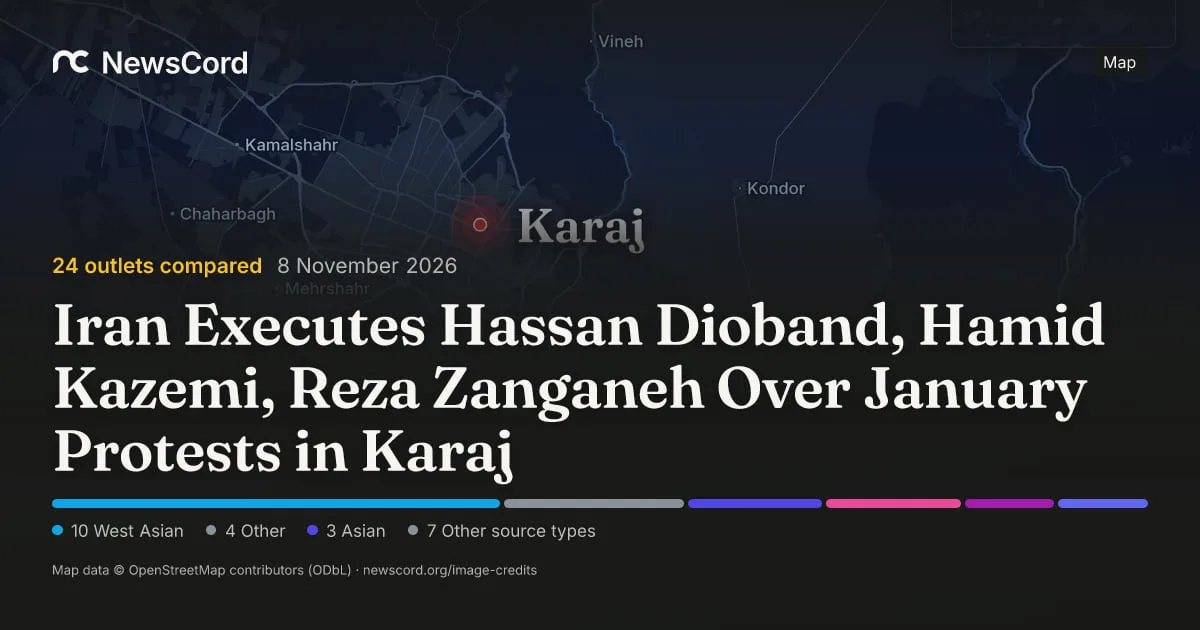
Iran executed three men on Sunday, Hassan Dioband, Hamid Kazemi, and Reza Zanganeh, following convictions for armed disturbances stemming from nationwide anti-government demonstrations in January. The hangings in Karaj, west of Tehran, mark the latest enforcement actions in a judiciary crackdown that has brought the total number of men hanged over the January protests to at least 39, according to Norway-based Iran Human Rights, which warned that many more remain at risk.
State news agency Tasnim and the judiciary’s Mizan news agency reported that the Supreme Court upheld the death sentences and asset confiscation orders for the three men. Authorities accused them of throwing Molotov cocktails and grenades, wielding bladed weapons and firearms, setting fire to public facilities, and damaging an electricity substation in Karaj that caused localized power outages.
What were the charges and how did the judiciary handle the case?
Iranian authorities stated that the convicted men carried out operations on behalf of the Israeli Zionist regime, the United States, and hostile groups. Investigators identified Hassan Dioband as a primary suspect in attacks on public property and incitement to violence, leading to his arrest on January 11. Ten other individuals accused of participating under his supervision were arrested subsequently and received prison terms ranging between five and 10 years, as reported by Reuters.
Rights groups have sharply criticized the legal proceedings, describing the trials as unfair. Despite these objections, the judiciary proceeded with the executions after exhausting appellate reviews through the Supreme Court.
Why are executions accelerating in Iran right now?
The pace of capital punishment has intensified against a backdrop of escalating regional hostilities. Executions in Iran have risen notably since United States and Israeli military strikes against the country began in late February. Some Iranians fear the regime is increasingly entrenched and pursuing retribution, while human rights organizations point to a broader pattern of suppressing domestic dissent under the banner of national security.
The original protest movement ignited in December of last year, initially driven by public anger over the high cost of living. It rapidly evolved into widespread anti-government demonstrations that peaked on January 8 and January 9. Iranian authorities reported more than 3,000 deaths during the unrest, attributing the violence entirely to terrorist acts orchestrated by Washington and Israel.
How do international monitors view the official narrative?
Foreign-based non-governmental organizations and international observers dispute the government's casualty figures and characterization of the unrest. The BBC received multiple accounts from citizens inside Iran stating that security forces opened fire directly on unarmed protesters.
United Nations human rights chief Volker Türk voiced alarm over the surging number of death penalties. In August, Türk stated that at least 56 people had been executed on national security-related charges since March 19, a total that included 27 individuals connected to the January demonstrations. Norway-based Iran Human Rights continues to monitor the situation closely, cautioning that many more were at risk.