Spain World Cup champions return to Madrid for massive victory parade
Nearly two million supporters gathered in Madrid to celebrate Spain's men's World Cup victory. The parade marked a milestone for Spanish football.
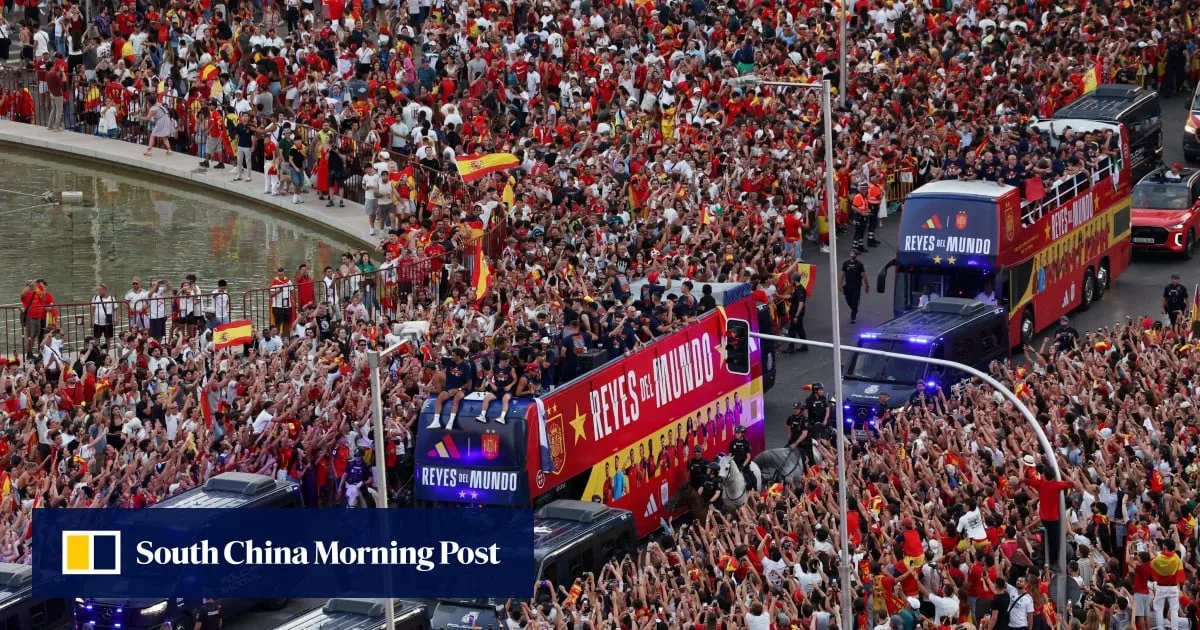
Spain’s World Cup champions returned to Madrid on Monday for a historic victory parade, drawing nearly two million fans in a celebration of footballing supremacy and national pride. The men’s team, who secured their second FIFA World Cup title with a 1-0 extra-time win over Argentina in New Jersey, were greeted by an estimated crowd of 1.8 to 2 million people as they paraded through the capital’s streets, culminating in a grand ceremony at Plaza de Cibeles. The event marked not only a triumph on the pitch but also a milestone for Spanish football, as the nation became the first to hold both the men’s and women’s World Cup titles simultaneously.
The parade began with official receptions at Zarzuela Palace, where King Felipe VI, Queen Letizia, and the royal family congratulated the squad. The players then met Prime Minister Pedro Sánchez before embarking on an open-top bus journey through Madrid’s iconic landmarks. Streets were lined with fans waving red and yellow flags, chanting team slogans, and capturing the moment on mobile phones. The atmosphere was electric, with temperatures exceeding 35°C, yet supporters endured the heat to witness the team’s return.
Key figures in the celebration included 19-year-old Lamine Yamal, whose rise as a star striker was celebrated alongside captain Rodri, who was awarded the FIFA Golden Ball for his tournament-defining performances. The team’s bus, adorned with two stars symbolizing Spain’s World Cup victories, passed through neighborhoods where fans had gathered for hours, creating a carnival-like environment. Forward Borja Iglesias even took on the role of DJ, spinning music as teammates danced and interacted with the crowd.
The victory parade coincided with a broader narrative of Spanish football’s dominance. The men’s team, now holders of the World Cup, European Championship, and Olympic gold, has built on a legacy of tactical discipline and collective play. This success follows the women’s team’s 2023 World Cup triumph and their recent dominance in the Women’s Nations League, cementing Spain’s status as a global footballing power. As the scmp.com article noted, the nation’s ability to maintain a unified footballing identity across genders and age groups has set a new standard in the sport.
Queen Letizia played a central role in the celebrations, wearing a red Adolfo Domínguez dress on both match day and the parade, echoing the colors of the national team. Her appearance, alongside Princess Leonor and Infanta Sofía, underscored the royal family’s support for the squad. The royals joined the players at Zarzuela Palace, where they posed in white “26” jerseys before the team proceeded to Moncloa Palace for further festivities.
While the parade focused on football, the broader context of the 2026 World Cup included political and social debates. Jules Boykoff, a scholar interviewed on Democracy Now!, highlighted the tournament’s role in amplifying global issues, from immigration policy to corporate influence. He criticized FIFA’s revenue model, noting the event’s $15 billion earnings and the exorbitant ticket prices, which he argued prioritized the “luxury classes” over fans. Boykoff also linked the tournament to U.S. political dynamics, including President Donald Trump’s attempts to leverage the event for his agenda, such as deflecting attention from immigration enforcement under ICE.
Despite these controversies, the Madrid parade remained a unifying spectacle. For many Spaniards, it symbolized a rare moment of collective joy amid global tensions. The celebrations also highlighted the personal journeys of players like Yamal, whose 2007 meeting with Lionel Messi at a UNICEF event was revisited during the tournament. The image of the young Yamal, now a World Cup hero, resonated as proof of the sport’s power to connect generations.
As Spain looks ahead to the 2030 World Cup, co-hosted with Portugal and Morocco, the 2026 victory has solidified the nation’s place in football history. The parade in Madrid was not just a celebration of a title but a reaffirmation of Spain’s footballing philosophy: one that values teamwork, development, and enduring excellence. For the fans who filled the streets, it was a moment to cherish—a reminder that in a world often divided, football could still unite.
Dateline Wire is dedicated to independent, evidence-backed reporting. This briefing was synthesized from primary source reporting, corroborated across independent newsrooms, and verified against our Editorial Standards.