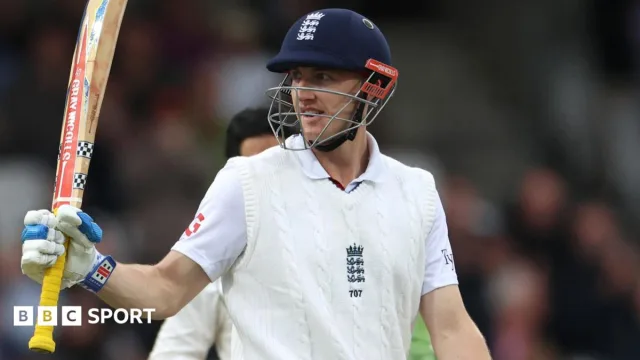
Harry Brook scores England's first ODI double century against Sri Lanka
England captain Harry Brook made history in Rawalpindi by smashing 202 from 114 balls against Sri Lanka, becoming the first Englishman to hit an ODI double century.
- Headline: Harry Brook scores England's first ODI double century against Sri Lanka
- Dispatch Summary: England captain Harry Brook made history in Rawalpindi by smashing 202 from 114 balls against Sri Lanka, becoming the first Englishman to hit an ODI double century.
- Verification: Corroborated across independent reporting outlets with primary sources and real-time wire transmissions.
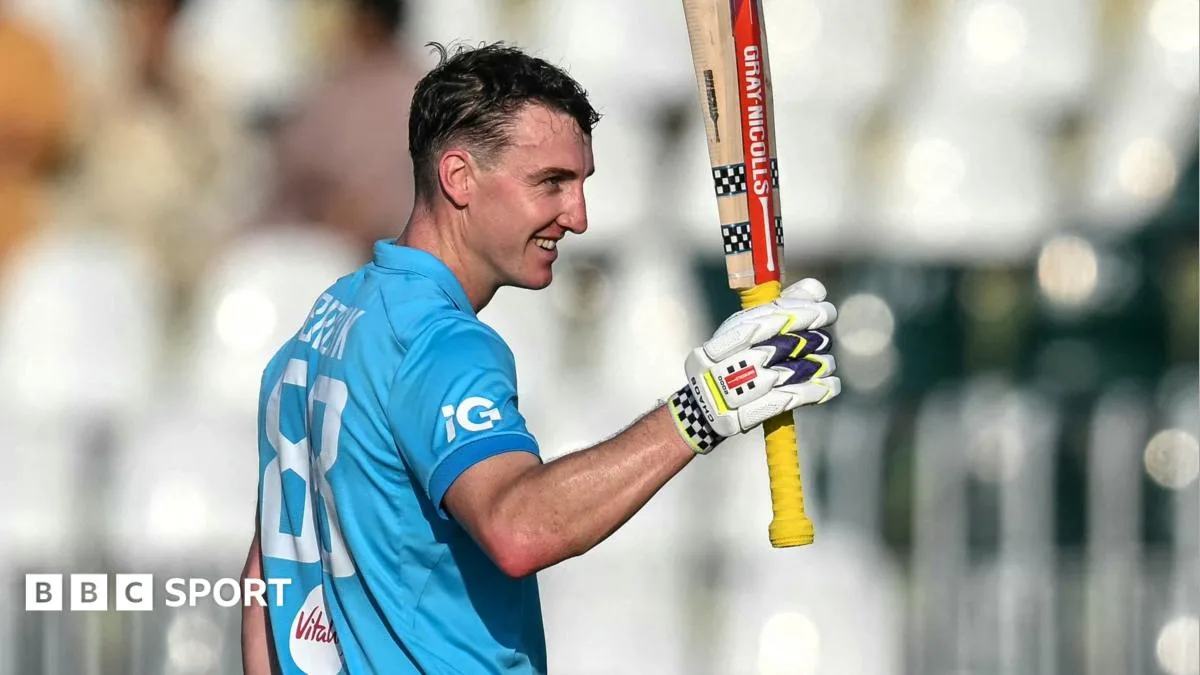
The record-breaking display by Harry Brook in Rawalpindi has redefined the ceiling for England in one-day international cricket. By scoring 202 against Sri Lanka on Thursday, October 22, 2026, the England captain became the first player in his nation's history to register a double century in the 50-over format, propelling his side to a total of 429-4. For the spectators and the Sri Lankan attack, the consequence was an afternoon of sustained, aggressive pressure that broke both individual and team records.
Brook’s achievement carries a weight that reaches beyond a single scoreline. He has now joined the short list of players — a group featuring West Indies great Chris Gayle — to have secured a century in international T20s, a double century in ODIs, and a triple century in Tests. This performance, achieved at the Rawalpindi Cricket Association Stadium, also sets a new benchmark for speed, with Brook reaching the 200-run mark in 114 balls.
The anatomy of a record-breaking 114-ball innings
The innings displayed a calculated transition from cautious observation to total clinical destruction. Brook began his time at the crease with measured intent, accumulating 13 runs from his first 24 deliveries. The pace of the knock shifted significantly as the innings matured; he reached 50 from 42 balls and secured his fourth ODI century in 75 deliveries. The final 100 runs of his total were amassed in just 39 balls, a rate of scoring that left the Sri Lankan bowlers with few tactical options.
The following table illustrates the comparative milestones of the fastest double centuries in ODI history as documented by sources:
| Batter | Opponent | Balls to 200 |
|---|---|---|
| Harry Brook (ENG) | Sri Lanka | 114 |
| Shubman Gill (IND) | West Indies | 117 |
How the captaincy affects individual output
There is a statistical correlation between Brook's leadership role and his performance at the crease. According to available figures, Brook averages 56.04 as England's ODI captain, compared to an average of 25.2 when he is not wearing the armband. This trend remains consistent across formats; in T20 international cricket, his average stands at 47.57 when leading the side and 28.5 when he is not. Following England's loss to Pakistan earlier in the week, Brook explicitly called for his batters to display increased positivity, a request he validated with his own performance on Thursday.
The innings was supported by a 159-run third-wicket partnership with Joe Root, who scored 69 runs. Upon Root's dismissal, England promoted Will Jacks to number five, a decision that resulted in an unbroken 185-run stand from 79 balls. Jacks contributed 66 not out from 25 balls, helping England finish their 50 overs with a total that is the highest ever recorded in an ODI in Pakistan.
The tactical collapse of the Sri Lankan bowling unit
Sri Lanka's attack faced significant difficulties in containing the scoring rate during the latter stages of the match. While Dunith Wellalage returned figures of 2/56, other members of the bowling unit endured expensive spells. Eshan Malinga finished with 0/91 from his 10 overs, and Dilshan Madushanka conceded 0/89. Dasun Shanaka was also targeted for 74 runs across his six overs. This lack of containment in the final overs allowed England to add 156 runs in the last 10 overs of the innings, providing the platform for Brook to eclipse Ben Stokes' previous England record of 182, set against New Zealand in 2023.
Who gains from this surge in form?
For England, the immediate gain is a strong position in the tri-series and the confirmation of a captain who thrives on high-pressure environments. Brook's affinity for Pakistani pitches, evidenced by his career Test average of over 80 in the country, including a 317 in Multan two years ago, suggests that his tactical comfort in these conditions is a significant factor in his current form. His 202-run innings, which saw him strike 21 fours and 10 sixes, serves as a high-water mark for England’s white-ball evolution under his leadership.
The sheer velocity of Brook’s scoring against a professional international attack suggests he is currently operating at a level where standard defensive plans are ineffective. England’s reliance on his ability to transition from a measured start to a explosive finish is now the primary engine of their one-day strategy, leaving opposing teams with the difficult question of how to disrupt his rhythm before he reaches the final 10 overs.