Franco Baresi, iconic Milan and Italy legend, dies aged 66
Franco Baresi, the iconic AC Milan and Italy defender who won six Serie A titles and spent his entire 20-year career with the club, has died at age 66.
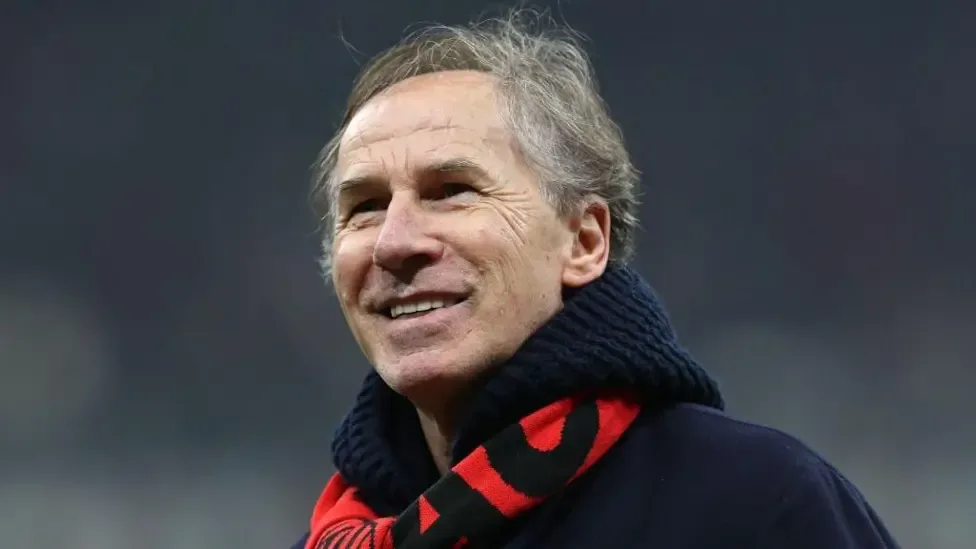
Franco Baresi, the legendary AC Milan and Italy defender whose career defined an era of Italian football, has died at the age of 66. The news was confirmed by AC Milan, which described him as a "symbol of the city" and a player whose "example and integrity will be forever etched into the club's DNA." His passing has sparked an outpouring of tributes from across the football world, with peers, rivals, and officials recalling his unparalleled loyalty, leadership, and impact on the game.
Baresi spent his entire 20-year playing career at AC Milan, making 719 appearances and scoring 33 goals between 1977 and 1997. He captained the club for 15 seasons, guiding them to six Serie A titles, three European Cups, and numerous other trophies. His career coincided with Milan's golden era under manager Arrigo Sacchi, during which the team revolutionized defensive play. Baresi, initially a libero, evolved into a central defender who mastered the offside trap, embodying a new philosophy of organized, attacking football that contrasted with traditional Italian catenaccio.
His legacy extends beyond club success. Baresi was a key figure in Italy's 1982 World Cup triumph, though he did not feature in the final. He later captained the Azzurri in the 1994 World Cup final, where Italy lost to Brazil in a penalty shootout. Despite missing his spot-kick, Baresi's recovery from a knee injury to play the match was hailed as proof of his resilience. "The fact he recovered to play in the final was simply inhuman," one tribute noted.
Baresi's influence on the game was recognized globally. He finished second in the 1989 Ballon d'Or behind teammate Marco van Basten, a rare achievement for a defender. Paolo Maldini, who succeeded him as Milan captain, called Baresi "the greatest footballer I ever had the honour of playing with," citing his leadership and dedication. Maldini also inherited Baresi's No. 6 jersey, which the club retired in 2002 — a first in Italian football. "No one will ever wear the number six again," Milan emphasized, underscoring his symbolic importance.
Tributes poured in from across the footballing world. Italian Prime Minister Giorgia Meloni called him "one of the greatest champions in (Italian) sports history," while Italian football federation president Giovanni Malagò praised his "romantic choice" of remaining loyal to AC Milan. Inter Milan, Baresi's fiercest rivals, acknowledged his role in shaping the Milan derby's history, calling him a "flagbearer of AC Milan" who "lived every match-up with competition and respect."
Baresi's final public appearance was at the opening ceremony of the Milan Cortina Winter Olympics in February 2026, where he carried the torch alongside Giuseppe Bergomi. In August 2025, he underwent surgery to remove a lung nodule and began immunotherapy, though the cause of his death remains undisclosed. His passing follows a period of health struggles, yet his legacy endures as a symbol of dedication and excellence.
Friends and colleagues recalled his humility and professionalism. Former Italy goalkeeper Gianluigi Buffon, who faced Baresi as a young player, described him as a "model of class, leadership, and respect." AC Milan owner Gerry Cardinale called him "the embodiment of the values, character, and excellence that define this club," adding that Baresi "quietly reminded us all what it means to wear these colors." The club's statement emphasized that "every Rossonero feels this loss as their own."
Baresi's career was marked by a rare commitment to a single club. Despite offers and opportunities elsewhere, he remained at AC Milan, a decision that cemented his status as a "one-club man." His nickname, "Piscinin" — meaning a "fragile, thin youngster" in Milan dialect, belied his strength on the pitch. Journalist Gianni Brera, who coined the term, once noted that Baresi's early trials at Inter as a 12-year-old ended in rejection, but his path to Milan proved fateful for football history.
As the football world mourns, Baresi's impact remains indelible. His career bridged the transition from traditional Italian defending to modern, tactical play, and his leadership inspired generations. "Franco Baresi is forever," Milan declared, a sentiment echoed by fans and players alike. In a sport often defined by fleeting moments, his name endures as proof of loyalty, skill, and the enduring power of a single, unforgettable player.
Dateline Wire is dedicated to independent, evidence-backed reporting. This briefing was synthesized from primary source reporting, corroborated across independent newsrooms, and verified against our Editorial Standards.