PM Modi and Nepal PM Balendra Shah hold bilateral talks in New Delhi
Nepalese Prime Minister Balendra Shah met with PM Narendra Modi in New Delhi for bilateral talks covering economic aid, energy projects, and new rail connectivity.
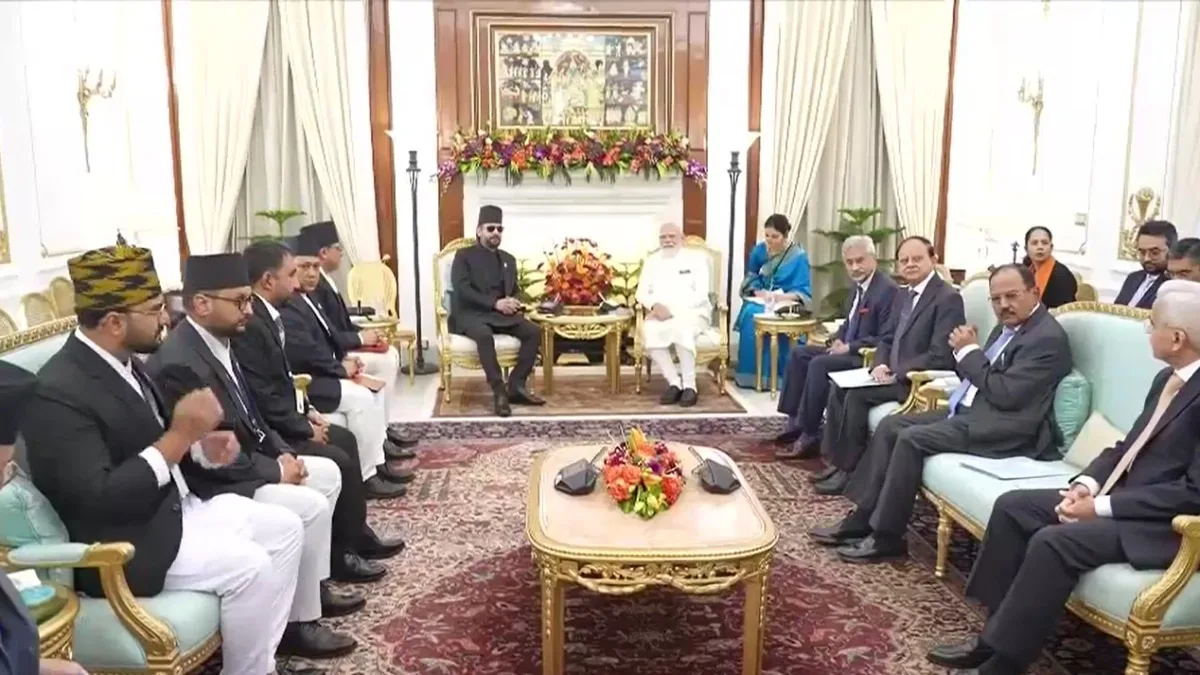
Prime Minister Narendra Modi and Nepalese Prime Minister Balendra Shah convened at Hyderabad House in New Delhi for bilateral talks aimed at reviewing ties between the two countries and exploring ways to expand cooperation across key sectors, during Shah's two-day visit on November 22-23, marking his first official bilateral foreign trip since assuming office in March.
The discussions unfold against the backdrop of significant political changes in Nepal following the youth-led protests of 2025, which resulted in the departure of the KP Sharma Oli government and brought Shah to the top office. Kathmandu has sought a financial assistance package of approximately USD 2 billion, including USD 1 billion in grants, to support economic development and reconstruction following devastating flash floods in August, alongside requests for greater access to Indian airspace, including changes to the Kathmandu-Mahendranagar air corridor to improve international flight connectivity.
Infrastructure, Railways, and Energy on the Agenda
Beyond financial aid, the two governments are reviewing an extensive portfolio of connectivity and energy projects. The leaders are scheduled to virtually flag off the Saryu-Kamala Express passenger train service connecting Ayodhya in Uttar Pradesh with Janakpur Dham in Nepal, a route linking Ayodhya, the birthplace of Lord Ram, with Janakpur in Nepal, the place of birth of Goddess Sita. Ahead of the virtual inauguration, the train arrived at platform number one of Ayodhya Dham railway station adorned with floral decorations.
India remains Nepal's largest trading partner and export destination, receiving about 80 per cent of Nepal's goods exports, while also serving as the largest source of foreign investment, accounting for almost one-third of the total foreign direct investment received by the country. Officials are discussing the long-term electricity trade arrangement envisaging the import of up to 10,000 MW of electricity from Nepal to India over a decade, alongside expanding hydropower exports and attracting greater Indian investment in electricity generation and transmission infrastructure. Further expansion of cross-border railway infrastructure, such as the proposed Raxaul-Kathmandu railway project, also features prominently in the talks.
- November 22: Nepal Prime Minister Balendra Shah arrives in New Delhi for a two-day state visit and is received at the airport by Union Minister of State for Commerce and Industry Jitin Prasada, with External Affairs Minister S Jaishankar subsequently calling on him.
- November 23: Shah receives a ceremonial Guard of Honour at Rashtrapati Bhavan in the presence of Prime Minister Narendra Modi, followed by a wreath-laying tribute and guestbook signing at Mahatma Gandhi's memorial at Raj Ghat.
- November 23: Prime Minister Modi and Nepal Prime Minister Shah hold bilateral talks at Hyderabad House, with Shah accompanied by a 34-member government delegation (or 35-member delegation including business representatives).
- November 23: The two leaders virtually flag off the Saryu-Kamala Express from Delhi, with Railway Minister Ashwini Vaishnaw and Uttar Pradesh Chief Minister Yogi Adityanath participating in Ayodhya.
- November 28: The Saryu-Kamala Express becomes available for regular service, completing the 604-kilometre distance between Ayodhya Cantt and Janakpur Dham in about 19 hours without requiring passengers to change trains during the journey.
Business Forums and Expanding Institutional Ties
The state visit also features a Nepal-India Business Forum aimed at attracting Indian investment to Nepal and providing a platform for business representatives from both countries to explore opportunities for collaboration and strengthen commercial ties. Prime Minister Modi will also host an official luncheon in honour of his Nepalese counterpart and his 34-member government delegation.
Both sides are expected to exchange memorandums of understanding covering education, health, agriculture, space, disaster management, and human resource development. Additional proposals on the table include establishing an offshore campus of an Indian Institute of Technology in Nepal, training opportunities for Nepalese startups, and greater cooperation in cricket, including coaching and training support for Nepal's national teams. India and Nepal are also exploring disaster resilience and digital technology.
Reflecting on the broader significance of the diplomatic outreach, Nepal's ruling Rastriya Swatantra Party stated that the state visit will strengthen the historic, friendly, and multidimensional relations between the two countries.