Mexican court finds three men guilty of murdering surfers
Three Mexican men have been found guilty of murdering two Australian surfer brothers and their American friend in Baja California following a monthlong trial.
- Headline: Mexican court finds three men guilty of murdering surfers
- Dispatch Summary: Three Mexican men have been found guilty of murdering two Australian surfer brothers and their American friend in Baja California following a monthlong trial.
- Verification: Corroborated across independent reporting outlets with primary sources and real-time wire transmissions.
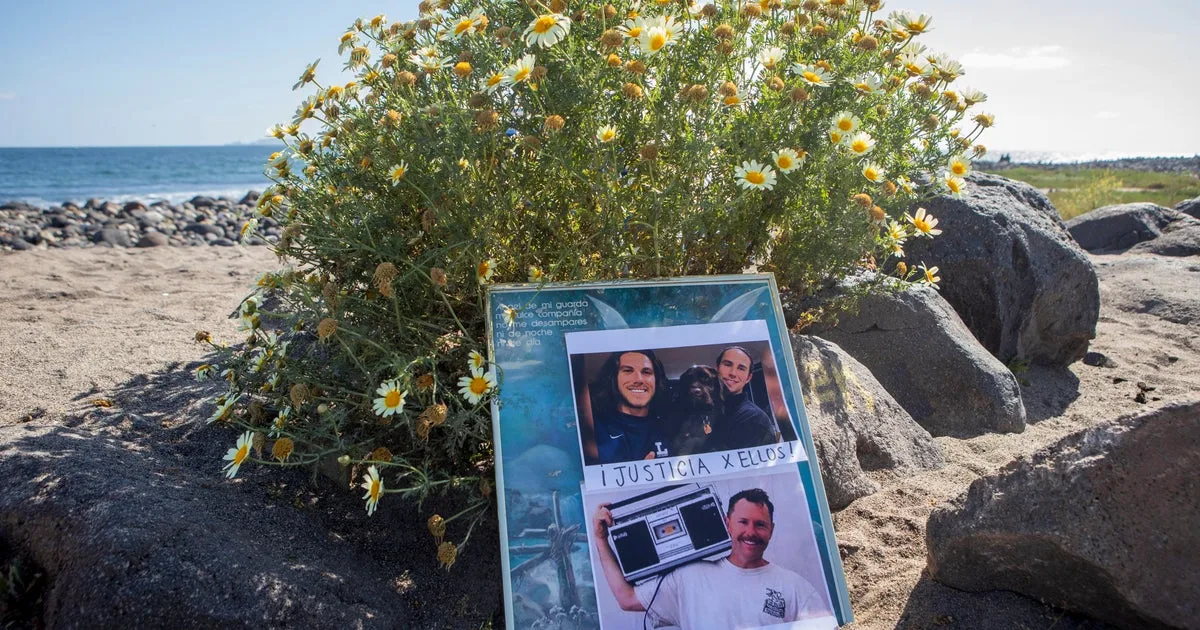
Families waiting more than two years for accountability learned on Friday that three Mexican men were convicted of murdering two Australian surfer brothers and their American friend during an April 2024 trip to the Baja California coast. Judge Raúl Hernández in the coastal city of Ensenada found Jesús Gerardo García, alias "El Kekas," Irineo Francisco "N" and Ángel Jesús "N" responsible for the triple homicide, along with armed robbery and armed carjacking. The verdict concludes a monthlong trial that drew international attention, bringing a measure of legal resolution even as the final prison terms remain to be set on Oct. 16.
The tragedy began in late April 2024 when brothers Callum Robinson, 33, and Jake Robinson, 30, alongside their American friend Jack Carter Rhoad, 30, crossed into Mexico to surf and camp near Punta San Jose, about 50 miles south of Ensenada. Barely 36 hours after their arrival, the three friends were reported missing. Following a days-long search aided by the FBI, their bodies were discovered on May 3 at the bottom of a well, each victim killed by gunshot wounds to the head. Prosecutors established during the trial that the tourists were targeted in a botched carjacking when they tried to resist the armed robbery of their truck, which was subsequently found burned nearby.
What happens next in the Ensenada courtroom on Oct. 16?
With the guilty verdicts secured, attention shifts entirely to the sentencing hearing scheduled for next week. The Baja California State Attorney General's Office requested the "exemplary sentence" of 210 years in prison for each defendant, while Reuters reported that prosecutors had sought sentences of up to 150 years against the suspects. Regardless of the exact number of years handed down by Judge Raúl Hernández, the three defendants are likely to spend the rest of their lives in a prison.
The swiftness of the primary convictions contrasts with the methodical dismantling of the criminal cell involved. Ary Gisell Silva Raya, García's then-girlfriend who was 23 at the time of her arrest, was sentenced in November 2025 to 20 years in prison after pleading guilty in an expedited proceeding to aggravated robbery with violence and vehicle theft with violence. The state prosecutor's office established that Silva Raya arrived in Punta San Jose on April 27, 2024, met the three foreigners, and instigated one of her companions to rob them. During the monthlong trial, chilling details emerged from testimony revealing that García arrived at the victims' tent with a 9 mm pistol, ignoring a victim who begged for his life.
How did the families experience the trial in Baja California?
Martin and Debra Robinson, the parents of the slain Australian brothers, traveled from their hometown of Perth to attend the four-week trial, remaining in Ensenada throughout the proceedings. During closing arguments, Debra Robinson told the courtroom that the murders of her sons had taken the future we had imagined with them,
adding that they took our sons from our lives forever,
and noting that what hurt most was that in their final hours, the men were treated with such cruelty. It's hard for a parent to lose a son, and we lost two sons,
Martin Robinson said, echoing the devastation that prompted him to describe the ordeal as hell.
Other loved ones participated from afar or spoke out against the lasting trauma left in the wake of the killings. Rhoad's widowed fiancée, Natalie Weirtz, spoke via video call from the United States alongside Rhoad's mother, Page. The accused are guilty and must be punished so that no other family suffers the same pain,
Weirtz said, adding that since Carter's death, she feels paranoid and isolated. Debra Robinson also expressed deep gratitude to Australians for the outpouring of support, noting that she and her husband felt the love and their arms around us.
Why does this case revive memories of past violence against foreign travelers?
The murders sent shockwaves around the world because the coastal area near Ensenada is usually considered relatively safe, standing apart from the violence in other parts of Mexico. Yet the killings revealed much about how commonplace such extreme violence remains in Mexico. Baja California ranks among Mexico's most violent states, plagued by organized crime and drug trafficking, prompting the US State Department to urge Americans to reconsider travel to the area due to crime and kidnapping risks. Tourism remains a key part of the regional economy, leading local officials like Baja California Governor Marina del Pilar Ávila to insist that the state is and will continue to be a state with safe tourism for visitors.
| Defendant | Role / Status | Legal Outcome |
|---|---|---|
| Jesús Gerardo García ("El Kekas") | Identified as the main perpetrator and ringleader | Found guilty of murder, armed robbery, and carjacking; awaiting sentencing on Oct. 16 |
| Irineo Francisco "N" & Ángel Jesús "N" | Co-defendants and accomplices | Found guilty of murder, armed robbery, and carjacking; awaiting sentencing on Oct. 16 |
| Ary Gisell Silva Raya | Then-girlfriend of García, instigated the robbery | Sentenced in November 2025 to 20 years in prison after pleading guilty |
The incident also recalls earlier dark chapters for foreign travelers in the country. Two Australian surfers, Dean Lucas and Adam Coleman, were killed in 2015 while traveling through the north-western state of Sinaloa, and their bodies were burned. Following the 2024 murders, local surfers in Ensenada turned out in force to paddle out at one of the area's best-known surfing spots, throwing flowers into the sea and demanding greater security for residents and visitors alike.
Who gains and who loses from the final verdict?
The conclusion of the trial brings a measure of closure for the families of Callum Robinson, Jake Robinson, and Carter Rhoad, who have fought for accountability across international borders for more than two years since the bodies were recovered on May 3, 2024. For the Mexican judicial system and local authorities in Baja California, securing convictions against the primary perpetrators helps counter criticisms regarding impunity in violent crime cases, even as the region continues to grapple with broader security challenges. Tourism operators and regional officials stand to regain stability if confidence in coastal safety can be restored.
The central question remaining for foreign travelers and regional authorities is whether increased legal accountability can meaningfully alter the security reality in isolated coastal areas. With prosecutors seeking 210 years, how the court balances retributive justice on October 16 will set the final legal benchmark for a crime that forever altered three families.