Coral reef presumed dead for 60 years found alive off Benin coast
Scientists have rediscovered a mesophotic coral reef off the coast of Benin, revealing that 1960s survey methods had long misidentified the structure as dead.
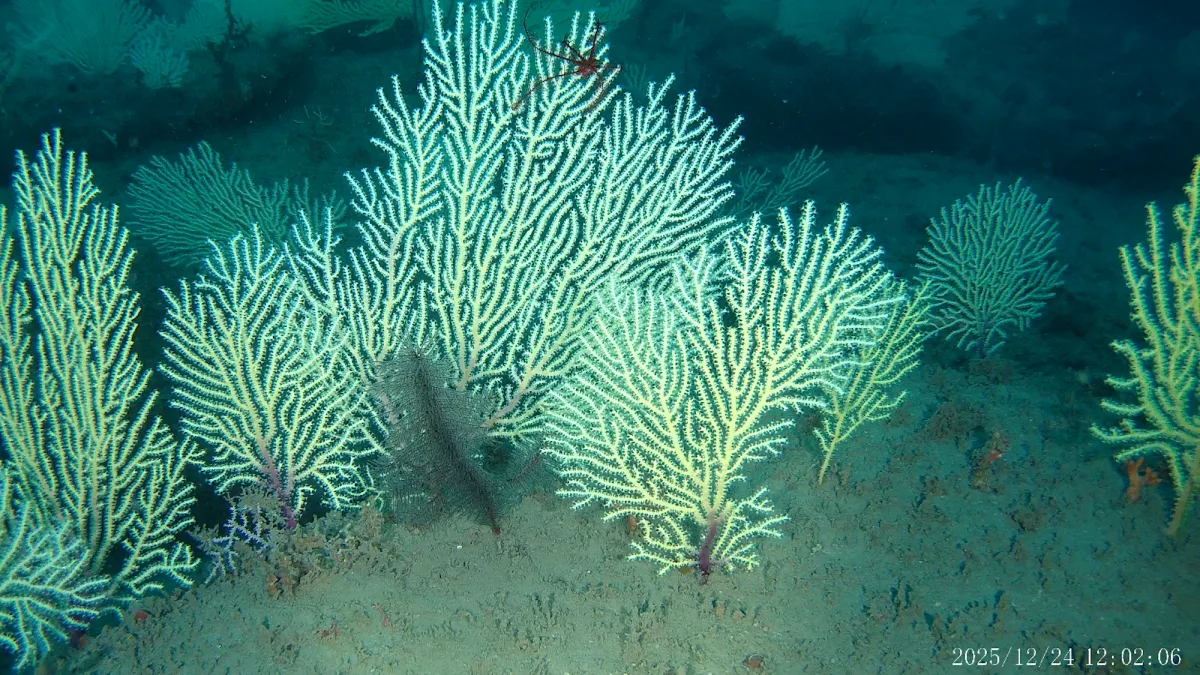
A deep-sea coral reef presumed dead for nearly six decades off the coast of Benin has been rediscovered, revealing a thriving mesophotic ecosystem that defied scientific expectation. The find, documented by a team led by Gérard Zinzindohoué of the Institut de Recherches Halieutiques et Océanologiques du Bénin, marks the first confirmed living mesophotic coral reef on the Gulf of Guinea continental shelf and underscores the limitations of mid-20th-century oceanographic methods.
Scientists first noted the reef’s presence in the 1960s during surveys of potential fishing areas, but its depth and the tools available at the time prevented direct observation. Researchers assumed the structure was dead, a conclusion that persisted for 60 years. In 2025, Zinzindohoué’s team revisited the site using side-scan sonar, underwater drones, and the National Geographic Exploration Technology Lab’s Deep Sea Camera System. At 54 meters below the surface, the team captured footage of a structured reef teeming with life, including eight coral types and eight fish species such as Guinean angelfish and golden African snappers.
The reef’s survival in the mesophotic zone — where sunlight is scarce and water pressure is high — challenged assumptions about coral resilience. Mesophotic corals grow more slowly than their shallow-water counterparts and often appear duller, leading to misidentification in earlier surveys. “It was not an easy field campaign,” Zinzindohoué recalled, describing the technical challenges and uncertainty that accompanied the effort. “It was a mix of long days at sea, technical problems, and a lot of uncertainty.”
The rediscovery highlights the limitations of 1960s marine science, which relied on trawl nets and rudimentary cameras to assess deep-sea environments. These methods lacked the resolution and real-time capabilities of modern technology, leaving gaps in understanding. The Benin reef, for instance, was dismissed as dead because dredges retrieved bleached coral fragments, a misinterpretation exacerbated by the era’s underfunded research infrastructure. “The knowledge gap is structural, not incidental,” noted a report from sciencesensei.com, attributing the oversight to sustained underinvestment in West African marine science.
While the reef’s existence has been confirmed, its ecological health remains unverified. Scientists have yet to conduct comprehensive sampling to determine coral cover percentages, biodiversity counts, or population trends. “The reef has been confirmed as alive; it has not been confirmed as thriving in any comparative or historical sense,” the report cautioned. Zinzindohoué emphasized the need for follow-up studies, stating that a proper scientific diving and sampling program would be his priority if funding allowed.
The find also raises questions about the prevalence of similar ecosystems in under-surveyed regions. Mesophotic reefs, often overlooked due to their depth, may represent a significant portion of global marine biodiversity. “I think what we found is probably not an exception,” Zinzindohoué said. “It is more likely a reflection of how little we still know about coastal regions in West Africa and elsewhere.”
The implications extend beyond the Benin coast. The reef’s rediscovery underscores the potential for technological advancements to reshape marine conservation. Affordable, autonomous imaging systems now enable deeper, more accessible surveys, challenging the notion that certain areas are beyond scientific reach. However, the reef’s newfound visibility also exposes it to new threats, including bottom trawling, deep-sea mining, and climate-driven ocean warming. “The tools to pursue those questions now exist,” one report noted, “and the Benin coral garden is concrete, documented proof of what happens when they are used.”
For now, the reef stands as proof of the persistence of life in the deep and the evolving capacity of science to uncover it. As Zinzindohoué’s team prepares for future expeditions, the Benin discovery serves as a reminder that the ocean’s hidden corners still hold secrets waiting to be revealed, and the technology to reveal them is no longer out of reach.
Dateline Wire is dedicated to independent, evidence-backed reporting. This briefing was synthesized from primary source reporting, corroborated across independent newsrooms, and verified against our Editorial Standards.