Jordan church shooting: 7 killed, 10 injured in attack in Karak
Unknown gunmen opened fire during a funeral at Hamoud Church in Jordan's Karak governorate, leaving at least seven dead and about ten wounded.
Seven killed and 40 injured in Jordan church attack as ISIS claims responsibility
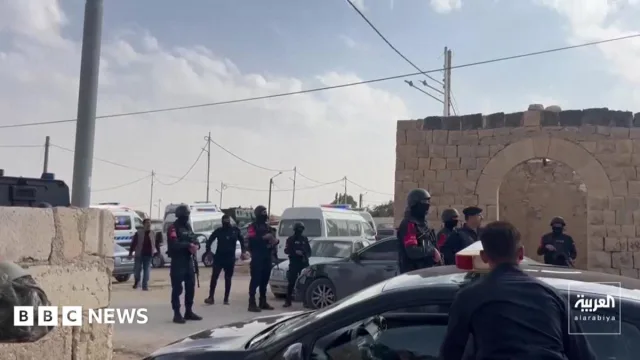
Gunmen opened fire during a funeral at a Greek Orthodox church in Karak, about 180km (110 miles) south of the capital, Amman, on Friday, October 23. The assault left seven people dead and 40 others wounded, according to authorities. Extremist group ISIS has claimed responsibility for the deadly shooting at Hamoud Church. The location sits roughly 90 to 110 miles south of Amman in Jordan's southern Karak governorate, home to a significant Christian community in the Muslim-majority kingdom. Jordan's Public Security Directorate deployed forces to the scene and launched a pursuit of the suspects.
That claim of responsibility by ISIS transforms an already shocking local tragedy into a major national security crisis for the Hashemite Kingdom. Attacks of this nature are extremely rare in Jordan, which is relatively stable but has faced increasing pressure, having been targeted by Iranian attacks this year since the United States and Israel launched strikes against Iran in February. When a terrorist network strikes a house of worship during a solemn gathering of 150 to 200 mourners, the state faces immediate pressure to demonstrate control over its territory and protect vulnerable minority populations.
What do eyewitnesses say about the vehicle, pistols, and the rifle?
According to reports, the assault involved multiple attackers arriving by vehicle to ambush the gathering. Footage broadcast on Jordanian state television showed two gunmen who appear to be holding pistols approaching the church and firing shots. A third man who appears to be holding a semiautomatic rifle then approaches and opens fire, and all three then run toward the church. Video footage taken by witnesses shows broken glass and pools of blood on the floor of the church.
An eyewitness attending the funeral, Khaled Burqan, told state-run Al-Mamlaka television that dozens of people had been attending the funeral and two men opened fire on them for several minutes, with one carrying a rifle and another carrying a pistol. Another witness told Al-Mamlaka that a vehicle arrived carrying the gunmen, who fired continuously for five minutes before fleeing the scene. Dorgham Halasa, who was among the mourners inside the church, said intense gunfire erupted 15 minutes after the funeral had started, and then people started running. It was a weird situation, and heavy gunfire,
Halasa said.
Halasa did not see the gunmen, but said other people reported seeing four of them. The Associated Press could not independently verify the number of assailants, and Jordan’s security services did not immediately release details. Those tactical details point to an assault planned with lethal intent rather than a spontaneous street argument. The rapid and sustained gunfire inside an enclosed space packed with mourners explains the high casualty toll.
How are King Abdullah II, Prime Minister Jafar Hassan, and government officials responding to the crisis?
Jordan King Abdullah II reacted to the incident by vowing that his government will punish the culprits. In an X post, he said Jordan will confront the terrorist act that targeted Karak with the harshest penalties, and he offered his deepest condolences to the families of the deceased and the martyrs, alongside wishes for recovery to the wounded.
Jordan will confront the terrorist act that targeted Karak with the harshest penalties
King Abdullah II, via X
Jordanian prime minister Jafar Hassan said during a security meeting in Karak on Friday evening that the attack was a result of terrorist ideology and blind extremism. He said the assailants will be punished and legal measures taken against those who seek to introduce extremism. Jordan declared three days of national mourning, according to the kingdom’s Petra news agency. Health minister Ibrahim al-Budour stated that two of those wounded are in critical condition.
Government spokesperson Mohammad Momani, also identified as Communications Minister Mohammed Al-Momani, wrote on X that security forces were following up on an incident of gunfire in Karak Governorate. He urged the public to rely on official sources and allow investigators to carry out their work, stating that verified information would be shared as details became available. Jordan's state-run Petra News Agency also reported through X that authorities were actively pursuing the suspects. A subsequent government statement said that the attack was carried out by unknown assailants, without specifying whether any gunmen were captured or killed, adding that investigations are under way at full speed.
Security forces are following up on an incident of gunfire in Karak Governorate
Mohammad Al-Momani, Government spokesperson, via X and news.abplive.com
That official caution contrasts sharply with the frantic accounts emerging from local broadcasters and state television networks as the search continues.
Who is releasing which figures from the scene?
Reporting on the incident involves conflicting institutional channels and successive updates from state media, international outlets, and regional networks. The Public Security Directorate earlier stated that six people were killed and 28 wounded, while state-owned media and recent authority reports put the death toll at seven and wounded figures reaching 40. The table below outlines the reporting from the primary outlets covering the attack.
| Outlet / Agency | Deaths Reported | Wounded Reported | Location Details |
|---|---|---|---|
| The Guardian / Authorities | 7 | 40 | Greek Orthodox church, Karak |
| The Independent / Public Security Directorate | 6 | 28 | Hamoud Church, Karak Governorate |
| Al-Mamlaka / Erem News / Daily Jagran | 7 | About 10 to 34 | Greek Orthodox Hamoud Church, Karak |
| State News Agency | Not specified | Not specified | Funeral with 150-200 people |
That divergence in initial numbers highlights the chaotic information environment typical of breaking security incidents in the region.
What historical precedents and regional reactions shadow the investigation?
In 2016, gunmen ambushed police in a series of attacks in Karak, including at a Crusader castle popular with tourists, killing 10 people, including seven officers, and wounding dozens. Jordanian security forces killed those gunmen after a long standoff.
Condemnation of the slayings came from around the region, including from Lebanon, Syria, Egypt and Oman. Ahmed al-Tayeb in Cairo, the grand imam of Al-Azhar, the Sunni Muslim world’s foremost religious institution, offered his condolences to the families of victims in Friday’s shooting, calling it a heinous terrorist attack. Iraqi foreign minister Fuad Hussein called his Jordanian counterpart and affirmed Iraq’s solidarity with Jordan in the face of terrorism, Hussein’s office said in a statement. UN Secretary-General António Guterres condemned the attack during a funeral as especially heinous, spokesperson Stephane Dujarric said, adding a call for all those responsible to be found and held to account.
As security forces pursue the unidentified attackers across the southern governorate, fundamental questions remain unanswered. While ISIS has claimed responsibility for the attack, authorities are still working to verify the full scope of the cell and whether the attackers belong to an organized network or acted alone. Officials have not yet released the identities of the dead or injured, and security forces remain deployed at the church as the manhunt continues.
Updated 2 times since publication; last update 12 November 2026, 15:15.